Structure and function
Nose Anatomy
Ask someone to point at the part of the nose that matters and they'll usually tap the tip. Maybe the bridge. Almost nobody points at the inside, where three scroll-shaped shelves and two pinches of cartilage decide how freely you breathe at 3 a.m.
The nose is a layered unit. An external framework of bone, cartilage, and skin sits over an internal cavity built around the septum, the turbinates, and the nasal valves. This page walks through each part, what it does, and why the structure matters for breathing as much as for appearance. The vocabulary follows the standard morphological terminology used in clinical literature (radix, dorsum, alar base, columella), so the terms here will match what a surgeon or a textbook says.
The quick answer
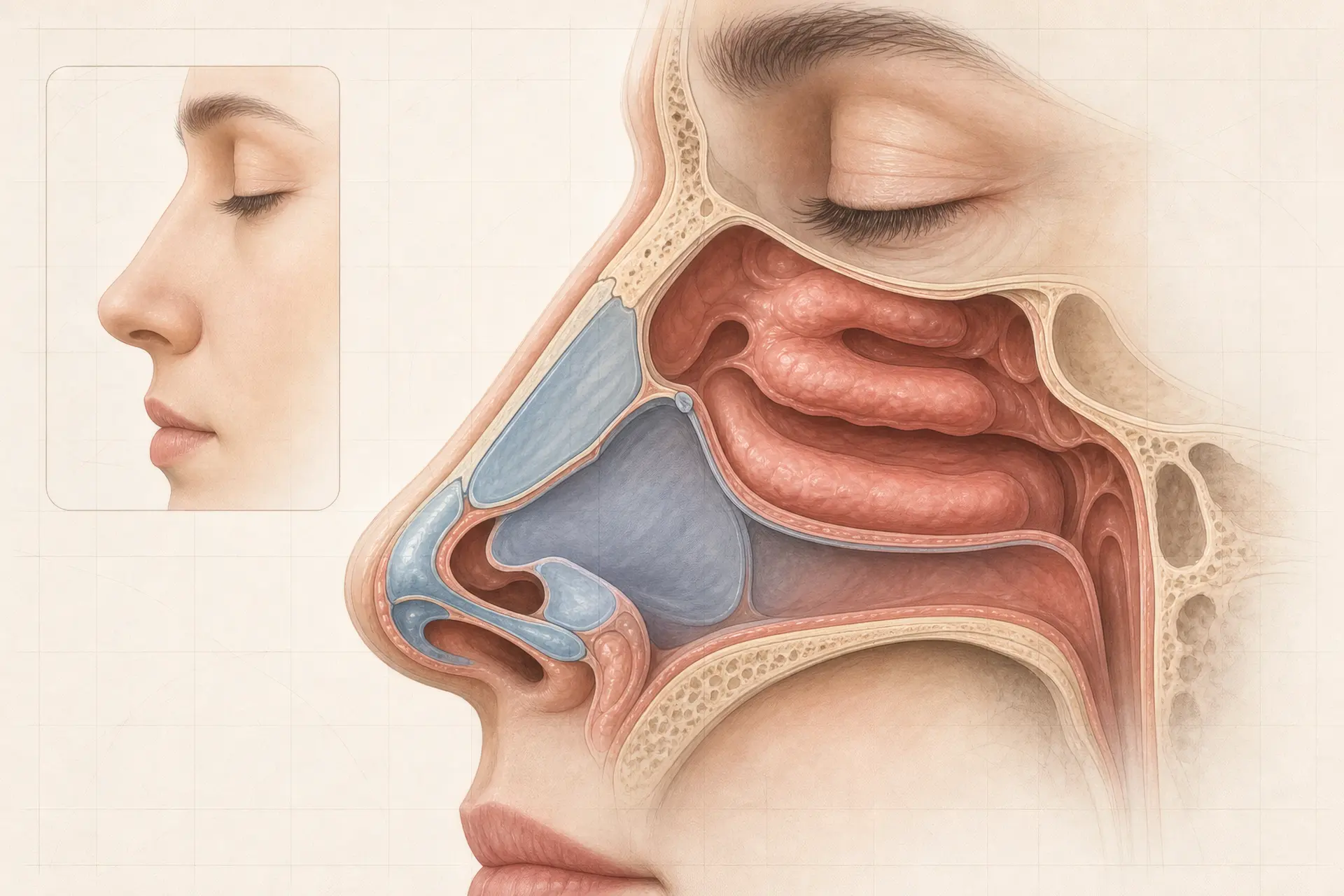
Split the nose in two halves. Outside, a framework of nasal bones up top and cartilage below, wrapped in skin of uneven thickness. Inside, a septum down the middle, turbinates that warm and filter air, and two narrow valves that meter every breath. Structure on one side, airflow on the other.
Curious about your own outside half? The free nose shape detector reads your bridge curve and tip angle from a single photo.
The outside framework: bones, cartilages, and skin
Everything you can see and pinch from the outside comes down to three stacked materials.
The nasal bones
The rigid upper third of the bridge.
Two small oblong bones meet in the midline and form the hard top of the nose. They connect to the frontal bone above, at the dip surgeons call the radix, and to the maxilla on each side. Bone does not flex. So the upper bridge holds a fixed height and width, and a bump sitting high on the dorsum is bone all the way through.
The cartilages
Everything from the mid-bridge down.
Paired upper lateral cartilages form the sidewalls of the middle third. Below them, the lower lateral cartilages (the major and minor alar cartilages) build the tip and brace the nostril rims. The quadrangular septal cartilage runs down the front of the septum and props up the lower bridge from inside. Cartilage bends. Bone doesn't.
The skin
One nose, several thicknesses.
Skin over the nose is not one material. At the radix it is thin and mobile. Over the tip it thickens and turns oily, sometimes two or three times as thick as the skin up top. That thickness decides how much cartilage detail shows through, and it changes how the nose heals after any procedure.
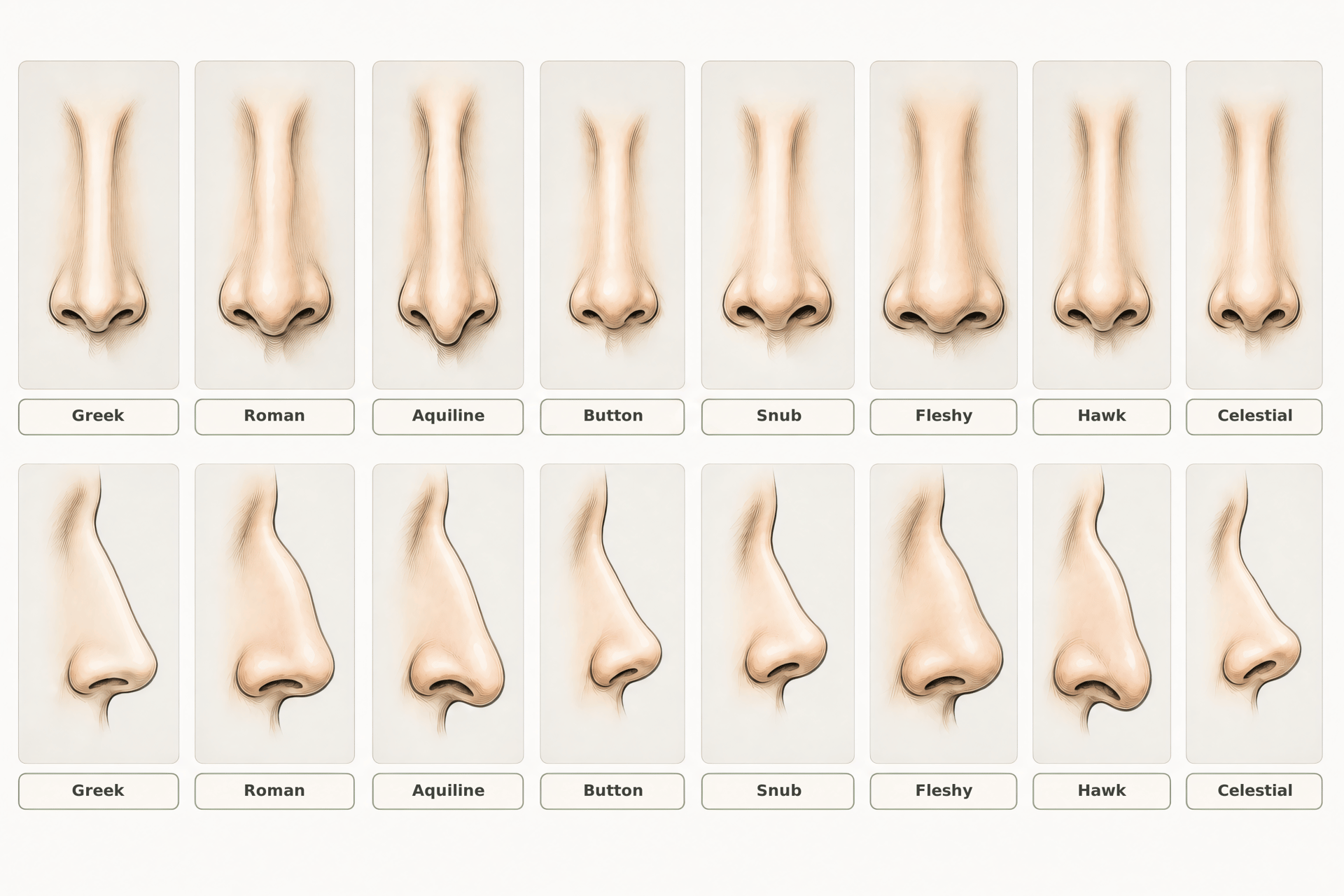
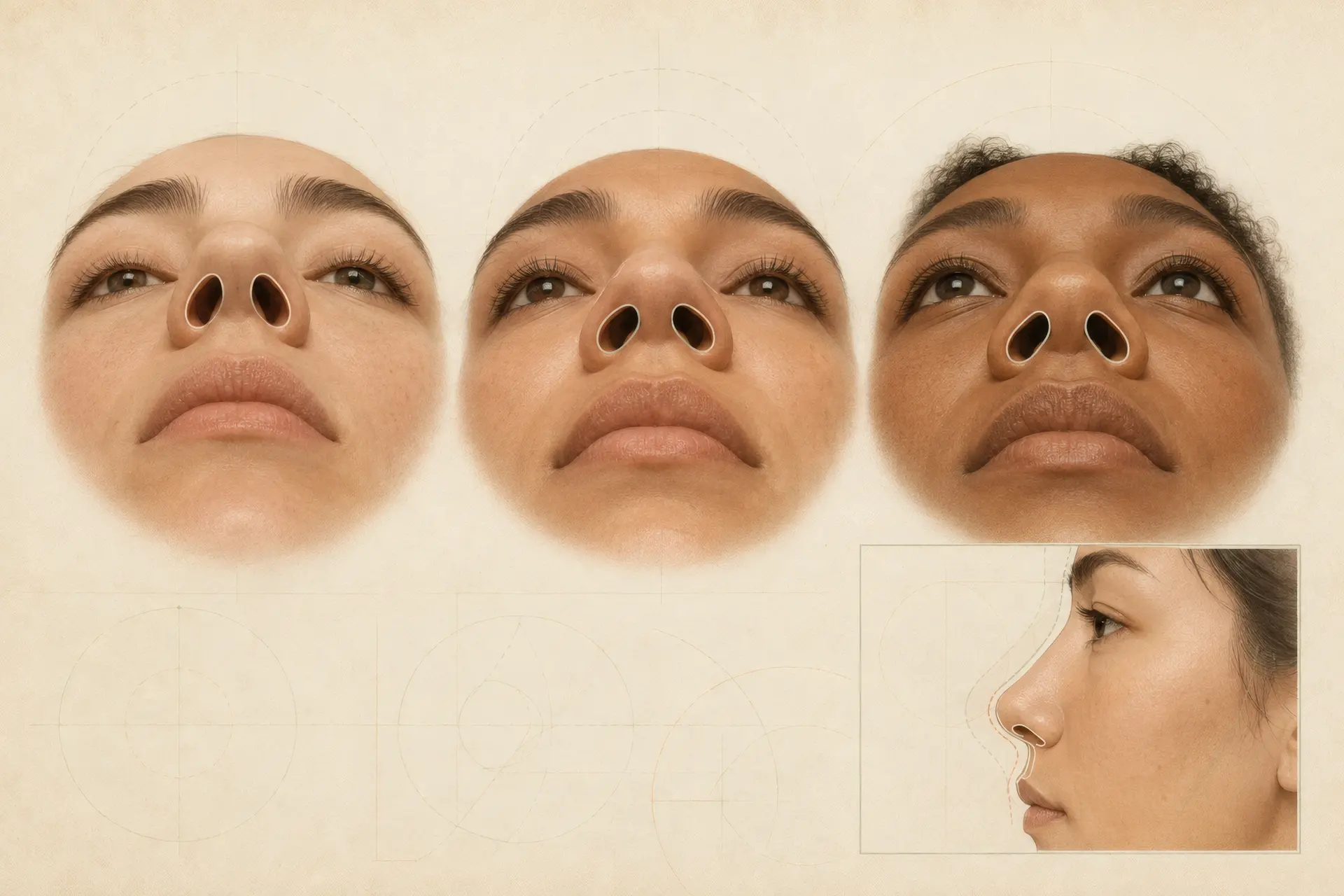
This stack explains most of what people call nose shape. A high or low radix, a wide or narrow bony vault, a flat or projecting tip, each one traces back to bone and cartilage doing specific work at specific spots. The nose bridge types guide maps those variations across the upper two-thirds, and the nostril shape guide shows what the alar cartilages are doing at the bottom rim.
Inside the cavity: septum, turbinates, and valves
Behind the nostrils the nose stops being sculpture and turns into plumbing. Good plumbing, mostly.
The septum
The wall down the middle.
The septum splits the airway into left and right. Its front portion is quadrangular cartilage, the same sheet that supports the lower bridge. Behind that, the wall turns to bone, the perpendicular plate of the ethmoid up high and the vomer along the floor. Almost nobody owns a perfectly straight one, and mild deviation rarely causes trouble.
The turbinates
Three shelves per side.
The superior, middle, and inferior conchae are scroll-shaped bones wrapped in vascular soft tissue, and they jut into the cavity like shelving. Their work is conditioning: warming incoming air toward body temperature, loading it with moisture, and trapping particles. The inferior turbinate does most of it, and it swells visibly on scans when allergies or a cold hit.
The nasal valves
The bottlenecks that meter every breath.
The internal valve sits between the upper lateral cartilage and the septum, at an angle of roughly 10 to 15 degrees, and it is the narrowest stretch of the entire airway. A small narrowing there costs a lot of airflow. The external valve is the nostril rim itself, held open by the alar cartilages and the muscles around them.
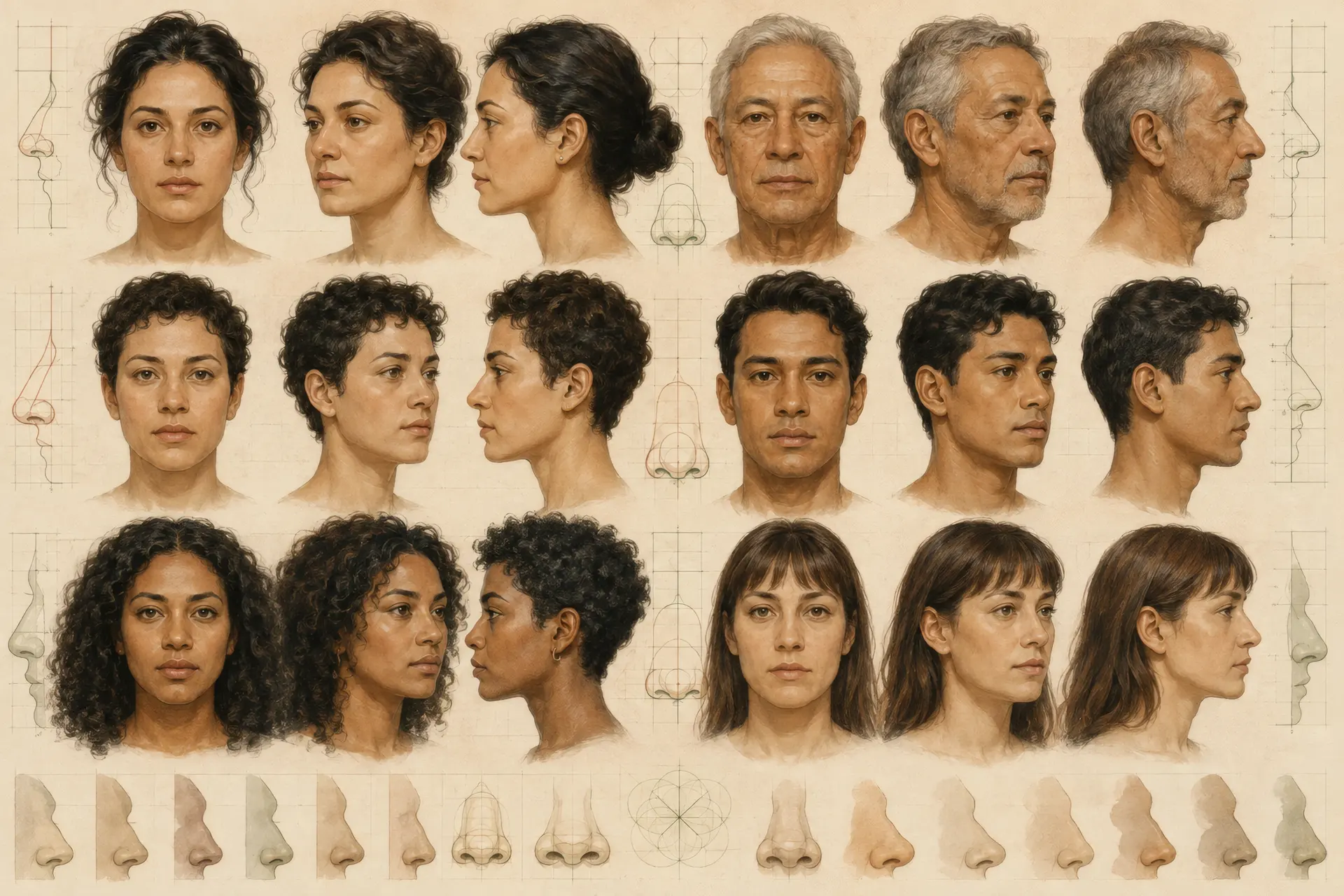
One more set of tenants lives back there. The paranasal sinuses, air-filled pockets in the forehead, cheeks, and between the eyes, drain into the nasal cavity through openings only a few millimeters wide. When those openings swell shut, pressure builds and your face aches. How wide the bones and cartilages grow, and how the whole framework proportions itself, varies across populations in consistent ways, and the nose types by ethnicity page covers that variation without the usual stereotypes.
Bone or cartilage, region by region
The single most useful anatomy fact for understanding any nose, including your own, is which material sits where. This table is worth a second look.
| Region | Framework | Behavior | What it means for shape |
|---|---|---|---|
| Upper third (bridge root) | Paired nasal bones | Rigid | Fixed height and width up top; bumps here are pure bone |
| Middle third | Upper lateral cartilages over the septal cartilage | Semi-flexible | Sidewalls that can be narrowed, spread, or shaved |
| Lower third and tip | Lower lateral (alar) cartilages | Springy | Where tip shape and definition live |
| Septum | Quadrangular cartilage in front, ethmoid and vomer bone behind | Mixed | The divider, plus the internal support for the lower bridge |
Press on your own nose and you can feel the seams. Rock the upper bridge side to side and nothing gives. Move down past the bony edge and the sidewalls start to flex. The tip is springiest of all, which is exactly why it's the hardest region to change predictably and the first place an inexperienced hand gets into trouble.
What all this structure does
Breathing is the day job. But the cavity handles a few other shifts at the same time.
- Air conditioning. The turbinates and the mucosa covering them warm inhaled air to near body temperature and saturate it with moisture before it ever reaches your throat. Even when the air outside is freezing and bone dry.
- Smell. Olfactory receptors sit high in the cavity in a patch called the olfactory cleft, a few square centimeters per side. Ordinary breathing mostly misses that patch, which is why you sniff when something smells off.
- A moving self-cleaning system. A blanket of mucus traps dust and pathogens, and tiny hair-like cilia sweep it backward toward the throat to be swallowed. The blanket renews itself roughly every 10 to 20 minutes.
- And resonance. A blocked nose flattens your voice, which is why one bad cold makes you sound like a different person on the phone.
All four jobs happen at once, in a space smaller than your thumb. I could be wrong here, but I'd argue the nose is the hardest-working few centimeters on the face.
Why anatomy matters for appearance and surgery
A dorsal hump is never one thing. The upper part of a hump is bone, the lower part is cartilage, and the ratio decides the technique. Bone gets rasped down. Cartilage gets cut. Any surgeon planning a hump reduction measures that split first, because treating a cartilaginous hump like a bony one leaves a noticable step in the profile.
Tip work runs on the same logic. Definition comes from the shape of the alar cartilages, but skin thickness sets the ceiling on how much of that shape shows. Thick skin forgives small errors and hides refinement. Thin skin does the opposite. And through all of it, valve function has to survive, because a prettier nose that collapses on every inhale is a failed job. That is why preserving the internal valve angle gets so much attention in modern rhinoplasty, and why the proportions behind a balanced, so-called perfect nose always keep the nasolabial angle in a range that breathes.
The scan that made this click for me.
A friend went in for a septoplasty consult and the surgeon pulled up his CT on the wall. The septum bowed so far left it nearly touched the sidewall, and the inferior turbinate on the right had swollen over years to fill the extra space. Two structures quietly compensating for each other. In my experience, once you see anatomy doing that kind of improvised teamwork, you stop thinking of the nose as a shape and start thinking of it as a system.
Anything involving breathing trouble, pain, or a procedure decision belongs with an ENT or a board-certified surgeon, not a blog post (this one included). For the appearance side of the question, the what type of nose do I have walkthrough helps you observe your own bridge, tip, and base the same way a clinician would.
Frequently asked questions
Which parts of the nose are bone and which are cartilage?
The upper third of the bridge is bone, the paired nasal bones. The lower two-thirds are cartilage and soft tissue, upper lateral cartilages on the sidewalls and alar cartilages in the tip. The septum is both, cartilage in front and thin bone behind.
Do turbinates affect how the nose looks?
Not directly. Turbinates sit inside the cavity and you cannot see them without a scope. They drive breathing and congestion, so they matter enormously for function while staying invisible in every photo.
Why does skin thickness matter so much?
Thick skin over the tip hides the cartilage underneath, so definition softens and refinement has limits. Thin skin shows everything, including small irregularities down to a millimeter or less. Same skeleton, very different surface.
What is the nasal valve in plain terms?
The tightest pinch point in your airway. The internal valve, between the upper lateral cartilage and the septum, accounts for about half of total nasal airflow resistance, so even a small collapse there feels like a blocked nose.
Sources
The terminology on this page, from radix and dorsum to alar base and columella, follows the standardized morphological vocabulary published for describing the nose and philtrum in clinical settings.
Next steps
Bone up top, cartilage below, skin deciding how much of it shows, and an airway inside doing four jobs at once. From here, the nose bridge types page shows how the bony and cartilaginous vault varies between people, nostril shape zooms into the alar cartilages, and nose types by ethnicity covers population-level variation. Want to place your own features on the map? Start with what type of nose do I have.