Population variation
Nose Types by Ethnicity
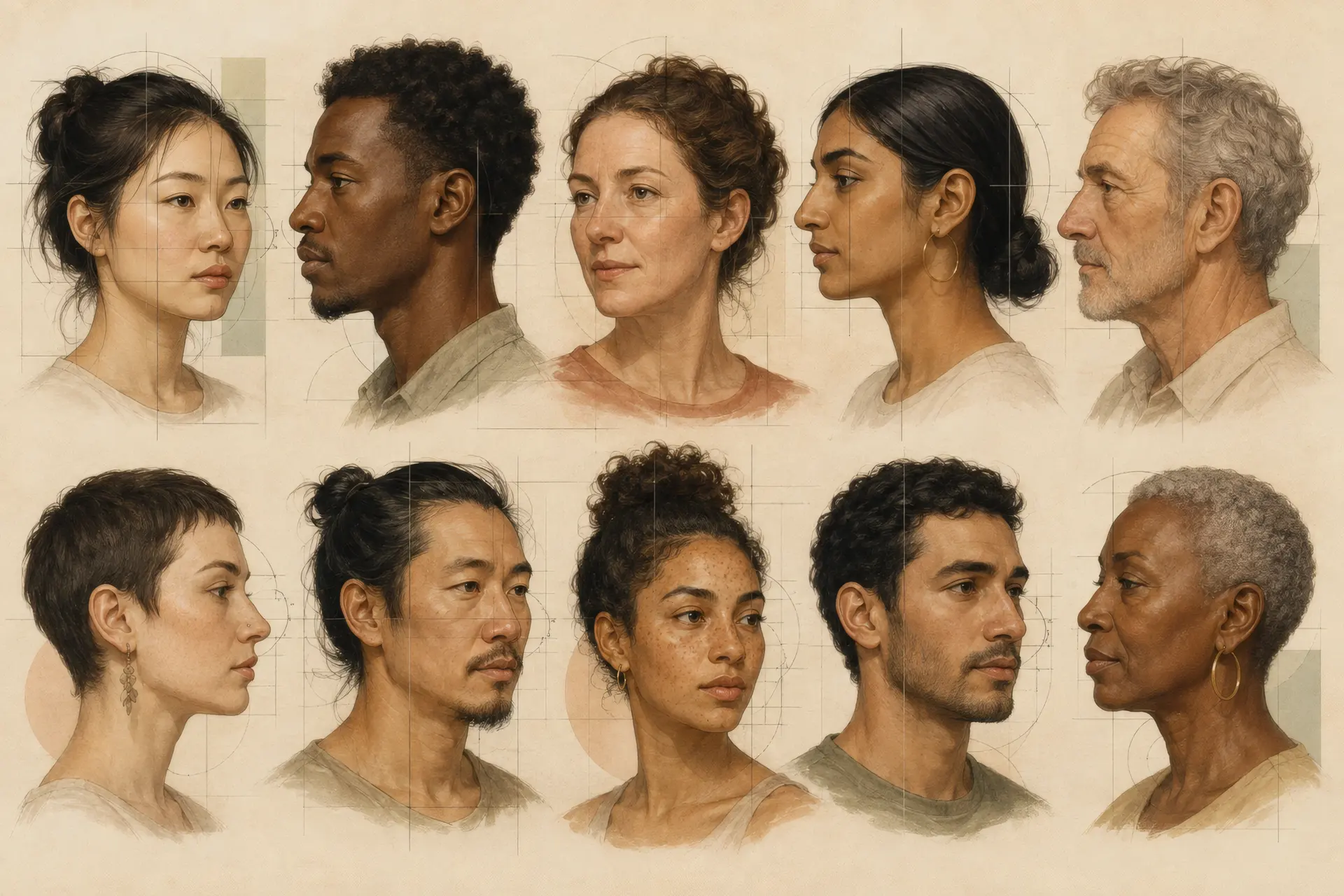
Anthropologists spent the better part of a century measuring noses, and the lesson they walked away with was humbling. Nasal proportions do cluster differently across populations. But the variation inside any single group dwarfs the average gap between groups, which means an ethnicity label can hand you a probability and nothing firmer.
So this page sticks to what the research supports. The workhorse measurement is the nasal index, the width of the nose divided by its height, multiplied by 100. Anthropometry sorts the results into three bands, leptorrhine (long and narrow), mesorrhine (middle), and platyrrhine (broad and short). You'll see where different samples tend to land, why climate likely played a role, and why none of it pins down your particular nose.
The quick answer
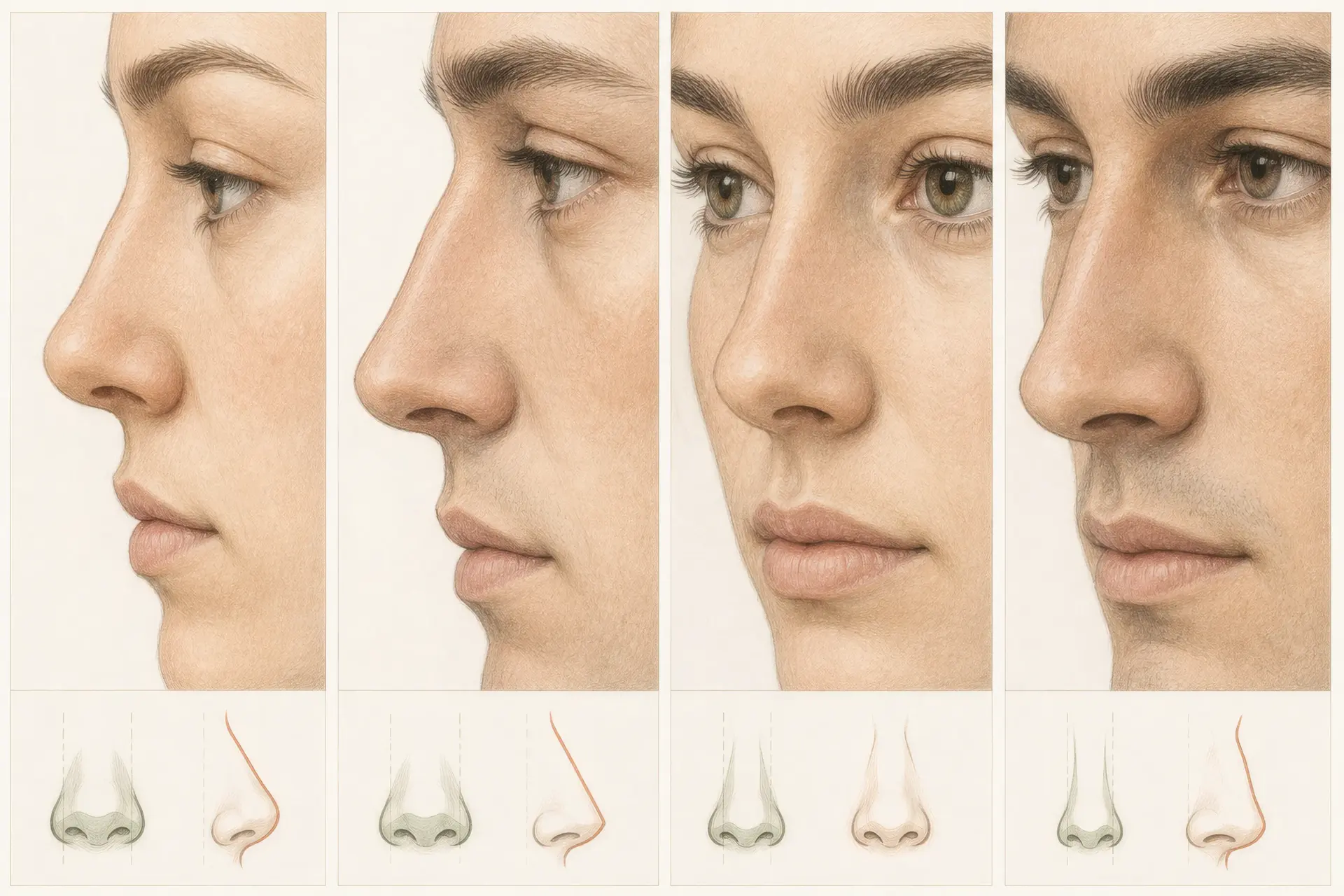
Nose shapes show statistical patterns across populations, and enormous overlap. European samples often average long and narrow, many West African samples average broad, and East Asian and Middle Eastern samples frequently land mid-scale. No label predicts an individual nose. The free nose shape detector reads your own bridge curve and tip angle from a photo.
The nasal index, explained
Take the widest point across the nostrils (the alar base), measure the height from the nasion at the top of the bridge down to where the columella meets the lip, divide the first by the second, multiply by 100. That single ratio has been the standard descriptor in nasal anthropometry for over a century, and it still shows up in surgical planning papers today. The landmarks involved are covered in the nose anatomy guide if you want a labeled map first.
Three bands carry most of the literature.
| Band | Index range | General description |
|---|---|---|
| Leptorrhine | Below 70 | A nose taller than it is wide. Long, narrow bridge and a narrower alar base in profile and front view. |
| Mesorrhine | 70 to 85 | The middle band. Height and width sit in moderate proportion to each other. |
| Platyrrhine | Above 85 | A nose wider than it is tall. Broader alar base, and in many samples a lower bridge height. |
Clinical planning
One reference among many.
Surgeons use nasal measurements as a proportion guide when planning rhinoplasty, alongside photos, airway exams, and the patient's own goals. The numbers help set targets that respect the face in front of them. Nobody reputable plans a nose from an ancestry label alone.
Forensics
Probabilistic, with stated error ranges.
Forensic anthropologists estimate population affinity from the nasal aperture of skeletal remains. The estimates come with confidence intervals, and honest practitioners treat them as leads rather than verdicts, because the overlap between groups guarantees wrong calls on some skeletons.
Descriptive anthropology
Comparing samples across space and time.
The index gives researchers a common ruler. It lets them track how nasal proportions shift with climate, altitude, migration, and intermarriage, and to do it with numbers instead of impressions.
I learned the measurement in a university anthropology lab, of all places. Twenty students, one box of spreading calipers, and a volunteer who kept sneezing every time the cold steel jaw touched his alar base. His index came out to 68.4, leptorrhine by two millimeters of width. The noticable thing was how little that number told us about the rest of his face.
Population patterns, described carefully
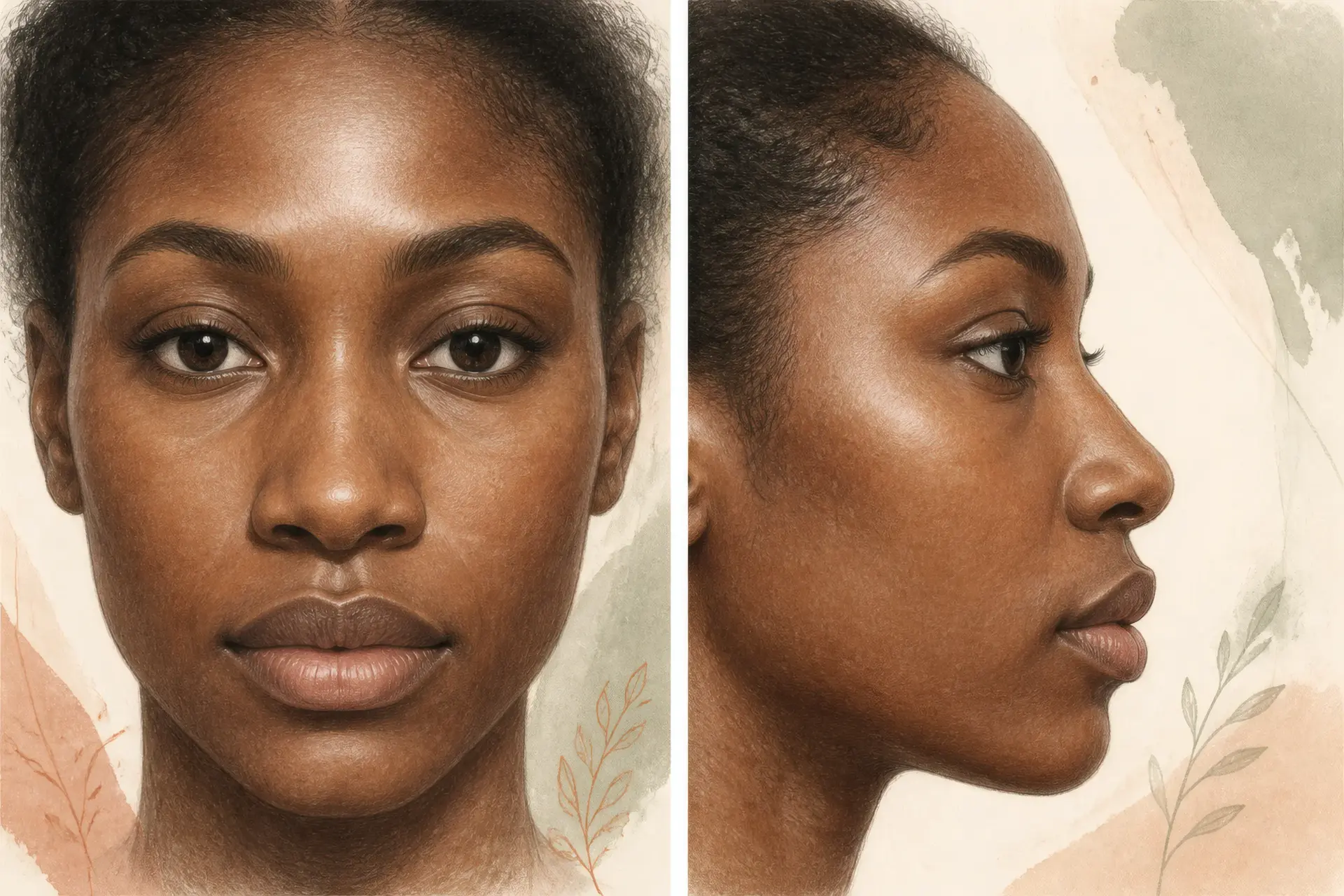
Measured across large samples, the averages drift by region. Studies of European populations frequently report leptorrhine means, long bridges and narrow bases. East Asian samples more often cluster in the mesorrhine band, with a softer radix and moderate width. Research on Middle Eastern and Iranian cohorts tends to land mid-scale as well, though with higher average dorsal convexity. And West African samples frequently average platyrrhine, broader alar bases with lower bridge height, the proportions celebrated on the Nubian nose page, in the wide nose guide, and in the low-bridge territory covered by the flat nose guide.
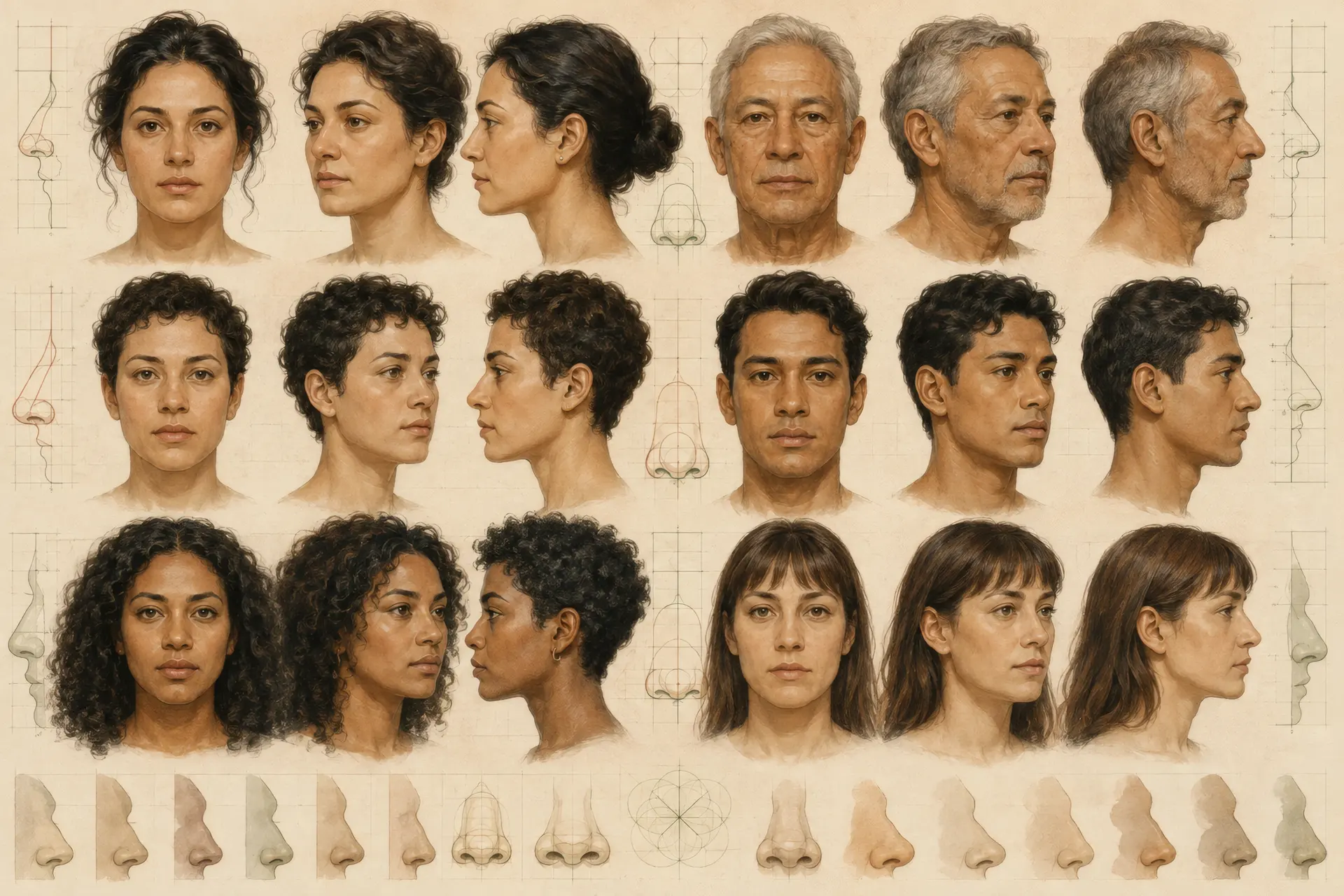
Read that paragraph again, slowly. Every sentence describes a mean with a fat spread around it. A 2009 systematic review of the nasal index found that proportions genuinely vary between groups while refusing to sort humanity into clean racial boxes. A 2022 review of regional nasal anatomy pushed the point further. Inside every continent-sized category it found many local variants, and it argued surgeons should work from regional evidence rather than treating "Asian" or "African" as a single phenotype. Nigeria alone spans more nasal diversity than some entire continents.
So the the useful unit is the region, and even that is rough.
Why climate probably shaped the averages
The leading functional story is air conditioning, literally. A longer, narrower nasal passage gives cold, dry air more contact time with warm, wet mucosa before it reaches the lungs. Broader, shorter passages move warm, humid air with less conditioning work to do. Populations that spent millennia in cold, dry regions may have drifted narrower. Populations from hot, humid regions drifted broader.
Plausible. Consistent with the global pattern. And still, as the nasal index review concedes, unproven in the strict sense, because you cannot run the experiment on humans. Add centuries of migration, trade routes, and intermarriage, and the old climate map gets smudged a little more with each generation. Genes travel faster than climates change.
Where ethnicity labels fall short
Here is where I plant a flag. A label can describe an average, and averages make lousy mirrors. The stereotyping hazard is obvious. Two sisters with the same parents can land in different index bands, and a friend of mine (mother from Oslo, father from Lagos) has a bridge narrow enough to fog one glasses lens before the other on cold mornings. Which band is she?
Surgical practice has mostly absorbed this lesson. The regional-variation review concludes that rhinoplasty works best when it preserves a patient's identity while improving harmony and airway function. I could be wrong here, but I think the trait-first habit helps outside the clinic too. "My alar base is wider than the space between my eyes" gets you further with a makeup artist or an optician than any ancestry word will. The traits worth knowing:
- Bridge height. Low, medium, or high, measured from the radix down the dorsum. One observation says more than any ancestry guess.
- Nasolabial angle, the tilt where the columella meets the upper lip. Published ranges usually run 90 to 120 degrees.
- Alar base width checked against the distance between your inner eye corners. Surgeons measure this ratio constantly.
- Tip projection. How far the tip stands off the face in profile view.
- And the bridge line itself, straight, convex, concave, or low-set.
The nose bridge types guide breaks bridge height and curve into concrete patterns, and the mirror method walks you through measuring your own traits in about five minutes. If mirrors are not your thing, the detector estimates bridge curve and tip angle from one photo.
Frequently asked questions
Does ethnicity determine my nose shape?
It shifts probabilities, and that is the whole story. Averages differ between population samples, but the spread inside every group is wide, and the overlap between groups is wider than the gap between their means. Treat ancestry as a hint about likelihoods. Your own measurements are the only description of you.
What exactly is the nasal index?
Nasal width divided by nasal height, multiplied by 100. Width is measured across the widest point of the alar base, height from the nasion to the base of the columella. Under 70 reads leptorrhine, 70 to 85 reads mesorrhine, over 85 reads platyrrhine.
Is the nasal index used in surgery?
Yes, as one planning reference. Rhinoplasty surgeons combine anthropometric numbers with photographs, skin thickness, and airway findings. The current consensus in ethnic rhinoplasty is to preserve a patient's identity while improving proportion and function, so the index informs the plan without dictating a target nose.
Can someone change an 'ethnic' nose?
Procedures change traits. Bone, cartilage, and the skin envelope can all be reshaped, and filler can adjust contours temporarily. Contemporary goals emphasize harmony with the rest of the face rather than erasing heritage. Any decision along those lines belongs in a consultation with a board-certified surgeon, and nowhere else.
Is one nose type healthier than another?
Published research has not shown meaningful physiological differences between ethnic groups despite obvious differences in proportions, and no evidence ties any group to sinonasal disease through anatomy alone. Breathing trouble, snoring, or recurrent sinus infections deserve a doctor visit, whatever shape your nose happens to be.
Sources
The claims on this page lean on two systematic reviews. Both are worth reading in full if you want the primary data.
- Leong and Eccles, a systematic review of the nasal index and the significance of nose shape and size in rhinology (2009). Proportions vary between groups, yet they do not define broad racial categories, and physiology differences between groups remain unproven.
- Heiman and colleagues, defining regional variation in nasal anatomy to guide ethnic rhinoplasty (2022). Numerous regional variants exist inside every historic geographic category, so regional evidence beats continent-level labels.
Next steps
Averages describe populations. Your mirror describes you. Figure out your own traits with what type of nose do I have, see how your bridge fits the bridge type patterns, or read why the idea of a perfect nose falls apart once you look at the data behind it.