Alar and columella guide
Nostril Shape
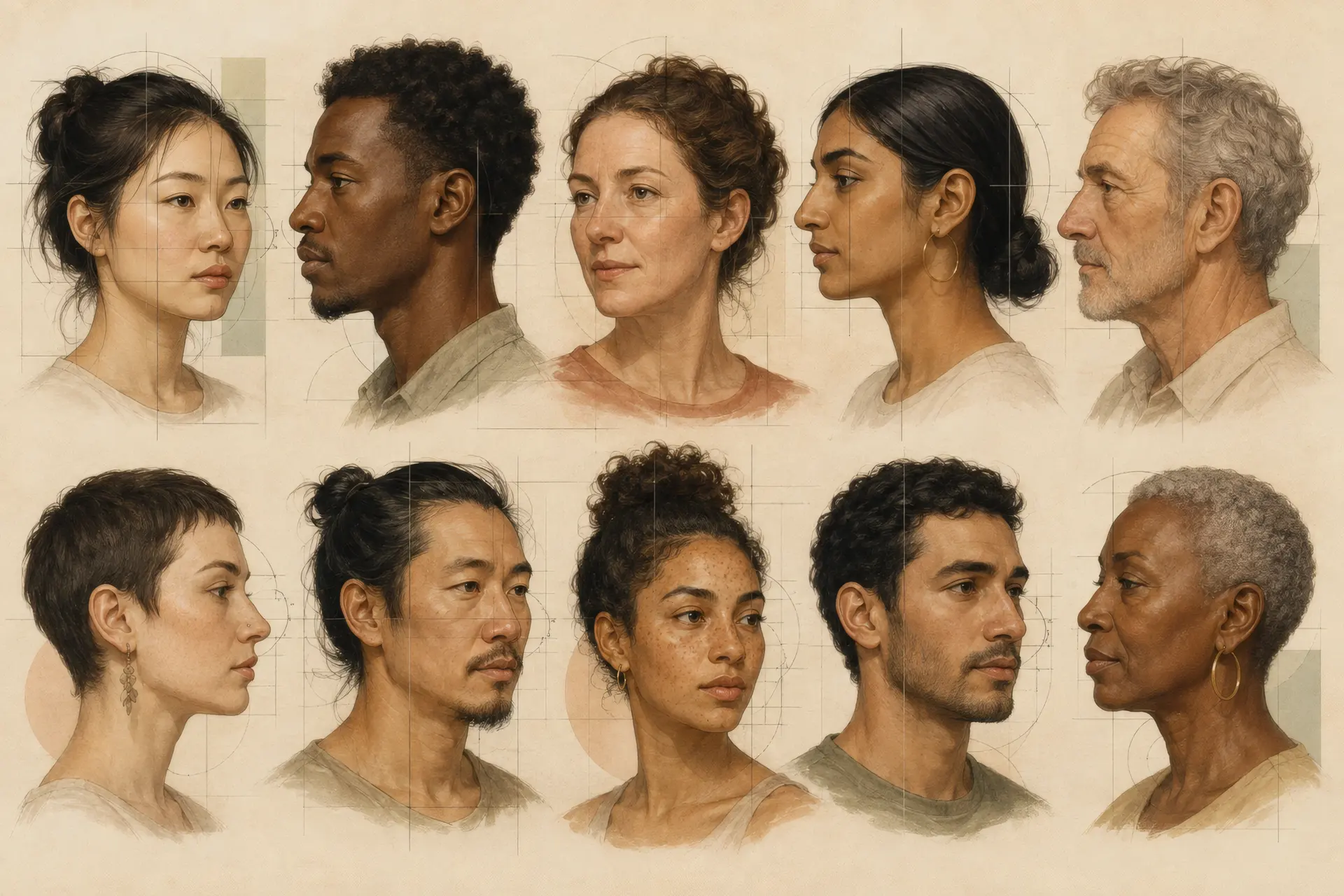
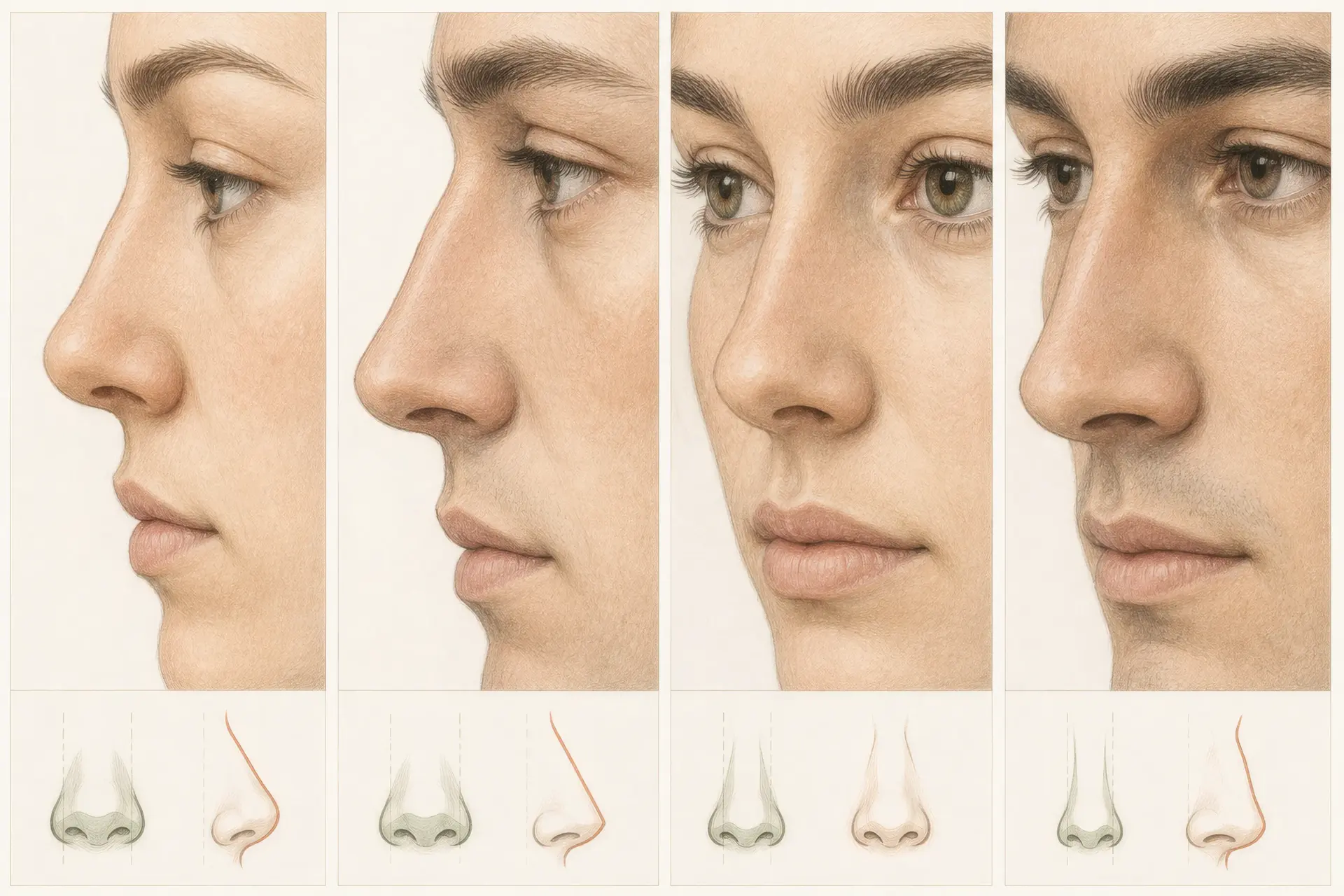
The worst nostril photo of your life probably already exists. Someone held a phone at chest height, the wide-angle lens did what it does, and suddenly your nasal openings looked like twin tunnels. Nostril shape is the form of those openings, seen from the front, from below, and in profile. Two structures draw the outline, the alar rims on the outside and the columella running down the middle.
This guide covers the common shapes, what alar flare does to perceived width, and how columella show shifts a profile. We'll also get into how the nostrils interact with tip rotation and bridge width, since nothing at the base of the nose acts alone. One thing first. Mild left-right asymmetry is standard equipment on human faces, and it is no defect.
The quick answer
Nostril shape is the outline of the nasal openings, drawn by the alar rims and the columella between them. Round, oval, and teardrop cover most noses, while alar flare, hanging columella, and alar retraction describe how the rims sit. All of it is normal anatomy.
Curious what yours reads as? The free nose shape detector pulls tip angle and bridge curve from a single photo.
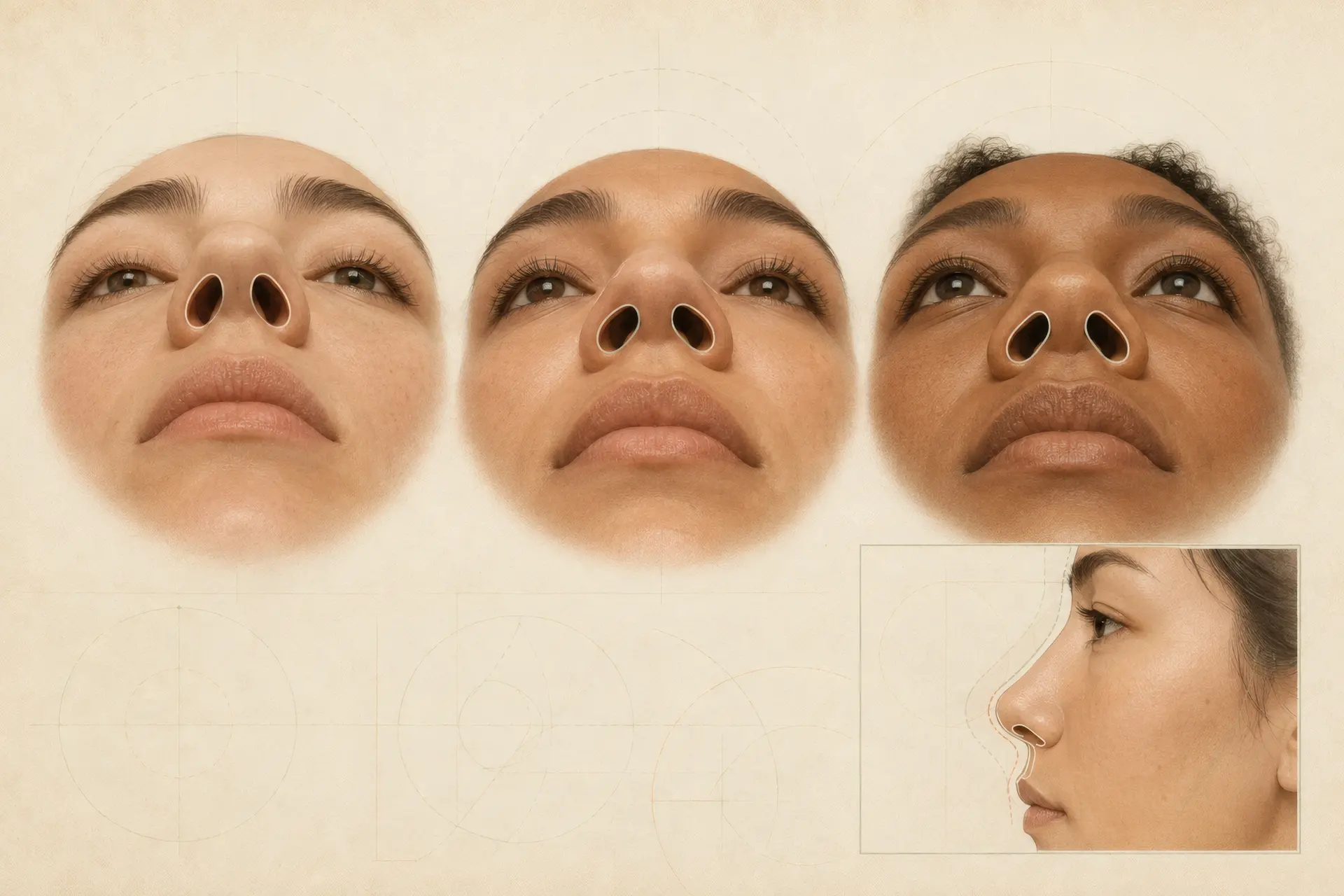
Common nostril shapes, front and base view
Three forms cover most of what you'll see in the mirror. The borders between them are soft.
Round
Circular openings with soft alar rims.
The rim curves in a near-even arc, so the opening reads as a circle in the base view. Round nostrils tend to travel with fuller soft tissue at the tip and alae. Softer rims scatter light instead of carving a sharp edge, which is why they photograph wider than they measure.
Oval
Vertically elongated, taller than wide.
The opening stretches upward, common when the tip has definition and the alar rims stay narrow. From the front you see slim slots rather than circles. Surgeons often treat the oval base view as a landmark of decent tip support.
Teardrop
Fuller up top, tapering toward the sill.
The wide end sits near the tip and the opening narrows toward the base, like an upside-down raindrop. Teardrop nostrils show up with certain tip rotations, and strong rotation can push a plain oval into teardrop territory because rotation changes what the base view shows.
Round openings tend to arrive with fuller soft tissue, which is why they so often show up on the bulbous nose shape and the fleshy nose. And no label is fixed. Tip rotation, lighting, and camera angle all redraw the outline. Tilt your head back ten degrees and an oval flattens toward round. A strongly upturned nose can push an oval toward teardrop without the nostril itself changing at all.
Alar flare and alar base width
Two measurements people mix up constantly. Alar base width is the distance between the outer points of the nostrils, measured straight across. For frontal balance, clinicians often compare it to the intercanthal distance, the space between the inner corners of the eyes. A base width close to that span reads proportionate on most faces.
Alar flare is different. It describes how far the nostril rims curve outward beyond the alar-facial groove, that small crease where the nostril meets the cheek. More curve means more flare, and more perceived width in photos.
Here is the part that surprises people. Flare and base width vary independently. A narrow base can still wing outward, and a wide base can sit flat against the face with barely any flare. So when you read your own photos, treat them as two separate dials. The wide nose guide deals with overall base width; flare is its own conversation.
Profile cues: hanging columella and alar retraction
Three traits live at the border between the alar rims and the columella, and each one changes the side view in a different way.
| Trait | What you see | Where it shows | How it reads |
|---|---|---|---|
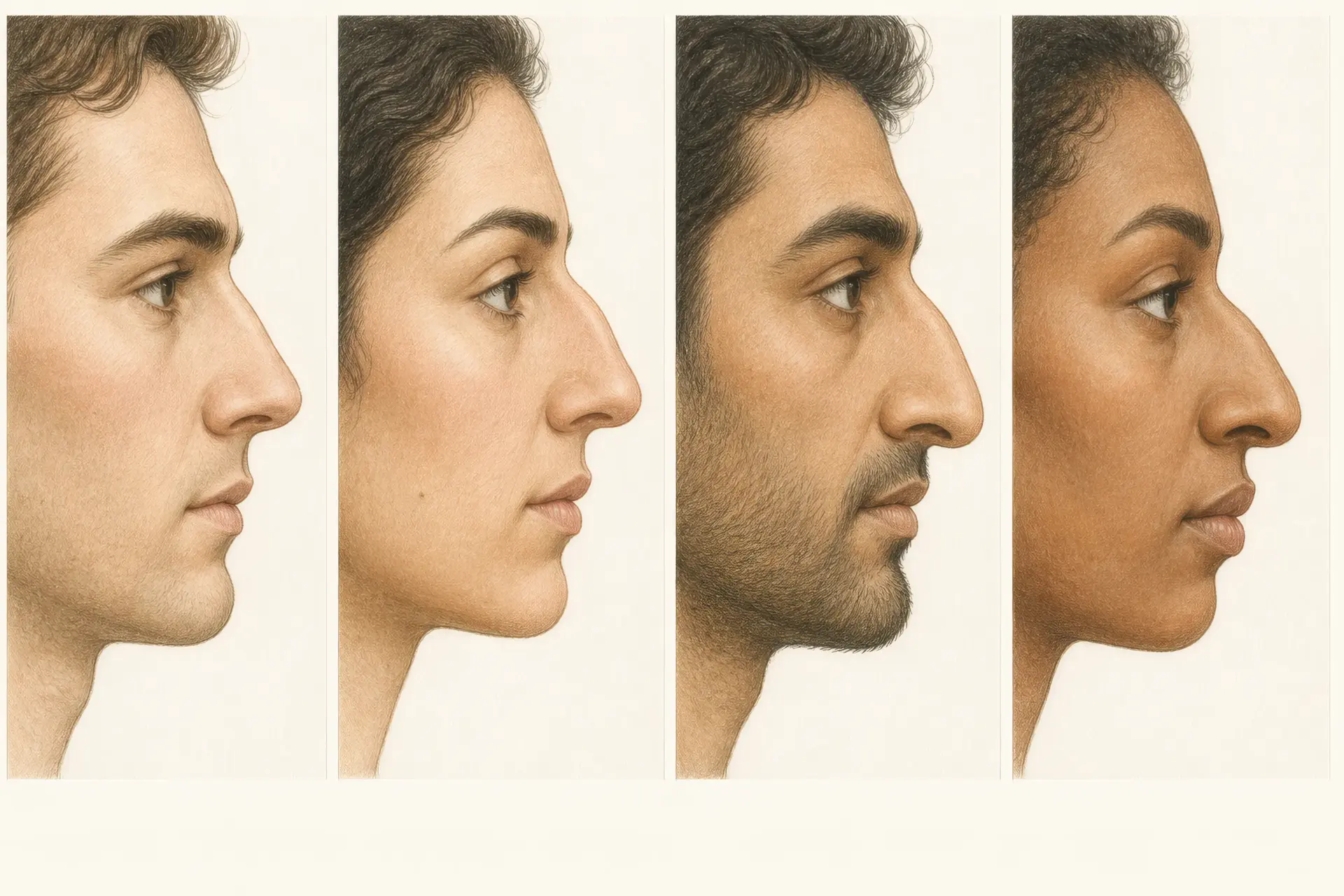
| Hanging columella | More than about 4 mm of columella visible below the alar rims | Mostly the profile view | The nose reads elongated or slightly drooping from the side |
| Alar retraction | Rims sitting high, exposing extra nostril interior | Front and profile both | The openings look larger and more visible head-on |
| Hooded nostrils | Alar rims overhanging and hiding the columella | Profile view | The base of the nose looks tucked or shadowed |
Columella show is the technical term for how much of that central strip you can see below the rims in profile. Under 2 mm and it barely registers. Past about 4 mm, people start calling it hanging. Retraction runs the other direction, the rims sit high enough that the nostril interior shows from the front. Surgeons treat rim and columella as two ends of one balance, and the nose anatomy guide maps every structure named here if you want the full diagram.
An honest photo self-check
Four rules, and the lens distance one matters most.
- Hold the camera at eye level, arm's length out, face relaxed. A smile pulls the alar base wider on everyone, so skip it for this one.
- Never judge width from a close-up selfie. The wide-angle lens on most phones balloons whatever sits nearest the glass, and that is your nose.
- Base view next. Tip your chin up around 45 degrees and keep the phone at the same distance, or the comparison means nothing.
- Side light in the evening shows columella show far better than a bathroom downlight, which flattens the rims into shadow.
If you'd rather have a structured walkthrough, the what type of nose do I have guide runs these same checks in order, front view first and base view last.
Styling and consultation notes
Small optical tweaks go a long way at the base of the nose.
- Glasses. A frame with a slight upsweep or wider-set end pieces pulls the eye outward and balances a broad alar base.
- Contour. A matte shade two steps deeper than your skin, tapped along the outer rims and blended hard, visually narrows flare. Keep it subtle. Heavy alar contour reads as dirt by lunchtime.
- One thin line of highlight down the dorsum moves attention upward to the bridge, away from the base entirely.
- Skip shimmery product on the tip if your nostrils already read prominent. Shine at the base adds volume exactly where you don't want it.
The 7 a.m. contour mistake.
A makeup artist friend says the most common nostril complaint she hears comes from people who contoured with a shimmery bronzer before work and wondered by lunch why the base of their nose looked sweaty and wider at same time. Matte only, in my experience. I could be wrong here, but I suspect half of all nostril anxiety is camera-angle anxiety wearing a costume.
If a consultation is ever on the table, three terms do the heavy lifting, alar base width, alar flare, and columella show. Say those and you skip twenty minutes of pointing at a mirror. Anything beyond makeup is a medical decision, so bring photos and questions to a qualified professional instead of deciding from a selfie.
Frequently asked questions
What is a hanging columella?
Excess columella show. In profile, the columella, the strip of tissue between the nostrils, hangs more than about 4 mm below the alar rims. From the side it can make the nose look longer or slightly drooping. It is a common anatomical variant and only registers from certain angles.
Are round nostrils bad?
No. Nostril shape carries no quality grade. Round openings read soft, oval openings read refined, and neither is healthier or better looking on its own. What the eye actually judges is balance, how base width and flare sit against the rest of your features.
Can nostril shape change with age?
Mildly, yes. As tip support weakens and skin loses elasticity, the tip can drop and the alar base can widen or flare a few millimeters over the decades. That shift is gradual. A change over weeks or months is a different story and worth having examined.
Is nostril asymmetry normal?
Completely. Most faces carry one nostril slightly larger, higher, or differently curved than the other, and nobody notices until they study a base-view photo at 200 percent zoom. Only a sudden new asymmetry, especially paired with breathing changes, merits a professional look.
Can makeup change my nostril shape?
Visually, yes. Matte contour along the outer alar rims narrows flare, and a bridge highlight shifts focus upward. The effect lasts until you wash your face. Any structural change to cartilage is a medical decision, so bring photos and questions to a qualified surgeon rather than deciding from a selfie.
Next steps
Round, oval, teardrop, flared, hooded. The base of the nose carries more vocabulary than most people expect, and now you have all of it. From here, the nose anatomy guide names every structure on this page, the upturned nose guide covers the tip rotation that redraws your base view, and what type of nose do I have turns this page into a five-minute self-check.