Bridge line and height
Nose Bridge Types
The dorsum runs from between your eyebrows down to the tip, and it sets the character of your whole profile. Everything else, tip, nostrils, alar base width, plays supporting roles around that one ridge.
Bridges vary in two independent ways. The line, straight, convex, or concave. And the height, high or low. Mix in width, length, and tip rotation and you get nearly every nose label on the internet. This page walks through both axes, shows how they combine, and covers what your bridge means for glasses and contour.
The quick answer
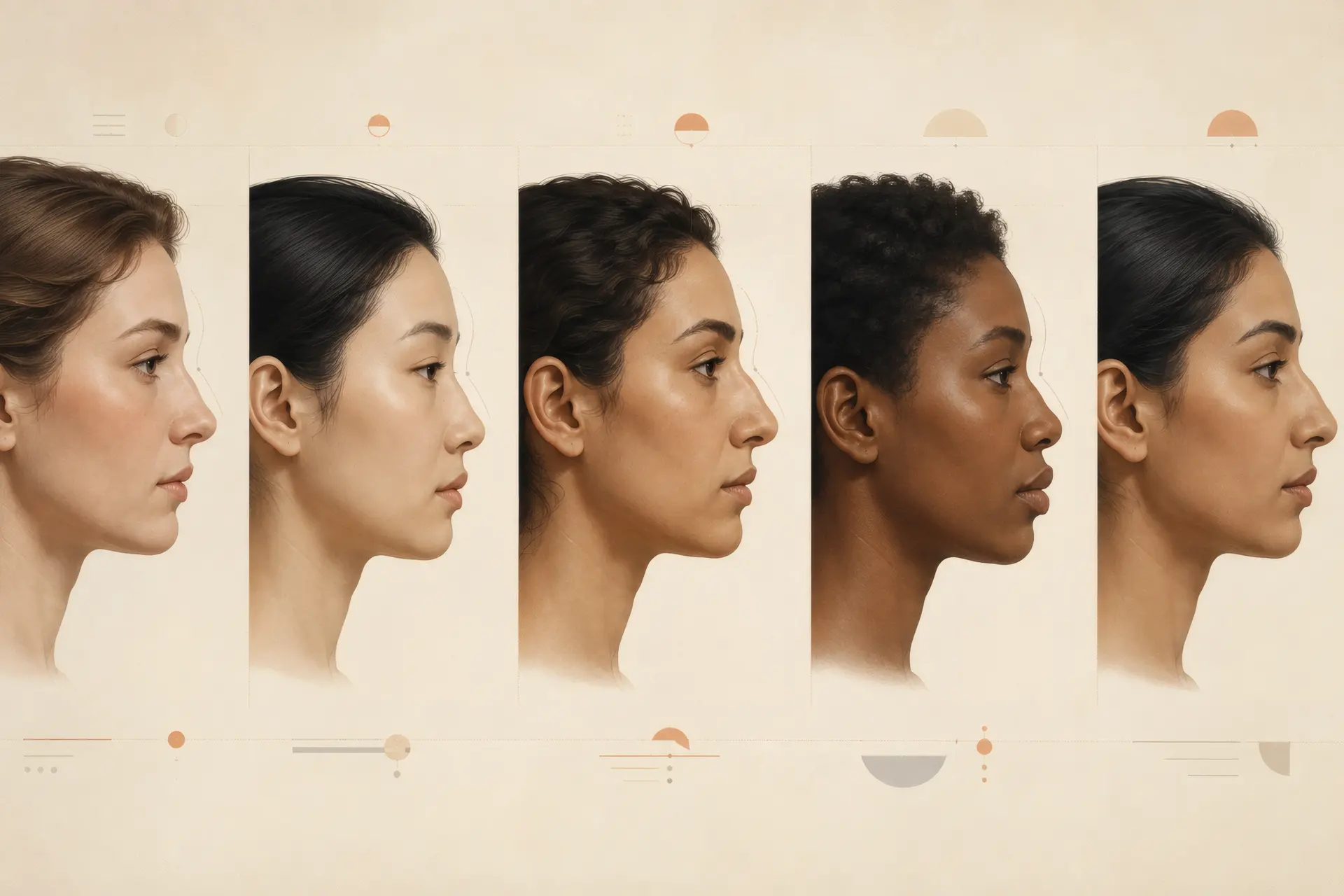
Nose bridge types split two ways. By line: straight, convex (an outward curve or hump, the Roman and aquiline family), or concave (a slight inward scoop). By height: high bridges start near the brow and project forward, low bridges sit flatter. Most noses mix one from each column, which is why the labels overlap so much.
Not sure where yours lands? The free nose shape detector reads bridge curve and tip angle from a single photo.
In this article(7 sections)
The three bridge-line shapes
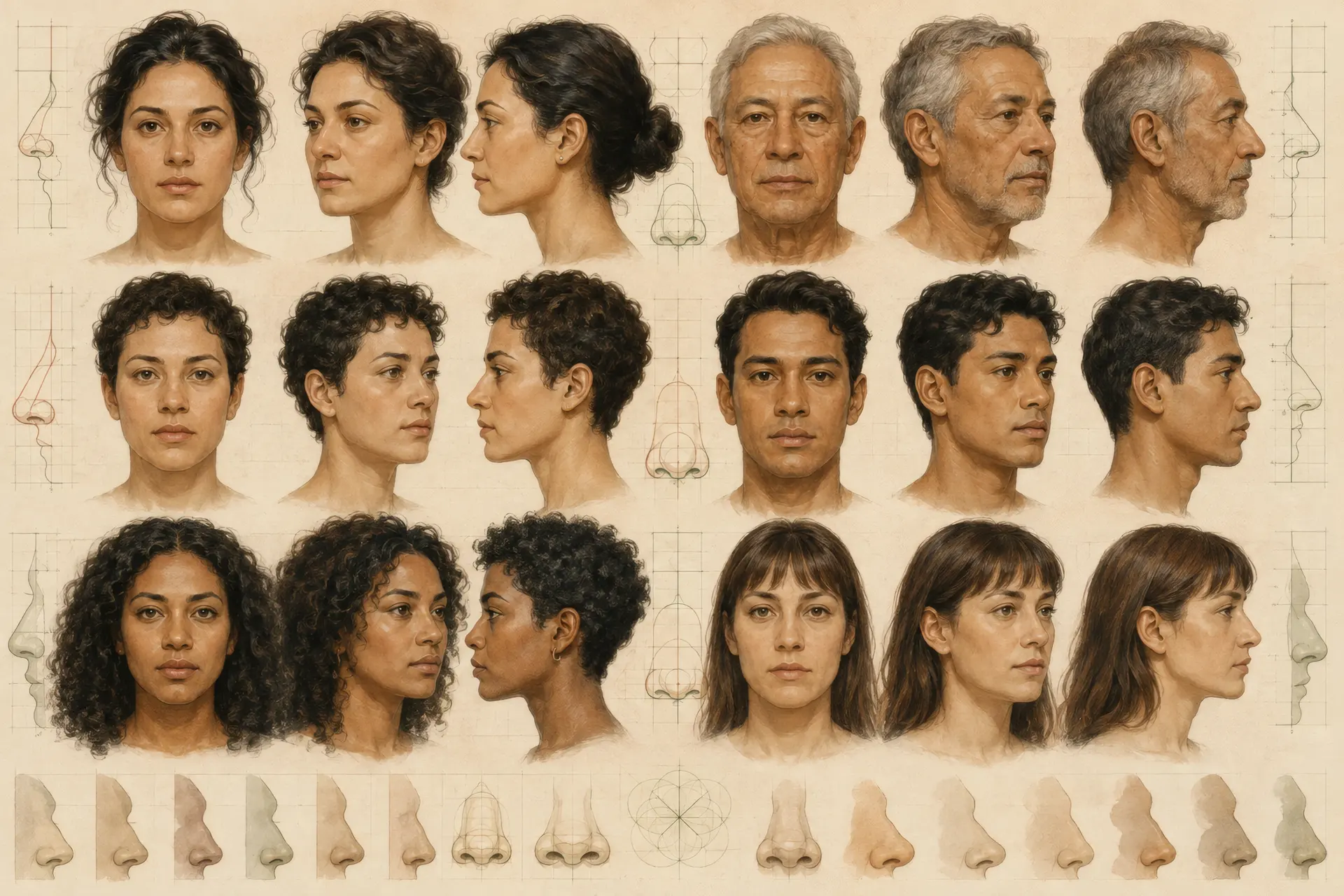
Take a side photo, trace the dorsum with your eyes, and the line falls into one of three buckets.
Straight bridge
A linear dorsum with no hump and no dip.
Run your finger from between the eyebrows down to the tip and the line stays flat the whole way. No bump, no scoop. This is the profile classical sculpture chased for centuries, and it is the baseline the other two types get measured against. The straight nose guide covers the full trait set, including the versions that drift a millimeter or two off ruler-flat and still count.
Convex bridge
An outward curve, from a gentle arc to a visible hump.
The dorsum bows outward, usually in the upper-to-middle third where bone meets cartilage. Small convexity reads as a soft arc in profile. Larger convexity reads as a hump you can catch from across a room. This is Roman and aquiline territory, the hawk nose sits at the strong end, and the profile tends to look defined and deliberate. Bold, basically.
Concave bridge
A slight inward dip along the dorsal line.
The line scoops inward, often with a tip that rotates up at the end. On some faces the dip is a whisper, on others it is a clear curve you can see in any side photo. Concave bridges show up constantly on shorter, turned-up noses, which is why snub and upturned profiles share so much DNA with this line.
One caveat before you self-sort. These are descriptive profiles, and plenty of noses blend features. A bridge can run straight through the bony third and finish with a faint dip above the tip. Another can carry a two-millimeter bump that shows up in some lighting and vanishes in others. Nobody's dorsum is a geometry exercise, so treat the buckets as coordinates, and expect to land between two of them. For the deep dives, see the straight nose, the Roman nose, the hawk nose, and the snub nose for the concave end.
Bridge height: high vs low
Height is a separate dial from line shape, and it confuses people because it changes what the nose does from the front, where the line is invisible.
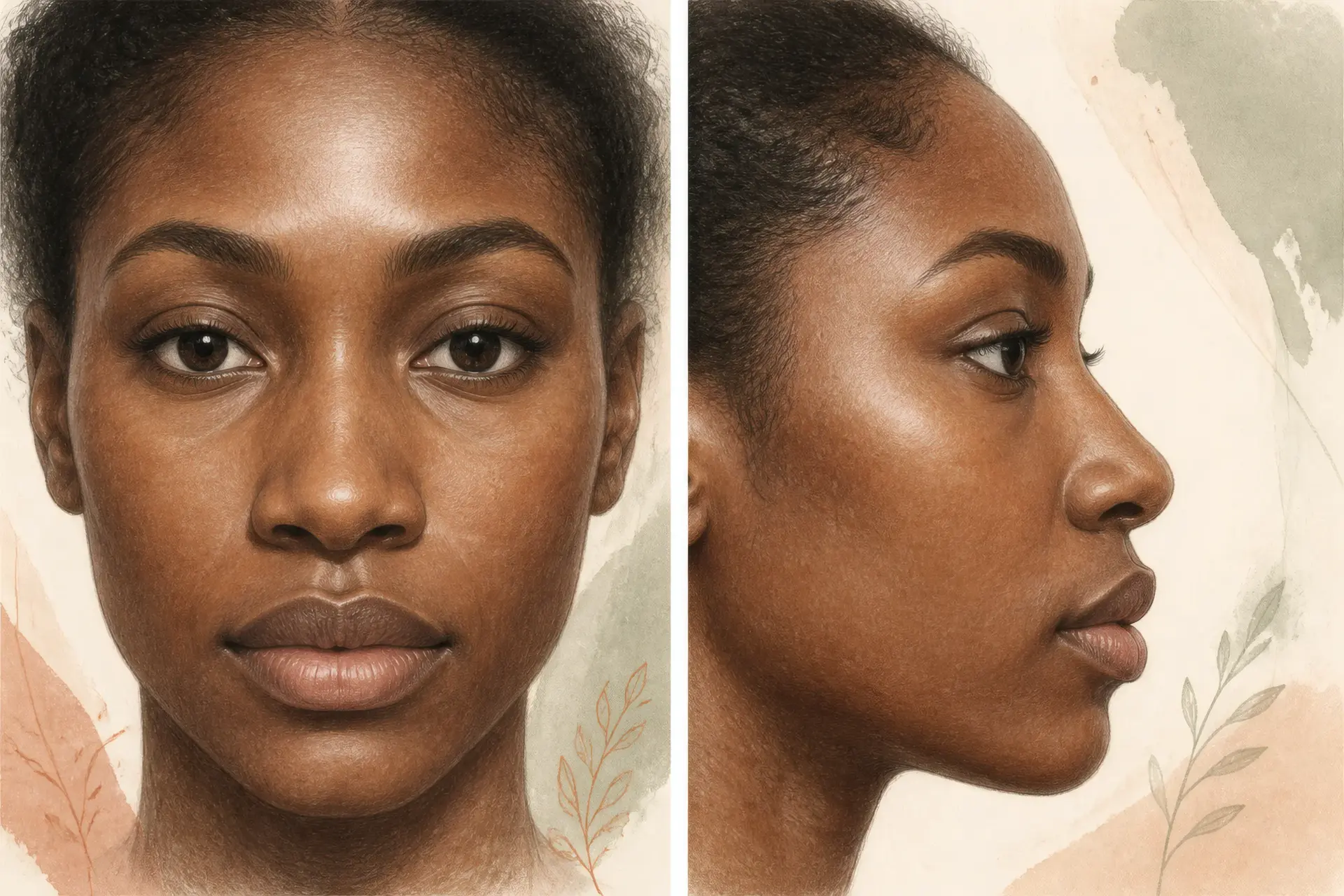
A high bridge starts near the brow. The radix, the dip where the nose meets the forehead, sits around the level of the upper lashes, and the bony ridge projects well off the face. Head-on, that projection casts soft shadows along both sides of the dorsum, so a high bridge often reads narrower than it measures. In profile it anchors the mid-face. Glasses sit up near the brow line and mostly stay there.
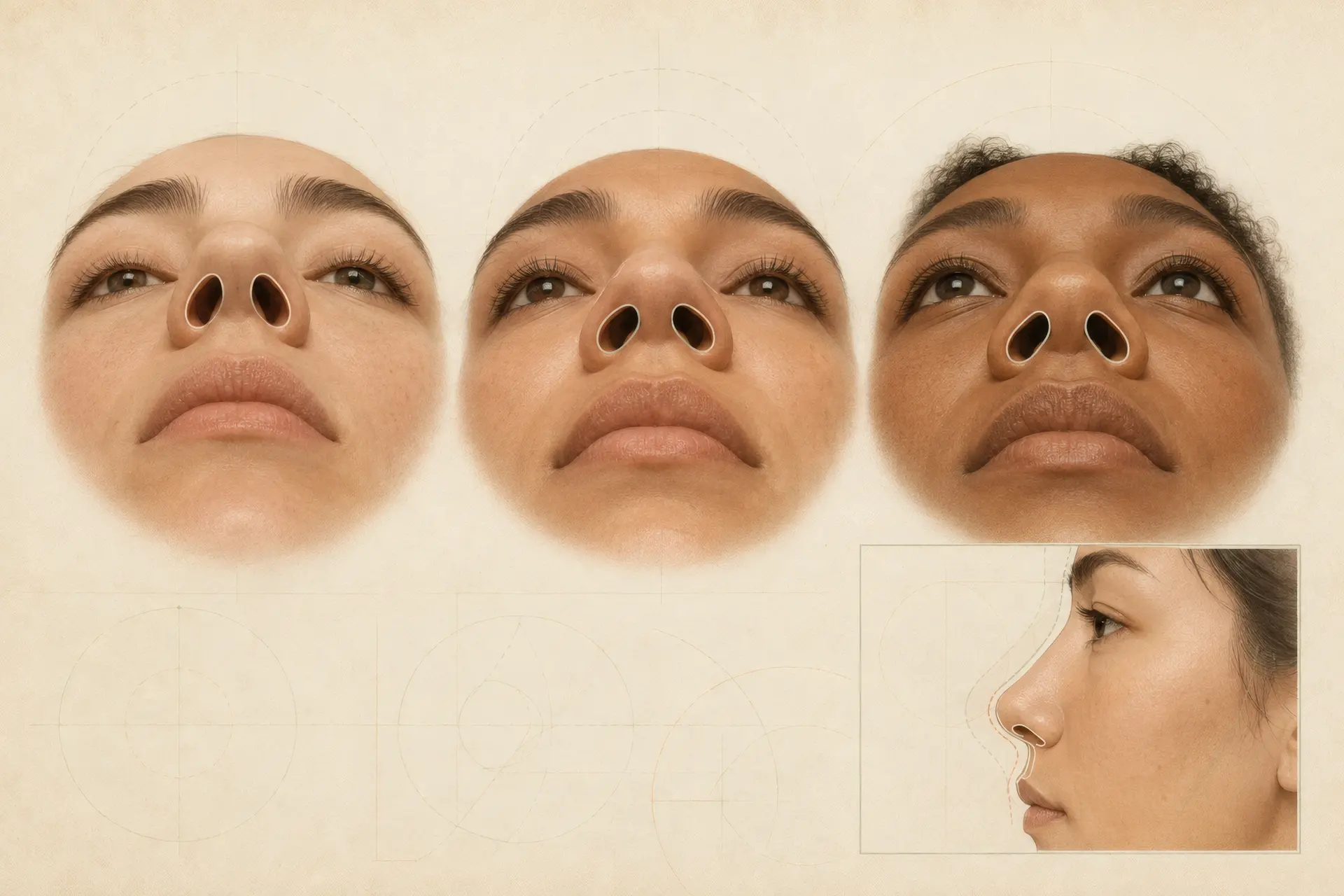
A low bridge starts farther down. The radix sits below the lash line, sometimes closer to the inner corner of the eye, and the ridge projects less. From the front, with no shadow carving out the sides, the same millimeters of alar base width can look wider. That is an optical effect, not extra tissue. The flat nose and wide nose guides go deeper on how projection changes the front view.
Population patterns exist, gently stated. Lower bridges with less projection are more common in many East Asian and African features, while higher, more projected bridges show up more often in some European and Middle Eastern profiles. Both show up everywhere. And the Nubian nose proves the point inside a single label, pairing a low or medium bridge with a wider base and a downward-leaning tip. Prevalence is a tendency, never a rule.
Worth repeating: height and line are independent. High straight bridges exist. So do low convex ones, which trip up anyone assuming a hump automatically means a tall bridge. The nose anatomy guide maps the radix, dorsum, and columella if you want the landmarks pinned down first.
How bridge type combines with width, length, and tip
A bridge line alone is half a description. The same dorsal curve reads completely differently once width, length, and tip rotation join in, and the familiar nose labels are mostly shorthand for specific bundles of these traits.
| Bridge line | Typical companions | Overall impression |
|---|---|---|
| Straight | High height, narrow width, level tip | Greek-like, balanced, the classical profile |
| Convex | High height, medium width, forward or level tip | Roman or aquiline, strong and defined |
| Concave | Low or medium height, short length, upturned tip | Snub or turned-up, reads youthful |
| Straight | Long length, downturned tip | Reads more severe, sometimes hawk-adjacent |
Look at the first row. Straight plus high plus narrow is the Greek nose recipe, the profile you see on marble statues. Swap in a convex line with a high bridge and medium width and you are standing in Roman or aquiline country. Concave with a low bridge and a short length gives you the snub or turned-up family, which the upturned nose page covers through the tip-rotation lens.
The last row is the sneaky one. A straight dorsum with extra length and a downturned tip reads far more severe than the word straight suggests, because the nasolabial angle closes and the tip pulls the eye downward. Same line, opposite mood. So when a label feels off, check the the tip before blaming the bridge. The five-minute mirror method walks through capturing all four traits in order.
Styling, glasses fit, and makeup
Bridge type has practical consequences, and glasses are where most people meet them first.
- High bridges: make sure the nose pads are tall enough. A pad that sits too low lets the frame perch on top of the dorsum and wobble with every nod.
- Sliding.
- Low bridges get the most out of adjustable pads or a keyhole bridge, because both let the frame grip higher up instead of resting on the wider, softer part of the nose. Fixed-pad plastic frames are the usual suspects when glasses creep down all day.
- Makeup: soften a hump on a convex bridge with a whisper of contour along the sides of the bump, never a stripe straight over it. On a low or flat bridge, do the reverse and run a narrow highlight down the center to fake projection.
- Hair counts too. Volume at the crown and a slightly off-center part pull attention upward and balance a strong convex profile, while heavy forward bangs can crowd a low bridge and make the mid-face look compressed.
The July problem.
A friend of mine has a low bridge and a beloved pair of fixed-pad acetate frames. Every summer, same story. Ten minutes into any outdoor errand the frames start their slow slide, and by the time the heat really kicks in she is pushing them up with the back of her wrist every block or so, a tiny grease mark left on the bridge each time. She swapped to an adjustable-pad pair in August and the problem vanished the same afternoon. In my experience, pad style beats frame weight, brand, and price for low bridges, and I could be wrong here, but I doubt the acetate pair gets worn again.
The glasses frames guide breaks down fit by bridge height with specific frame styles, and it pairs well with the contour placement notes above if makeup is part of your routine.
Frequently asked questions
Can my nose bridge type change over time?
The bone and cartilage under your bridge finish growing in the mid-to-late teens and barely remodel after that, so the underlying line and height are set. What does shift is perception. Skin loses elasticity with age, tips droop a few degrees, and a straight bridge at 25 can read slightly convex at 60 because the tip dropped while the dorsum stayed put. Weight changes and filler wear-off can tweak the look for months at a time, but the skeleton underneath is stable.
Is a hump the same thing as a convex bridge?
Yes. A visible dorsal hump is convexity by definition, because the line bows outward where the hump sits. The only nuance is size. People say hump for a bump you can spot head-on in a profile photo, and gentle convexity for an arc you need a ruler to confirm. Same family, different volume.
Do bridge types affect breathing?
External shape on its own tells you almost nothing about airflow. Breathing depends on the internal nasal valves, the septum, and the turbinates, and a perfectly straight bridge can hide a deviated septum while a strong convex one breathes fine. If airflow is a concern, that is a question for an ENT, not a mirror.
What is the difference between a high and low nose bridge?
Where the ridge starts and how far it projects. A high bridge begins near the brow, at a radix that sits roughly level with the upper lash line, and pushes forward off the face. A low bridge starts farther down, projects less, and the mid-face reads flatter in profile. Both can pair with any line shape.
Which glasses work best for a low nose bridge?
Frames with adjustable nose pads, keyhole bridges, or designs sold as low-bridge fit. All three raise the contact point so the frame stops sliding down the softer part of the nose. Adjustable pads are the easiest win, since an optician can bend them in a two-minute fitting.
Next steps
You now have both dials, line and height, and a way to read how they combine with width, length, and tip. From here, compare your bridge against the straight nose, the Roman nose, or the flat nose depending on which dial moved you most. If you want the raw landmarks first, the nose anatomy guide names every part, and what type of nose do I have turns it into a step-by-step self-check.