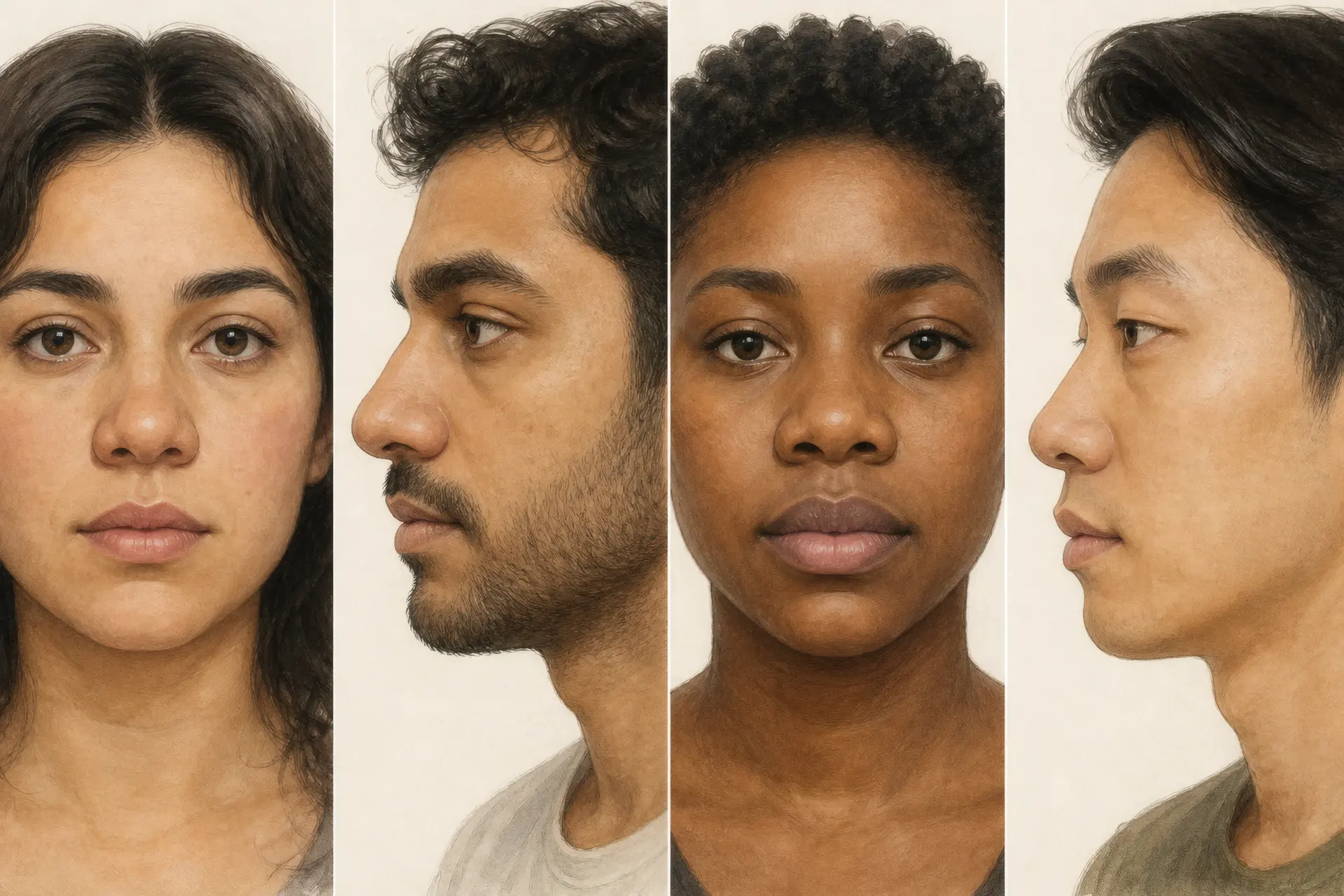
Bridge, tip, and nostrils, decoded
Nose Shape
Nobody stands in front of a mirror analyzing their nose out of boredom. Something prompted it. A photo from the side, a pair of glasses that sits wrong, a contour tutorial that assumed a bridge you don't have. Nose shape is the visible form of the nose, and it comes down to three things: the bridge profile, the tip angle, and the width of the nostrils and base. Nose types are the shorthand categories surgeons and stylists use for the common patterns, names like Roman, aquiline, button, hawk, Greek, and snub.
Knowing yours pays off in mundane, useful ways. Glasses that balance your bridge instead of fighting it. Contour that works with your tip rather than against it. And if you ever weigh a non-surgical tweak or a consultation, you walk in speaking the same language as the person across the desk. This page is the big-picture framework. Dedicated subpages go deep on each type.
The quick answer
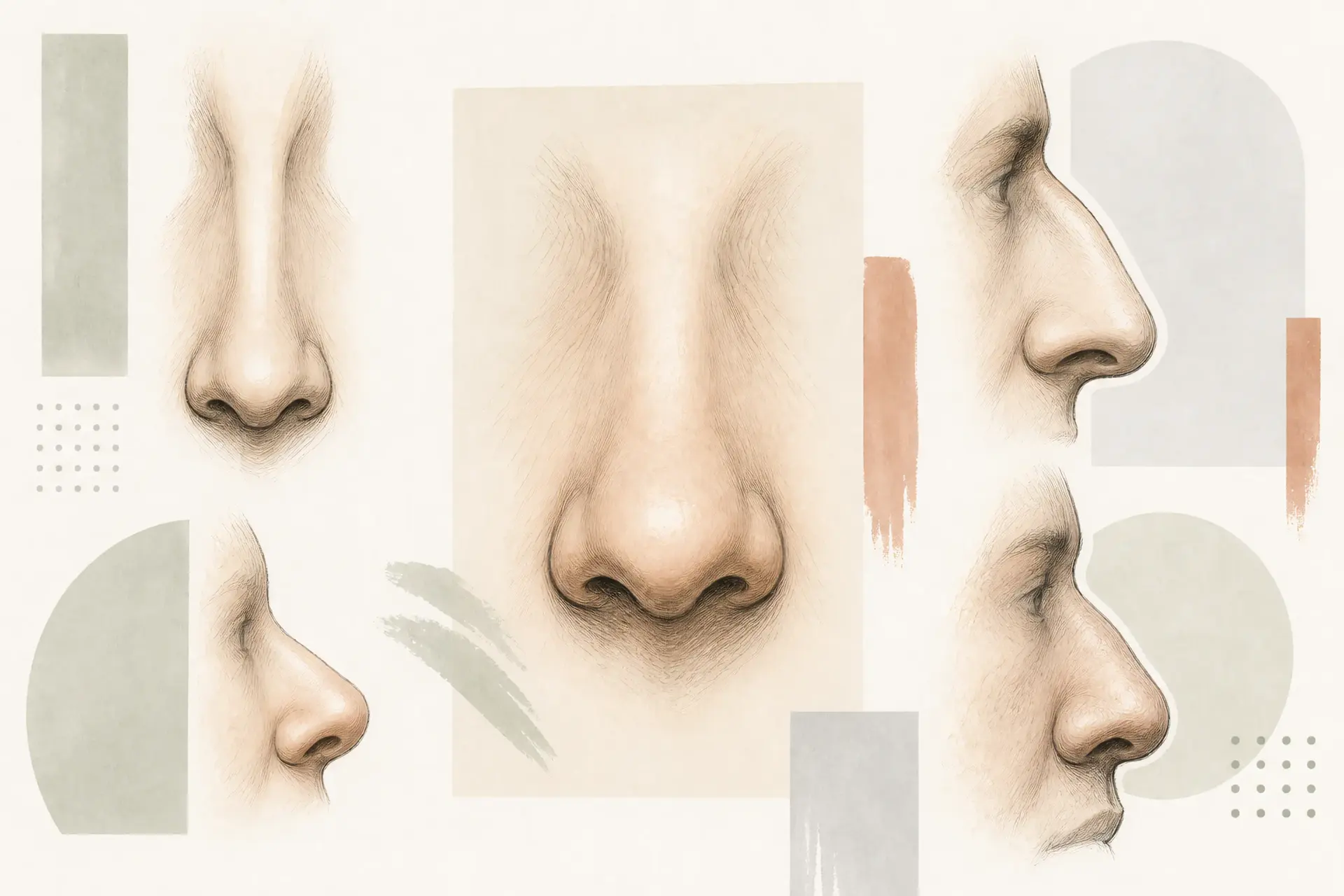
Your nose type comes from three features: the bridge (straight, convex, or concave), the tip (upturned, level, or downturned), and the width of the nostrils and base. Straight bridges give Greek and Nubian noses. Convex bridges give Roman, aquiline, and hawk. Short upturned tips give button, snub, and celestial. Wide or low bases give flat, bulbous, and fleshy.
Want the answer from a photo instead of a mirror? Try the free nose shape detector.
How nose shapes are classified
Three anatomical features do most of the work. Learn to read them and every type name in this guide starts making sense.
Profile
The bridge (dorsum)
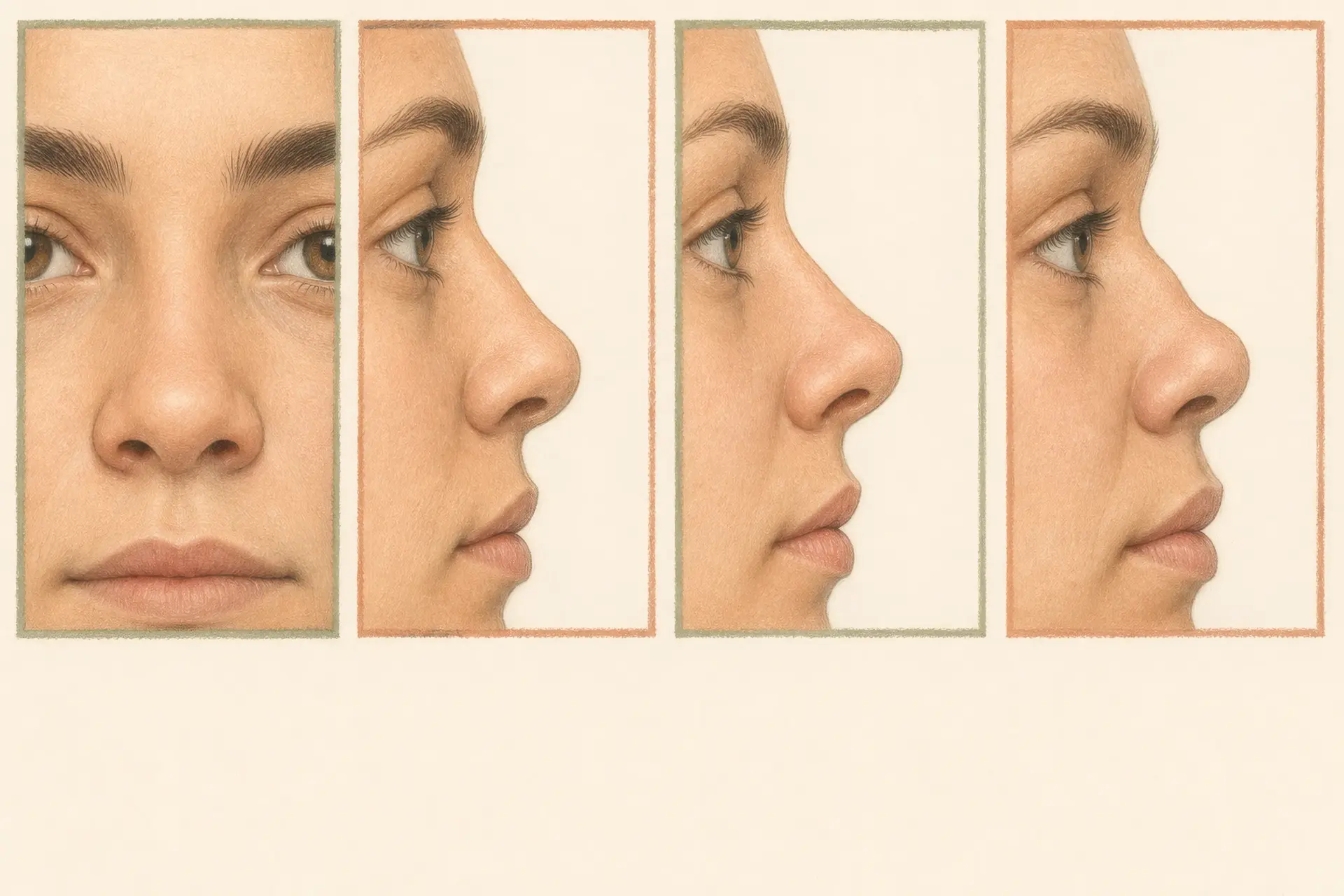
Straight, convex (an outward curve or hump), or concave (an inward dip). Read it from the side. The front view hides everything interesting about a bridge.
Direction
The tip
Upturned, level, or downturned. Then size and shape: small and rounded versus bulbous or pointed. Tip direction does more for the overall read than people expect.
Front view
Nostrils and base
Narrow versus wide, flared versus refined. Base width is what ties the nose to the proportions of the rest of the face.
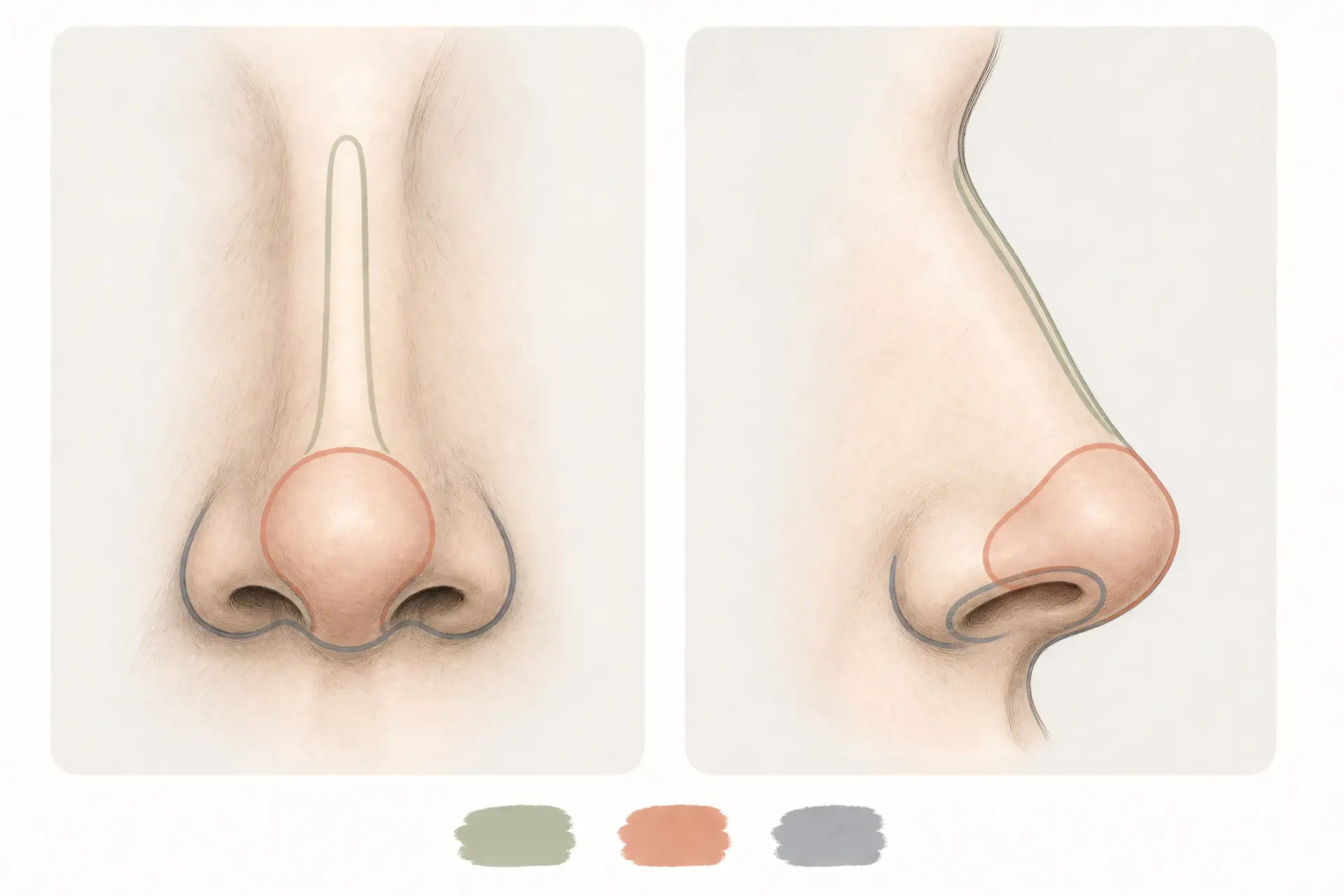
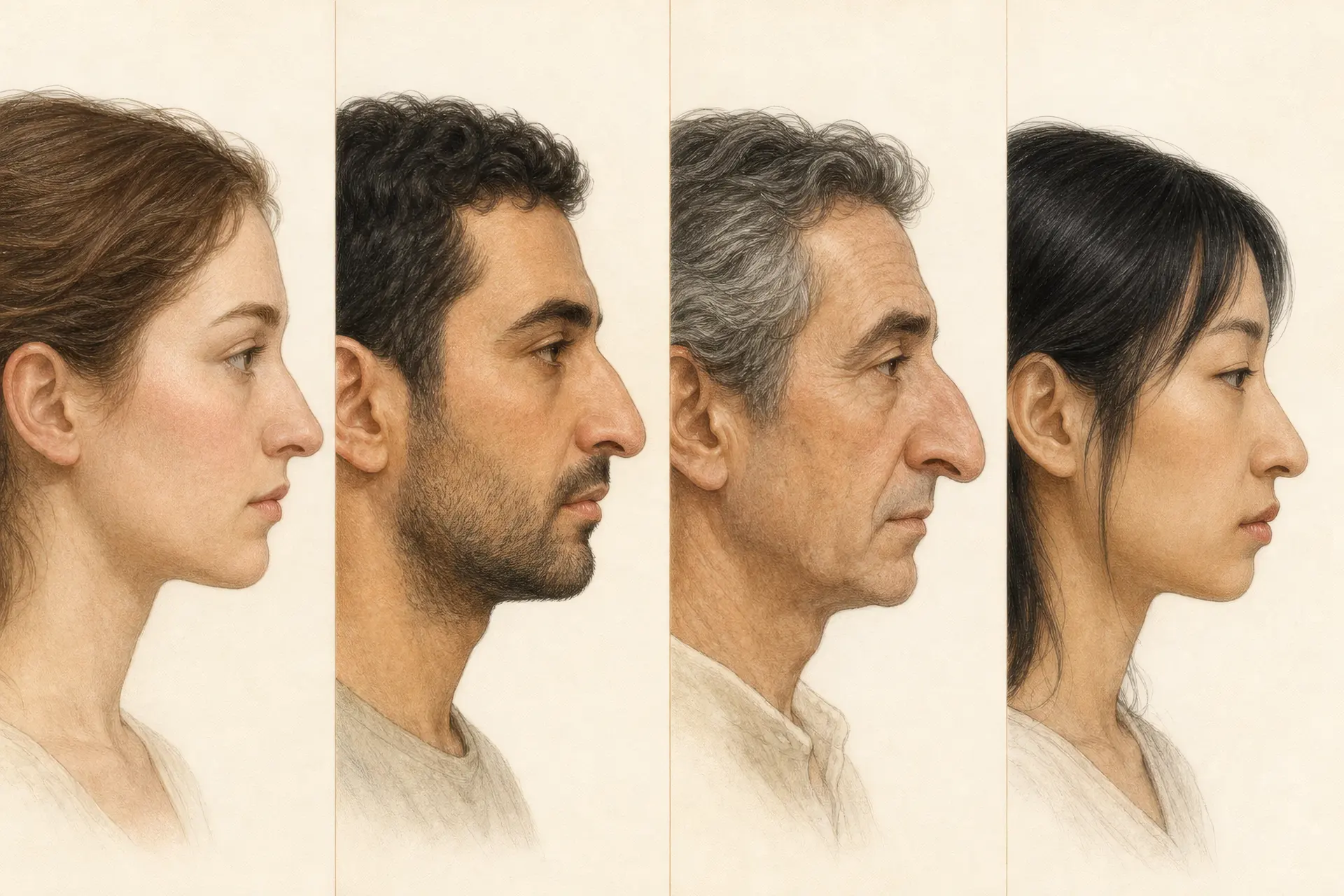
Professionals also weigh length, projection (how far the nose extends from the face), and the way the nose relates to the chin, forehead, and lips. Genetics and ancestry influence which patterns show up often, but every nose is unique. Blending features from two or three types is the rule, and a clean single-type nose is the exception.
The most common nose shapes and nose types
Fourteen names cover nearly every nose you'll meet. Each one below comes with the defining bridge, tip, and base, plus a quick way to spot it.
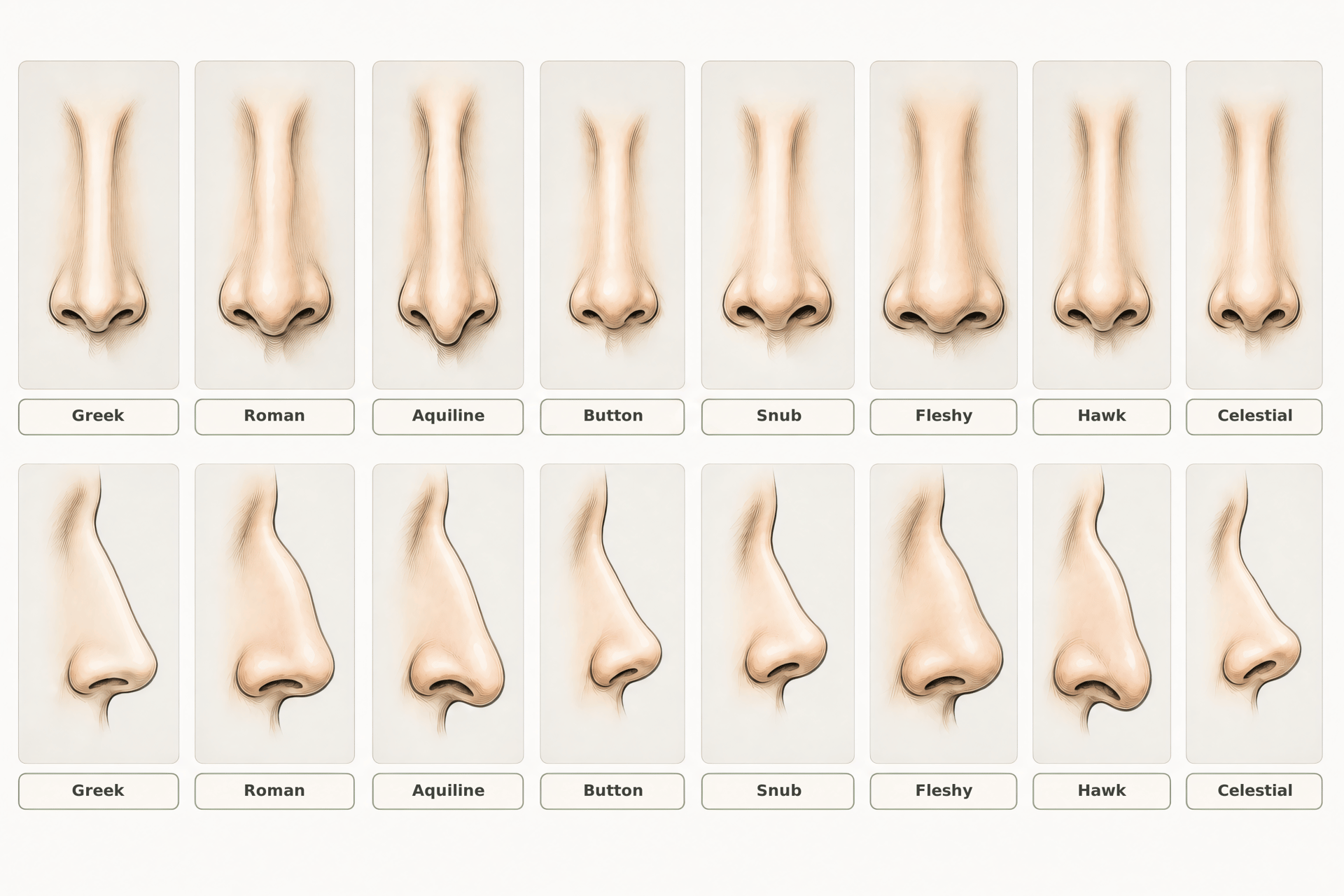 Open the full labeled nose shapes chart
Straight and balanced nose shapes
The bridge line stays clean from root to tip. Balance does the talking.
Greek Nose
In profile, the bridge line barely deviates.
Smooth, straight bridge from root to tip. No humps, no dips. The tip sits level with the bridge line, which gives the whole profile a balanced, columnar look.
Straight Nose
The bridge runs even, but everything else can vary.
The wider family behind the Greek label. Any linear dorsum qualifies, whether the bridge sits high or low, the base narrow or broad. Greek is the classical subset, not the whole story.
Nubian Nose
From the front, the base width reads deliberate rather than heavy.
A longer bridge with moderate height, a rounded tip, and a wider base with broader nostrils. The overall effect is elongated and proportional, and it tends to look strong from every angle.
Convex bridge family: Roman Nose, Aquiline Nose, Hawk Nose
One family, three intensities. The bridge curves outward and the profile gets bolder as you move down the list.
Roman Nose
In profile, the curve peaks around the upper third of the bridge.
A prominent, slightly convex bridge with a small hump or curve, and a tip that often leans slightly downward. The side profile is strong and defined.
Aquiline Nose
The bridge is a continuous arc rather than a single bump.
A cousin of the Roman with a longer, more pronounced outward arch, and a tip that may lean down. The eagle comparison gets overused, but the curved silhouette is exactly the idea.
Hawk Nose
The hooked, downturned tip is visible at a glance.
The intensified version. A strongly curved outward bridge paired with a sharply downturned, hooked tip. The boldest profile in the family, and the easiest to identify.
Small, rounded, and upturned nose shapes
Shorter length, softer lines, and tips that aim up.
Button Nose
Everything is compact, and the tip rounds instead of points.
Small, rounded, soft. A low to moderate bridge, compact overall proportions, and a gently rounded tip. It reads youthful on almost everyone who has one.
Snub Nose
The upturned tip reveals the nostrils slightly from the front.
Short with a gentle slope and a soft, upturned tip. The bridge often carries a subtle inward dip or sits low.
Celestial Nose
The upward tilt at the tip is the whole point.
Short with a clear upward tilt and nostrils more visible from the front. Delicate and lifted. The difference from snub is degree: the tilt is more pronounced and deliberate-looking.
Wide, low, or full nose shapes
Width and soft tissue lead, projection stays modest.
Flat Nose
In profile, the bridge barely rises above the plane of the face.
A low bridge and a wider base with a smooth profile and minimal projection. Common in many Asian and African populations.
Bulbous Nose
From the front, your eye lands on the tip first.
A rounded, full tip that appears wider than the bridge. The tip may be fleshy or broad while the bridge stays straight or slightly curved.
Fleshy Nose
Soft tissue dominates across both bridge and tip.
Fewer defined angles, a fuller look, often wider overall. A common mix-up: people call any wide nose fleshy, but cartilage shape and skin thickness are different conversations.
Other notable variations
Types that describe one dominant trait and often overlap with the families above.
Bumpy Nose
Run a finger down the bridge and you feel the irregularity.
Visible bumps or irregularities along the bridge, usually cartilage or bone structure, sometimes an old injury. It coexists with other types. A Roman with a bump is still a Roman.
Narrow Nose
The bridge line looks drawn with a fine pen.
Slim bridge, refined tip, narrow nostrils. The overall look is delicate and linear.
Saddle Nose
The bridge dips inward in profile.
A depressed bridge creating a concave profile, often from trauma or a medical condition. This one belongs in medical conversations more than styling ones.
How to identify your nose shape: a simple 3-step method
Five minutes, one mirror, one honest profile photo. Work through the steps in order, because the bridge narrows the field before the tip and base settle it.
- 1
Check the bridge in profile
Stand sideways to a mirror or use a profile photo. Trace an imaginary line from between your eyebrows to the tip. A straight line points to the Greek or straight family. An outward curve or bump points to Roman, aquiline, or hawk. An inward dip or a very low bridge points to snub or flat.
- 2
Read the tip direction
Same profile view. Upturned suggests snub, celestial, or button. Level suggests Greek, Nubian, and most straight noses. Downturned or hooked puts you in the convex family.
- 3
Judge the front view
Face the mirror. Small and rounded overall is button territory. A wider base with a longer bridge reads Nubian or flat. A full, rounded tip reads bulbous or fleshy.
Hold your three answers next to the type descriptions above and pick the closest match, then go deeper on that type's subpage. For a slower, step-by-step version with self-check questions, read what type of nose do I have. If you'd rather skip the mirror work, the nose shape detector classifies bridge, tip, and nostril proportions from a single photo.
Why nose shape matters: style, aesthetics, and options
The nose sits at the center of the face, so it sets the terms for facial harmony. A strong convex bridge plays differently against a soft jawline than against a sharp one, and a small upturned nose changes how the lips and chin read next to it. Knowing your type turns styling from trial and error into something closer to pattern matching.
Glasses
Match frame design to bridge height and width. A high convex bridge carries bold frames well; a low or flat bridge usually needs adjustable nose pads or a saddle bridge so the frame sits where it should. Read the glasses guide.
Makeup
Contour works with the bridge you have. Convex bridges take soft shadow along the sides, straight bridges need only a light highlight down the center, and upturned tips benefit from a touch of shadow beneath rather than on top.
Hairstyles
Volume and parting change how prominent the nose reads. Height at the crown and off-center parts pull attention upward; flat, center-parted styles frame the profile and emphasize it.
A fitting story I think about often.
A client with a pronounced Roman bridge spent years blaming her face for glasses that never sat straight. The frames were the problem. Standard keyhole bridges were resting on the bump, so the whole frame teetered, and by noon the sore spot behind her ears ached from the clamping. Switching to adjustable nose pads fixed in one fitting what three new pairs of frames hadn't.
For those weighing changes, the non-surgical route uses filler to smooth a small hump or refine a tip, and it stays temporary. The surgical route, rhinoplasty, can adjust the bridge, tip, or nostrils permanently. Either way, bring your type name and your three-step observations to a qualified professional. You'll have a sharper conversation, whether you end up embracing your natural shape or changing it.
How this guide is organized
This page is the pillar for nose shape and nose types: the overview, the classification system, and the identification method. Each subpage below goes deep on a single type, with detailed traits, styling tips, and FAQs.
- Roman Nose (also covers Aquiline Nose, Hooked Nose)
- Greek Nose
- Hawk Nose
- Straight Nose
- Upturned Nose (also covers Celestial Nose, Retrousse Nose)
- Downturned Nose
- Snub Nose Shape
- Button Nose Shape
- Bulbous Nose Shape
- Fleshy Nose
- Flat Nose
- Nubian Nose
- Wide Nose
- Pointy Nose
- Small Nose
- Big Noses
- Nose Shapes Chart
- What type of nose do I have?
- Nose Bridge Types
- Nostril Shape
- Nose Anatomy
- Perfect Nose
- Nose Types by Ethnicity
- How to Prevent Nose From Getting Bigger With Age
- Scientific Evidence for Nose Taping Changing Shape
- How to Contour Different Nose Shapes
Common questions about nose shapes and nose types
These five questions cover distinct topics about anatomy, breathing, classification, and surgery. Each one has a direct answer on its own page.
Is the nose an organ?
Yes. The nose is an organ made of several tissues working together. It forms the entrance to the respiratory tract, conditions inhaled air, supports immune defense, enables smell, and helps shape speech resonance.
Can human survive without nose?
A human can survive without an external nose when the airway remains open or doctors create another airway. Life without functional nasal passages brings major breathing, feeding, smell, infection-control, and rehabilitation needs, especially for a newborn.
Does septoplasty change nose shape?
Septoplasty usually does not aim to change the outside shape of your nose. It straightens or reshapes the internal septum to improve airflow. Swelling can temporarily change appearance, and a lasting external change is a recognized but uncommon risk.
What if my nose doesn't fit one type perfectly?
Most noses are hybrids. Classify the bridge, tip, and base separately.
Do nose types affect breathing or health?
Outside shape says little. The septum, valves, and turbinates inside decide airflow.
Where to go from here
Nose shapes come down to bridge, tip, and nostril characteristics, and those three features form types you can actually recognize. Run the 3-step method or let the detector do it, explore the subpage for your closest match as the guides roll out, and use what you learn in your next glasses fitting or consultation. The goal was never a perfect nose. It's knowing yours well enough to dress it properly.
Your nose interacts with the rest of your features, so the face shape guide and the jawline shape analyzer are useful next stops.