Visual reference
Nose Shapes Chart
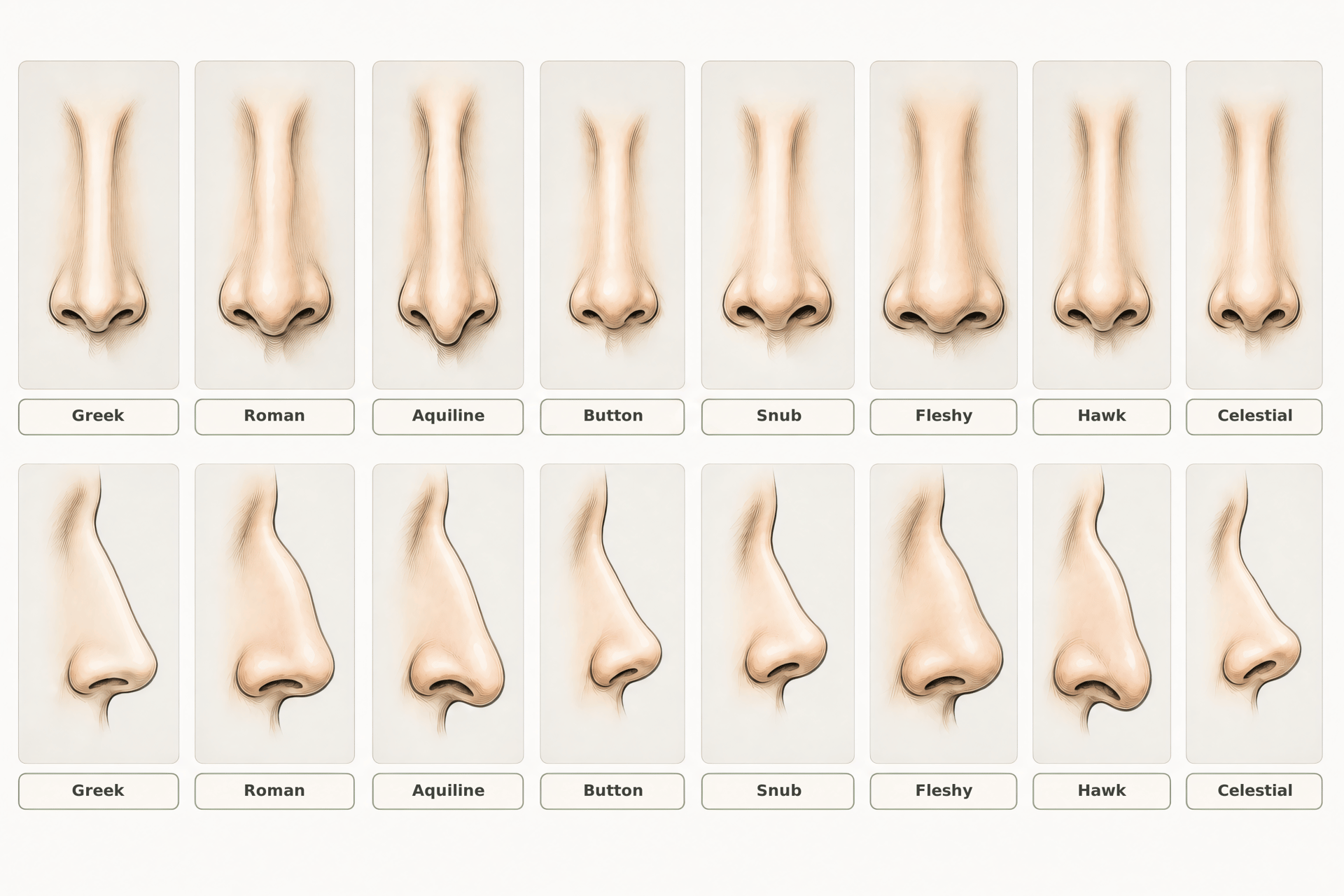
Use this nose types chart to compare the features people notice first: bridge line, tip direction, tip fullness, and base width. The original front and profile studies give you a visual starting point, while the table below adds the words to use when your nose blends more than one type.
Original visual chart
Eight nose shape studies, two useful views
Front view shows the base and tip. Profile shows the bridge and direction. Compare both before choosing a label.
06
Fleshy Nose
Fuller bridge and tip
Top row: front view. Bottom row: profile view. The labels are a visual key, not a diagnosis or a fixed classification system.
01
Start with profile
Use the lower row to read bridge direction and tip angle. Straight, convex, concave, upturned, and downturned are easier to spot from the side.
02
Confirm from the front
Use the upper row to compare base width, nostril visibility, and tip fullness. Front view adds the proportions a profile can hide.
03
Choose the closest match
Most noses combine traits. Pick the name that describes your strongest feature, then add a second descriptor when it helps, such as straight and narrow.
Nose types at a glance
Compare the chart nose types by feature
A name describes a pattern, not a rule. Bridge shape usually does the most work in profile; base width and tip fullness do more from the front. Use the cue in the last column when two rows feel close.
| Type | Family | Front view | Profile view | Fastest cue |
|---|---|---|---|---|
| Greek Nose or Straight Nose | Straight | Narrow to medium base with a clean, even outline. | The bridge runs in a straight line from root to tip; the tip is level or gently refined. | Look for a bridge with no visible hump or dip. |
| Roman Nose | Convex | Balanced front view; the bridge gives the nose its definition. | A modest outward curve or hump, often paired with a slightly downturned tip. | The curve usually peaks in the upper or middle bridge. |
| Aquiline Nose | Convex | Usually medium to narrow at the bridge, with a defined tip. | A longer, continuous outward arch that creates a strong side silhouette. | Read the whole arc rather than looking for one isolated bump. |
| Hawk Nose | Convex | Often narrow through the bridge with a pronounced tip shape. | The most hooked profile in this group, with a strongly downturned tip. | The hook is visible even in a small profile photo. |
| Button Nose | Short and rounded | Small, rounded tip and compact nostril base. | Short bridge with a gentle slope and a softly rounded tip. | The tip looks neat and domed rather than pointed. |
| Snub Nose | Upturned | Small to medium base; the nostrils may show slightly. | Short nose with a low or subtly concave bridge and a lifted tip. | The tip turns up without the stronger tilt of a celestial nose. |
| Celestial Nose | Upturned | Narrow to medium base with more visible nostrils from the front. | A clear upward tilt at the tip, usually on a shorter bridge. | Tip direction is the defining feature, not nose width. |
| Nubian Nose | Long and broad-based | Longer center line with a wider, rounded base. | Moderate bridge height with a longer, smoother side profile. | The front view helps most: compare base width with bridge length. |
| Bulbous Nose | Full tip | The tip is wider and rounder than the bridge. | The tip projects as a full, rounded dome; the bridge can be straight or curved. | Your eye lands on the tip before the bridge. |
| Fleshy Nose | Full tissue | A wider, softer outline with less visible angular definition. | The bridge and tip look fuller because soft tissue leads the shape. | Fleshy describes fullness; it can overlap with another bridge type. |
| Flat Nose | Low bridge | A wider base and more visible nostril width are common cues. | The bridge has low projection and a smooth, low-relief profile. | Judge projection from the side, then confirm base width from the front. |
| Narrow Nose | Narrow proportions | Slim bridge, tip, and nostril base from a straight-on view. | A fine, linear silhouette with limited width from root to tip. | Narrow describes proportion and can overlap with Greek or aquiline. |
A quick matching method
Find your closest nose shape in three observations
Start with the feature you can describe most clearly. Then use the other two to narrow the result. Natural variation is broad, so a blended answer is common.
Read the bridge in profile
- Straight
- Greek Nose or Straight Nose
- Outward curve
- Roman Nose, Aquiline Nose, or Hawk Nose
- Low or inward dip
- Flat Nose, Snub Nose, or Celestial Nose
Then check the tip and base
- Small and rounded
- Button Nose
- Full and rounded
- Bulbous Nose or Fleshy Nose
- Upturned
- Snub Nose or Celestial Nose
- Downturned or hooked
- Roman Nose, Aquiline Nose, or Hawk Nose
Keep exploring
A chart gives you the vocabulary. Your features give you the answer.
Read the full nose shape guide for more detail on each type, or use the mirror method to work through your bridge, tip, and base one feature at a time.