A five-minute mirror method
What Type of Nose Do I Have?
"What type of nose do I have?" usually gets asked at a glasses counter, or while staring at a profile photo you can't unsee. Sometimes it's contour tutorials. Sometimes it's a consultation you're half-considering and want to walk into prepared.
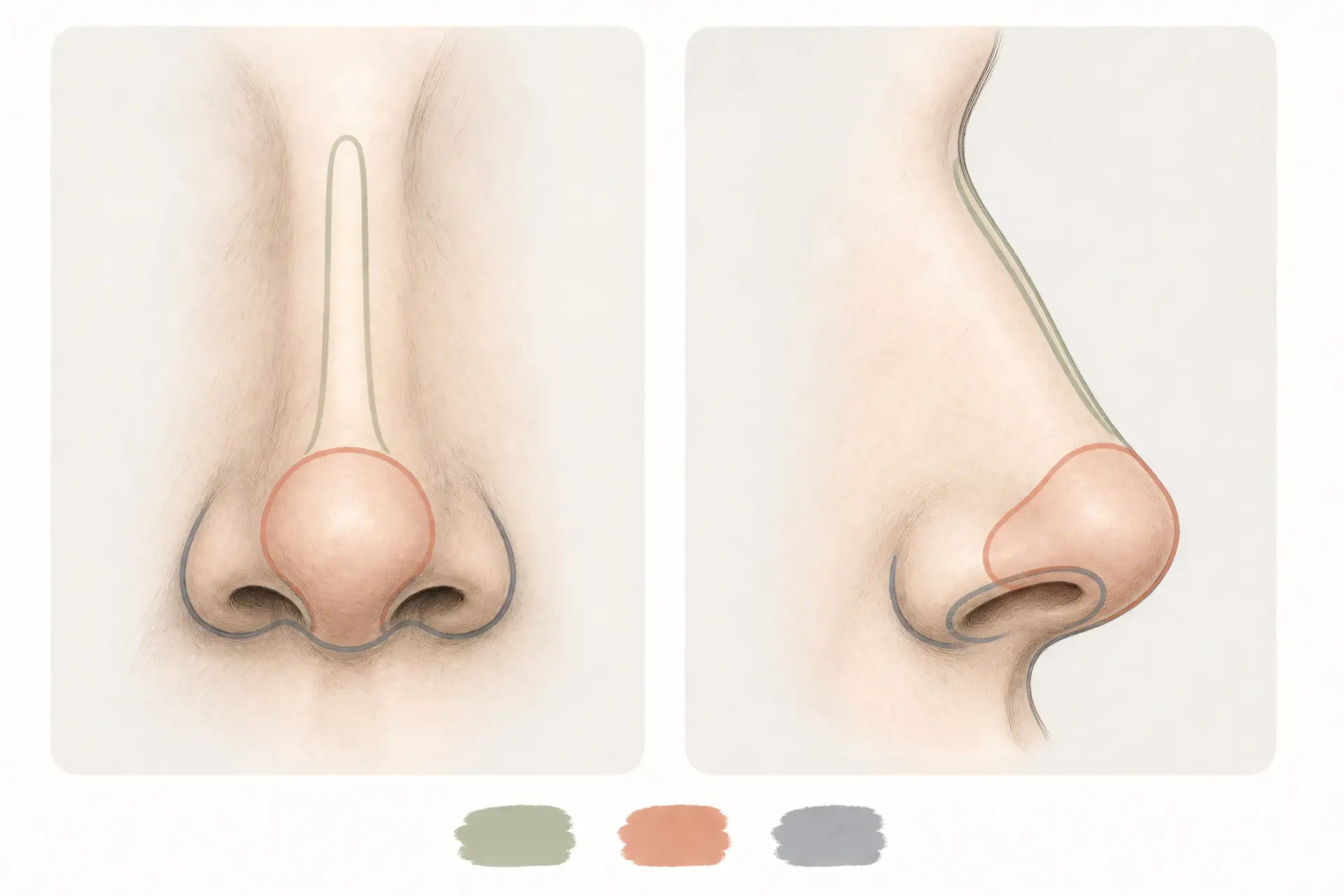
Your nose shape is the visible form created by three features, the bridge profile, the angle and definition of the tip, and the width of your nostrils and base. Below is a 3-step mirror method anyone can run at home, plus plain descriptions of the most common nose types so you can match yourself with some confidence. One expectation to set. This is a guide, not a diagnosis, and plenty of noses blend features from two types. The goal is your closest match.
The quick answer
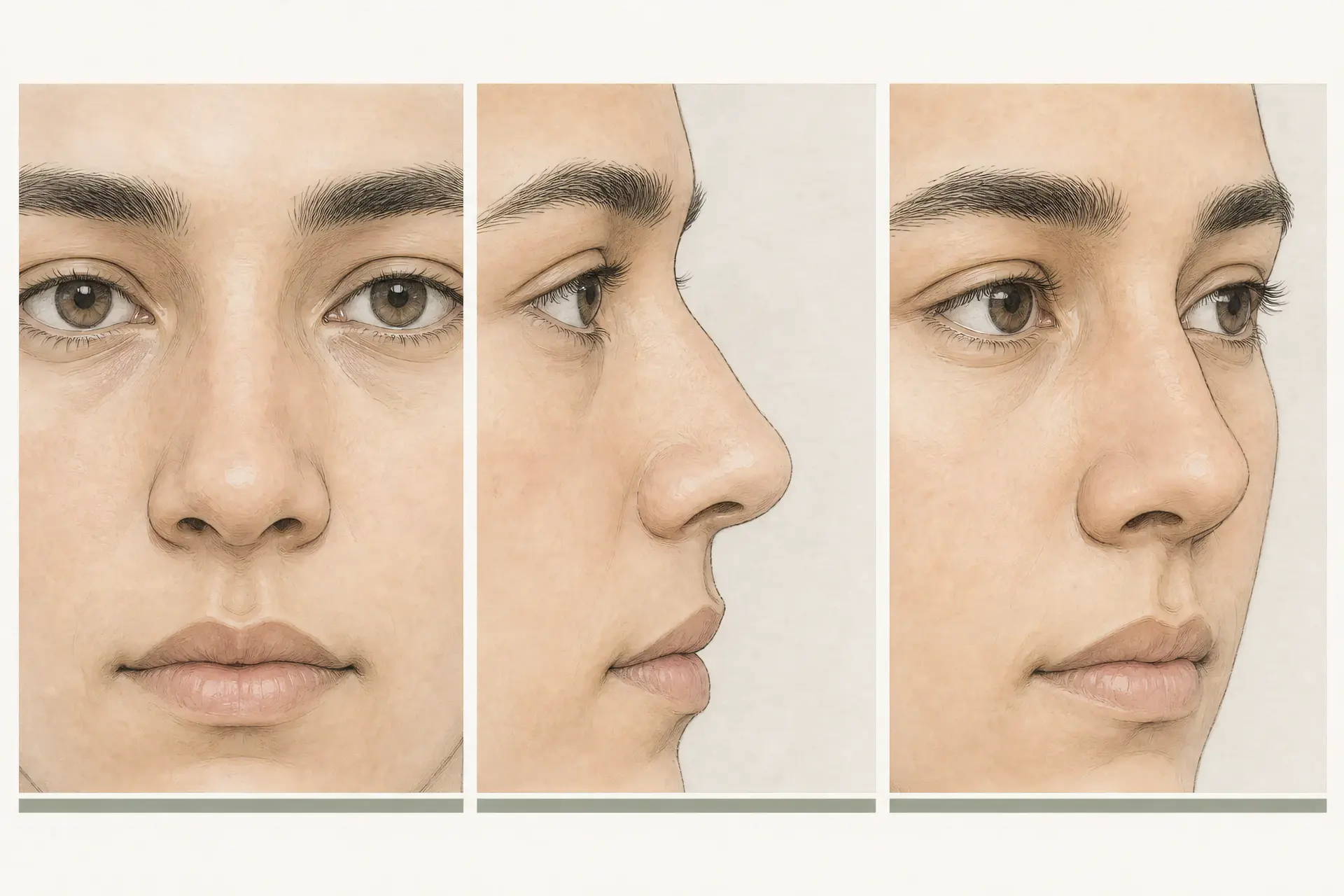
Check three things in a mirror. Bridge from the side: straight means Greek territory, an outward curve means the Roman/aquiline/hawk family, a dip or very low bridge means snub or flat. Tip: upturned means snub, celestial, or button; downturned means the hooked family. Base from the front: small and rounded means button, wider and longer means Nubian or flat, a full soft tip means bulbous or fleshy.
Want to skip the mirror? The free nose shape detector classifies your bridge, tip, and nostril proportions from one photo.
Before you start: how to observe your nose accurately
Bad lighting has mistyped more noses than bad genetics. Set up first, judge second.
- Even, diffused lighting. A window in daylight beats any bathroom downlight.
- Neutral expression. Smiling lifts the tip and widens the nostrils, which skews every observation below.
- Hair pulled back, face relaxed.
- Use a mirror and photos together: front, side profile, and a three-quarter angle. Photos freeze what the mirror keeps moving.
- Jot notes as you go. Straight or curved, up or down, narrow or wide. Three lines of notes are enough.
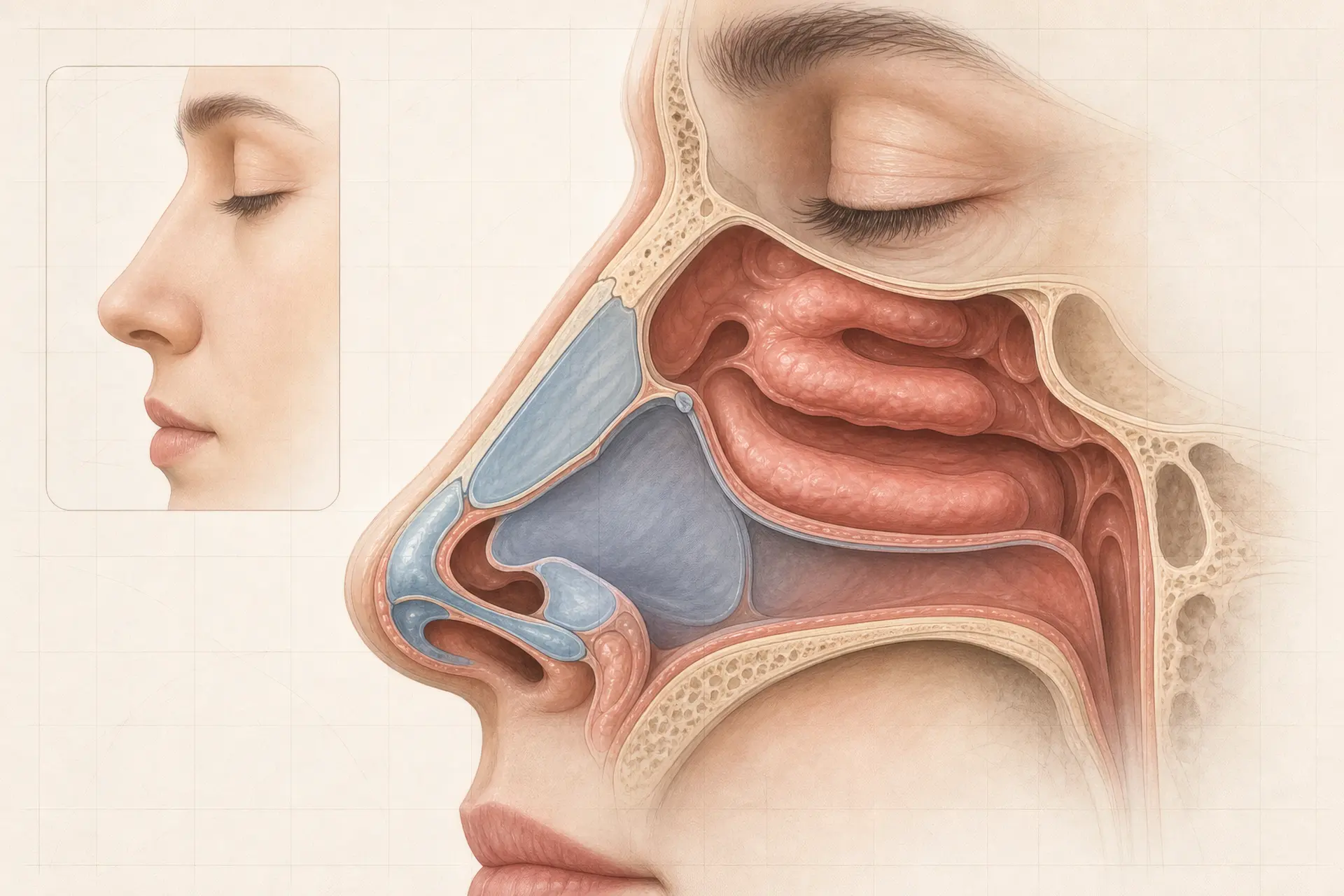
What you're looking at overall. The bridge (straight, outward-curved, or inward-dipped), the tip (rounded, pointed, or bulbous, and aiming up, level, or down), the nostrils and base (narrow or wide, and how much shows from the front), and the size of the whole thing relative to your face. New to the terms? The nose anatomy guide maps every landmark named here.
Step 1: analyze your bridge profile (side view)
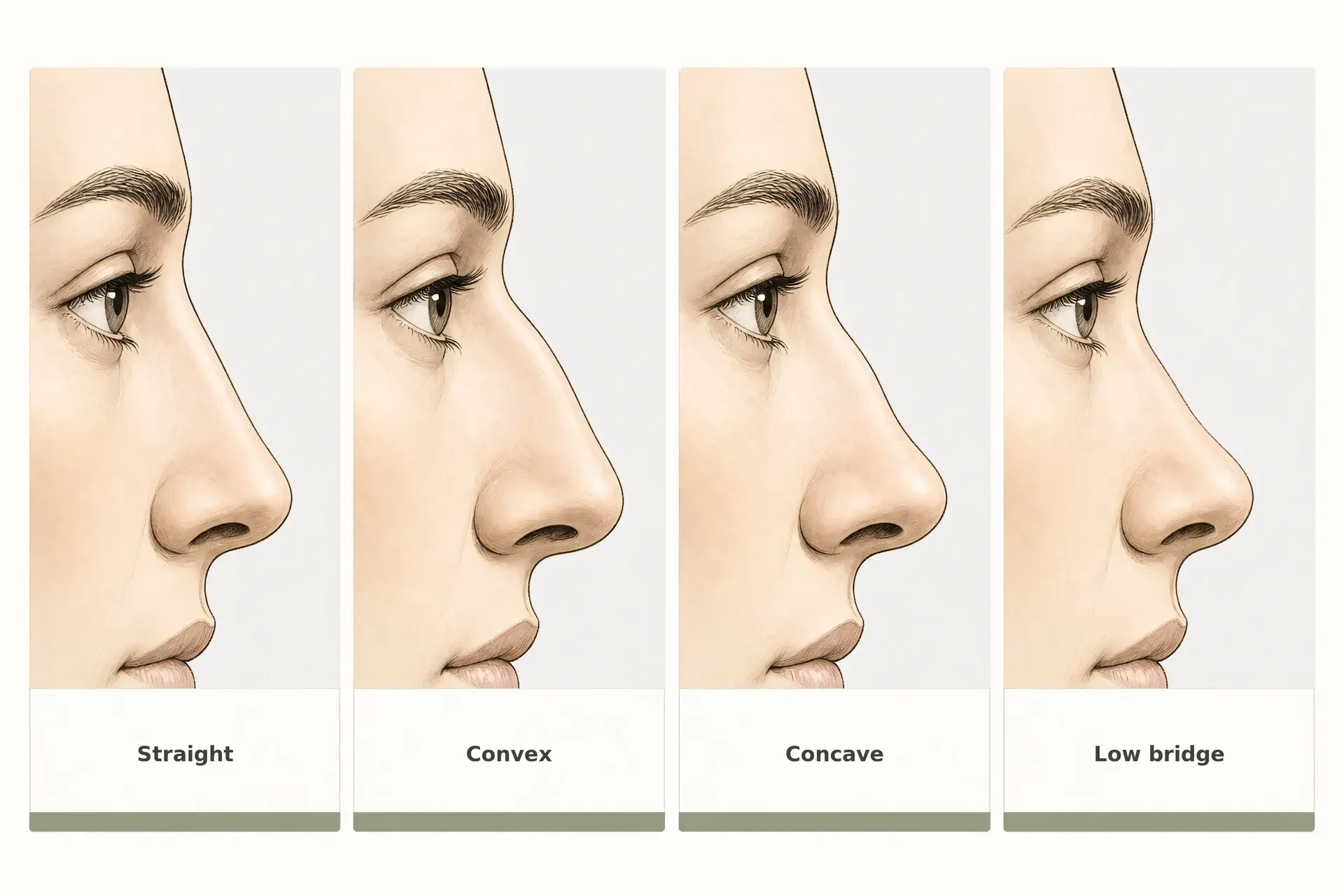
Turn sideways to the mirror or open a profile photo. Trace an imaginary line from between your eyebrows down to the tip and watch what the bridge does along the way.
- Straight bridge. A smooth line from root to tip with no hump or dip. Points to the Greek or straight family.
- Convex bridge. A visible bump or gentle outward arch. The Roman, aquiline, and hawk family lives here.
- Concave bridge. A slight inward dip, a scooped look. Shows up in snub and celestial profiles, and in saddle-type profiles, which belong to medical contexts.
- Low or flat bridge. Minimal projection, the bridge sits low and smooth against the face. Common in flat noses and some Nubian-type noses.
The fast version. A prominent hump with a strong profile puts you in the Roman, aquiline, and hawk family. A very smooth, even line puts you in the Greek and straight family. Everything else gets settled by the next two steps. For the full breakdown of each profile, see the guide to nose bridge types.
Why I insist on a profile photo.
A reader once sent me four front-facing selfies asking if she had a button nose. Every one of them said yes. Then one profile shot arrived, and there was a clean Roman hump hiding in plain sight. Front cameras flatten the bridge (worse in bad light, and passport-booth fluorescents are the worst I've tested). One honest side photo outweighs a stack of selfies.
Step 2: check your tip angle and definition (side and front)
The tip does more to define a nose type than any other single feature, so look from the side and the front.
Rotation first. Upturned, where the tip rotates up and the nostrils peek out from the front, points to snub, celestial, and some button noses. Level, pointing straight ahead, fits most Greek and Nubian types. Downturned, aiming toward the upper lip, belongs to Roman, aquiline, and hawk.
Then shape. A small, rounded, compact tip is button territory. Pointed or refined suits the straight and narrow types. Wide, soft, and less defined means bulbous or fleshy.
Three questions that settle most tips
- Does my tip look like a small, neat dome? Lean button.
- Does my tip clearly angle downward? Consider Roman, aquiline, or hawk.
- Do I see my nostrils easily from the front because the tip lifts? Snub or celestial.
Step 3: assess nostrils, base width, and overall proportions (front view)
Face the mirror straight on. Look at the nostrils first. Narrow or wide, round or flared, and how much of them shows at rest. Then the base. Does the nose look wide or narrow at the nostrils compared to the rest of your face? Finally, step back and judge length and overall size against your eyes, lips, and chin.
Small, neat nostrils on a compact nose lean button or snub. A wider base with a longer bridge leans Nubian or flat. Narrow, refined nostrils under a straight bridge lean Greek or narrow. If nostril size or flare is the deciding factor for you, the guide to nostril shape covers each variation.
Proportions can move the answer. A nose that reads average in isolation can look long on a small face or delicate on a broad one, so judge it in company, not alone. (This is where most mirror sessions go wrong, at least in my experience.)
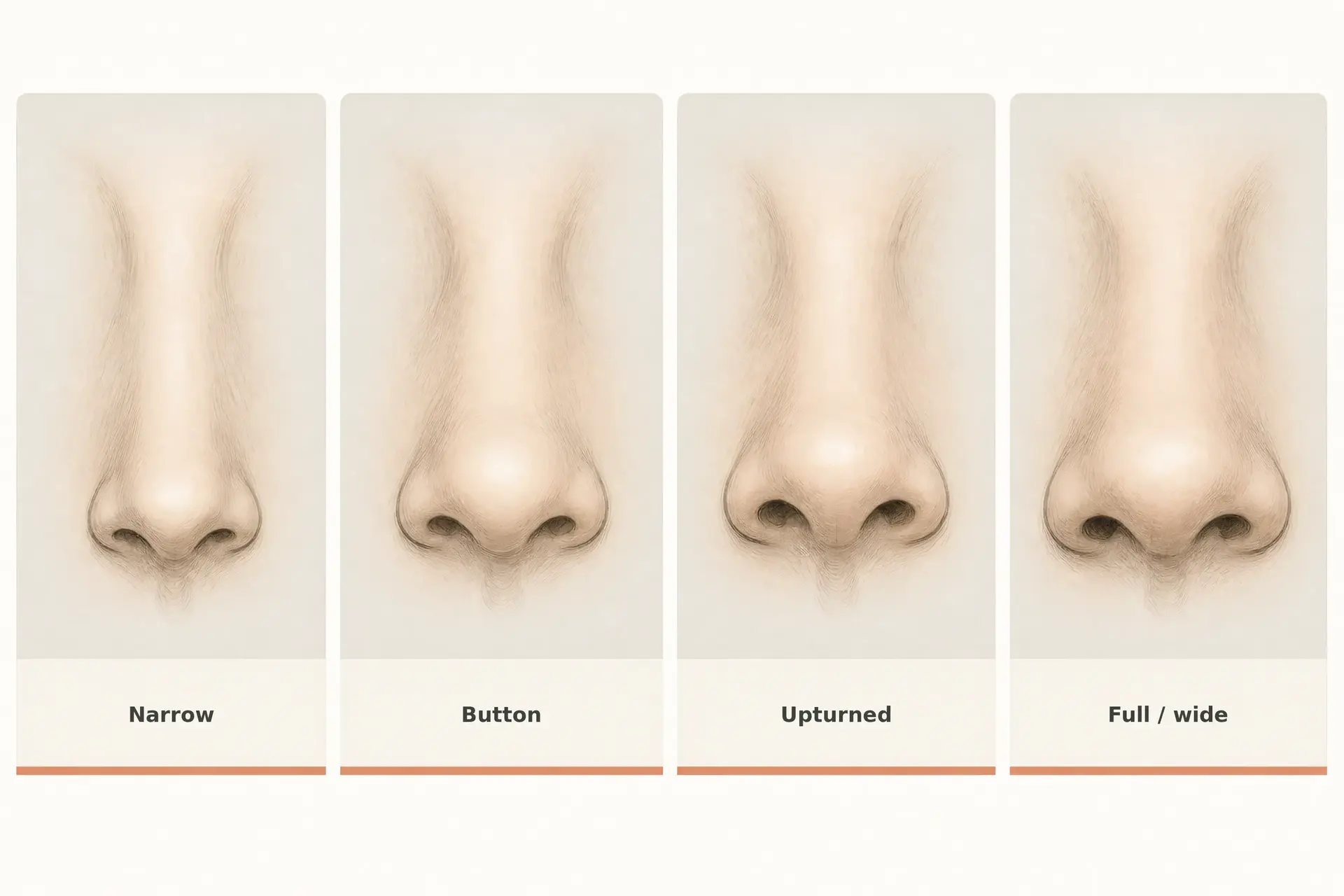
Match your features to common nose types
Take your three sets of notes and find the card where most of them land. A stray trait or two is normal. Majority rules.
Straight Nose (Greek Nose)
Smooth bridge, level tip, nothing dominates.
The bridge runs straight from root to tip with no hump or dip. The tip sits level or slightly refined, never strongly upturned or downturned. The overall profile is balanced and columnar, usually medium width.
Roman Nose, Aquiline Nose, and Hawk Nose
An outward-curving bridge with a downward-leaning tip.
The bridge is convex with a visible hump or arch, and the hawk version is the most pronounced of the three. Tips in this family tend to angle downward; the hawk tip is sharply hooked. Strong, defined profile, often medium to long.
Button Nose
Small rounded dome tip on a compact nose.
The bridge is low to moderate and smooth, with no strong hump. The tip is small, rounded, and neat. Everything reads compact and youthful, and the nostrils usually stay hidden from the front.
Snub Nose and Celestial Nose
A short nose with a tip that visibly lifts.
The bridge is short, sometimes slightly concave or very low. The tip is clearly upturned, so the nostrils show partly from the front. Celestial is the more dramatically upturned of the two.
Bulbous Nose and Fleshy Nose
A wide, soft tip that draws the eye first.
The bridge can be straight or slightly curved. The tip is rounded, wide, and soft, with less defined angles. The nose reads fuller overall, especially from the front.
Flat Nose and Nubian Nose
A low or long bridge with a wider base.
Flat means a low, smooth bridge with minimal projection. Nubian means a longer bridge at moderate height with a wider base. Tips run rounded to slightly broad, and nostrils may be wider. Nubian reads elegant and proportional; flat reads low-profile and smooth.
Narrow Nose
Everything is slim, bridge to nostrils.
The bridge and tip are both narrow, the nostrils refined. The profile is delicate and linear.
What if my nose doesn't fit one type perfectly?
Welcome to the majority. Plenty of people run a straight bridge into a slightly upturned tip, or a Roman hump into a rounded button-ish dome, and no chart was ever going to capture that cleanly.
Start from your dominant trait, which is usually the bridge or the tip, and use the closest category as a working guide for styling, glasses, and research. Keep in mind that lighting, camera angle, weight changes, and aging all shift how your nose reads from one photo to the next. I could be wrong here, but I suspect most people sit between two types their whole lives and never notice until they go looking.
Why knowing your nose type is useful
Glasses shopping gets easier when you know your bridge height and base width, since frame fit lives and dies on those two numbers. Our glasses frames guide covers the fit side. Contouring gets easier too, because softening a hump and defining a flat bridge are opposite moves (the nose contouring guide maps them by type). Hairstyles and parting can pull attention toward or away from the nose, depending on what you want.
And if a consultation is ever on the table, walking in with clear terms like "bridge hump," "upturned tip," or "wide base" changes the whole conversation. The point of all this is understanding and styling. Changing anything stays optional, and entirely yours.
Quick self-check summary
Run down the left column, mark what matches, then take the right column back to the type cards above.
| What you observed | It points toward |
|---|---|
| Bridge is straight | Greek Nose or Straight Nose |
| Bridge curves outward or has a hump | Roman Nose, Aquiline Nose, or Hawk Nose |
| Bridge dips inward or sits very low | Snub Nose, Celestial Nose, or Flat Nose |
| Tip is small and rounded | Button Nose |
| Tip is upturned, nostrils visible | Snub Nose or Celestial Nose |
| Tip is downturned or hooked | Roman Nose, Aquiline Nose, or Hawk Nose |
| Tip is wide and soft | Bulbous Nose or Fleshy Nose |
| Base is narrow and refined | Straight Nose or Narrow Nose |
| Base is wider and more visible | Nubian Nose, Flat Nose, or Bulbous Nose |
Next steps
Identifying your nose type comes down to three observations: bridge profile, tip angle and shape, nostril and base proportions. Re-run the steps once more in good light, read the full nose shape guide for the type-by-type detail, and put the answer to work the next time you buy glasses or sit down with a professional.