Direct answer
What if my nose doesn't fit one type perfectly?
Somewhere between the third and fourth nose chart, most people hit the same wall. The bridge matches one drawing, the tip matches a different one, and the base belongs to a third. Nothing is wrong with your face. The charts are the problem.
This page keeps it short. Why hybrid noses are the default, a quick way to split your own nose into features you can label, and the point where labels stop being useful at all. If you want the full identification walkthrough with photos and mirror steps, that lives in what type of nose do I have.

The quick answer
Completely normal. Most noses blend two or three types. Instead of hunting for one perfect label, pick your dominant features: bridge line, tip direction, and base width. Match each feature to its closest type, then use those type pages as your guides.
Want the features read for you? The free nose shape detector pulls bridge curve and tip angle from a single photo.
In this article(6 sections)
Why hybrid noses are the rule
Nose types were invented for conversation. They are descriptive labels for patterns that show up often enough to deserve a name, closer to hair types than to bone anatomy. Nobody sat down and drew clinical borders around them.
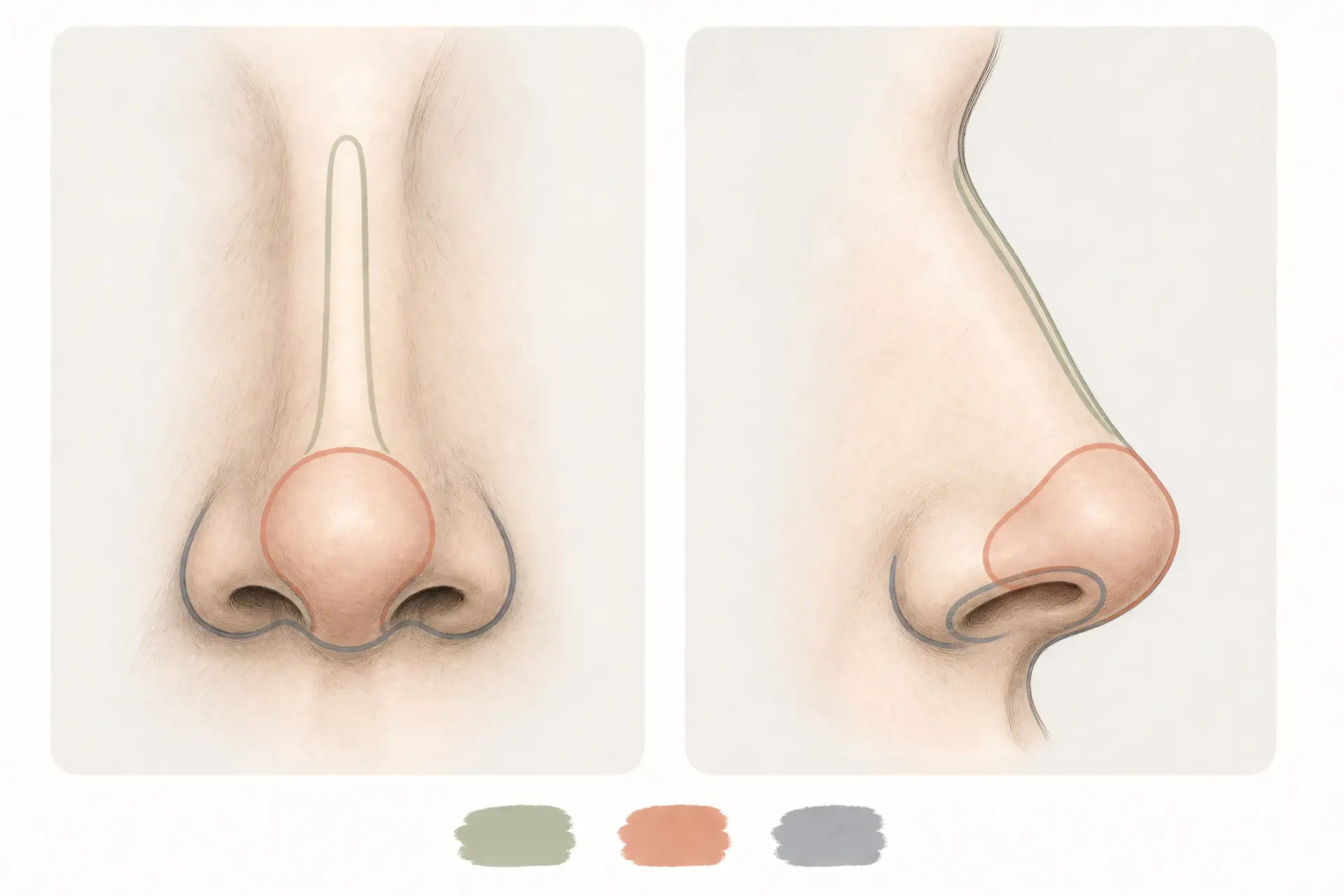
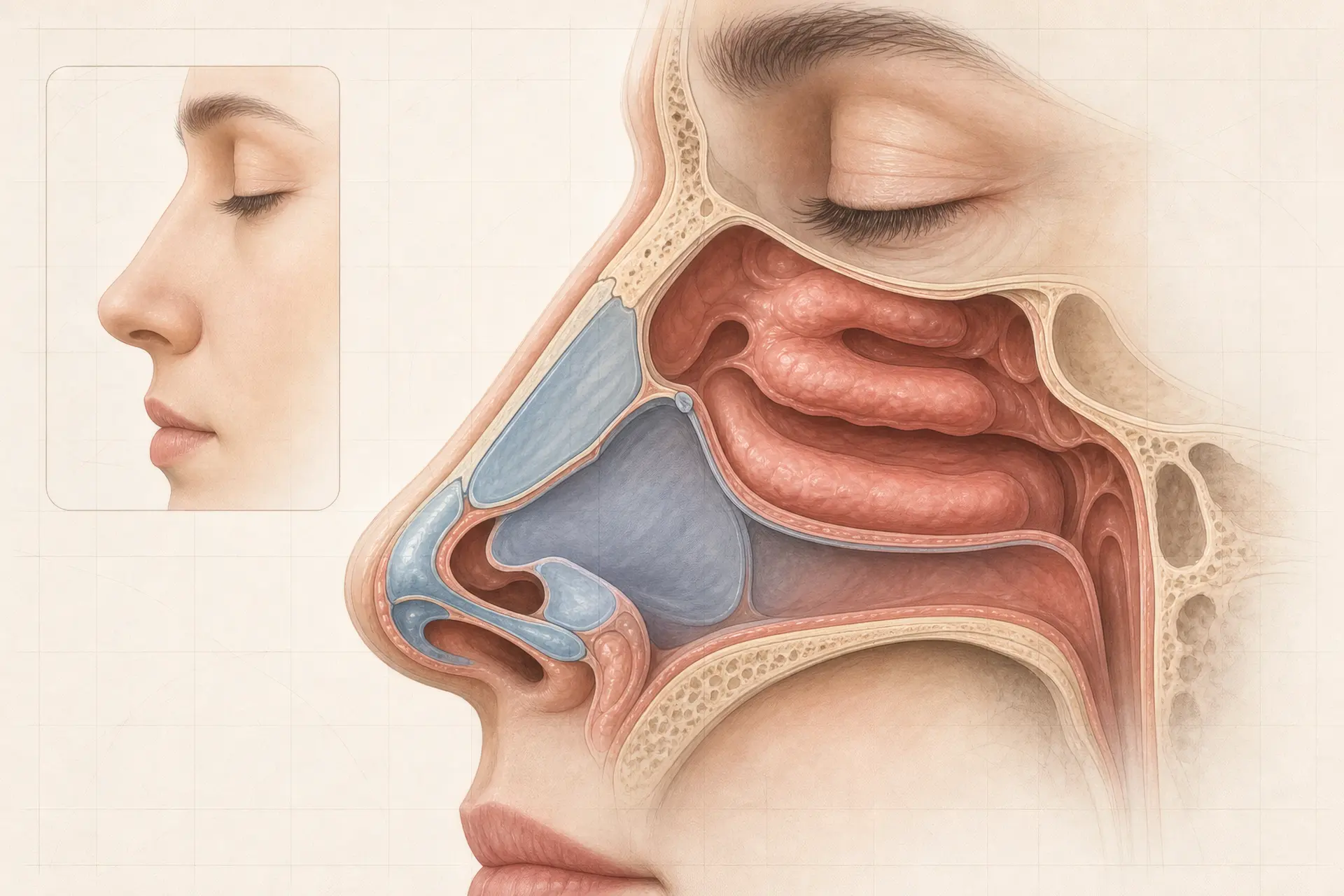
And here is why the labels strain. The bridge, the tip, and the base grow on independent tracks. Your dorsal line comes from the nasal bones and the septum underneath. Tip rotation lives in the lower lateral cartilage. Base width is set at the alar base, where the nostrils meet the cheeks. Three structures, three separate inheritances. So a straight bridge plus a wide base plus a bulbous tip is one person walking around, and it was never three types fighting for custody of the same face.
I could be wrong here, but the clean single-type noses on charts look common mostly because charts need clean drawings. Real faces are messier. A friend of mine spent a whole evening cycling through nine type quizzes and got three different answers, which is roughly what you would expect once you know the parts vary on their own.
How to classify a mixed nose in three passes
Give each feature its own label. Five minutes with a mirror or a phone camera covers all three.
Bridge line
Check it in profile.
Hold your head level and look at the dorsal line from the side. Straight, convex with a hump, or concave with a scoop. That one observation picks your bridge family, and the nose bridge types guide maps every variation of it.
Tip rotation
Profile again, same photo works.
Look at where the tip points relative to the alar base. Level, lifted, or pulled down toward the lip. Surgeons call this the nasolabial angle, and it decides whether you read the upturned or downturned pages.
Base width
Front view this time.
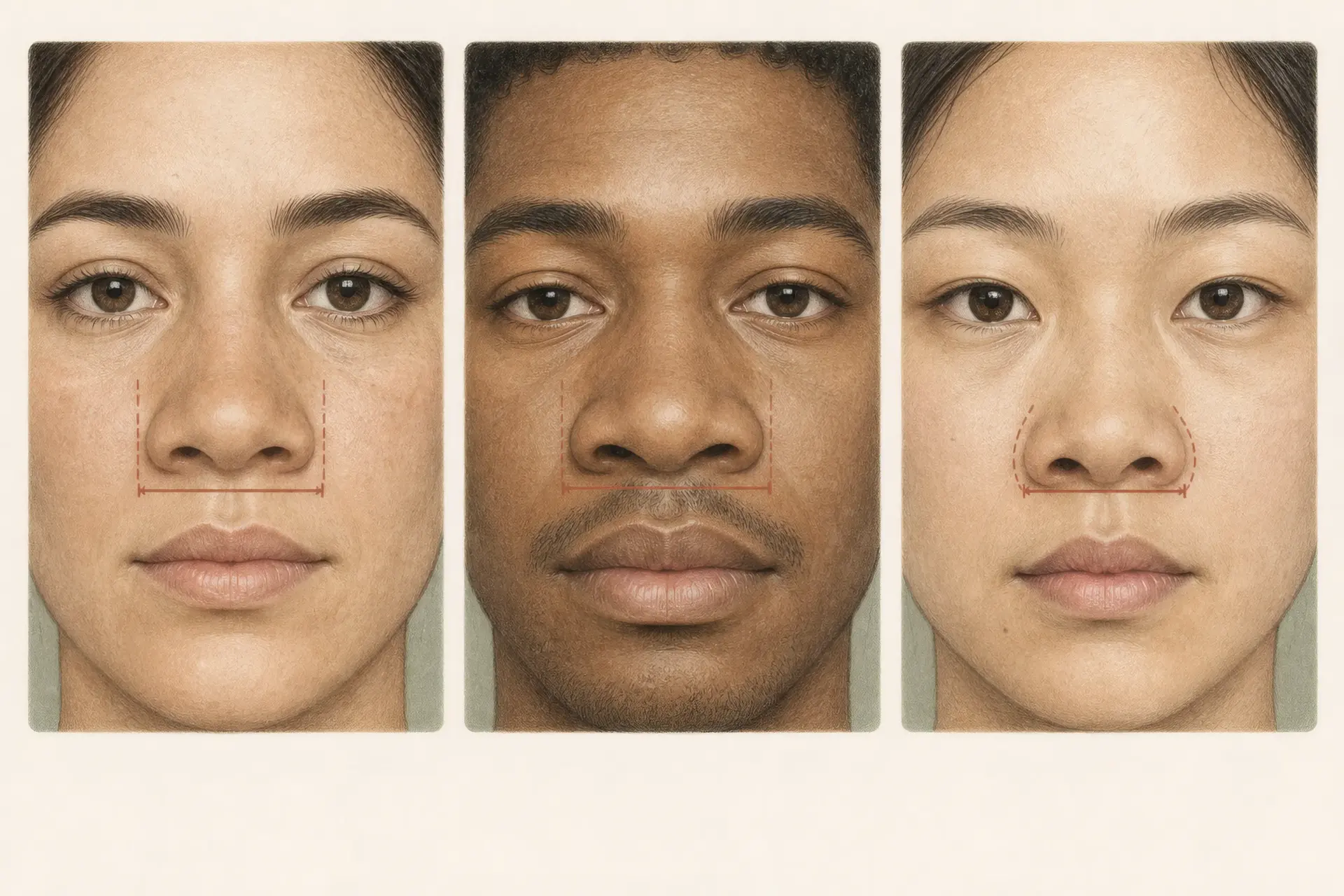
Face the mirror straight on and compare the alar base against the space between your eyes. Wider, narrower, or about even. Width is its own axis, and it owes nothing to whatever your bridge decided to do.
A worked example. Say your profile shows a flat dorsal line with no hump and no scoop. That is the straight nose family. Same photo, the tip pulls down toward the lip, which puts you on downturned nose turf. Front view, the base sits narrower than the space between your eyes. So you read the straight and downturned pages, skip the width pages, and you are done. No identity crisis required.
Which pages deserve your time? Let the feature that bothers you, or interests you, make the call. If glasses slide or contour never lands right, that feature points at the the page worth reading first. The nose bridge types guide covers every dorsal line, and nostril shape handles the base end of things. For the full ordered method, start to finish, use the step-by-step identification guide.
When labels stop helping
Labels are a decent filing system and a poor decision tool. The moment you need to do something with your nose, observable traits beat type names every single time.
- Glasses shopping. Opticians fit frames from bridge height and pad placement, and nobody behind the counter has ever asked whether a customer is a Roman or a Greek.
- Contouring. Highlight and shadow follow the actual lines on your face. A label tells you nothing about where the light falls on your specific dorsum.
- Talking to a surgeon. Consultations run on structural terms like dorsal hump, tip rotation, septum position, and internal nasal valve width. Type names never come up.
- One exception worth keeping: labels are handy as search terms. They get you to the right guide fast, then the guide does the real work.
My honest take: the label question matters for about ten minutes. Long enough to find the right guides. After that, bridge height, tip rotation, and base width carry every real conversation you will ever have about your nose.
Frequently asked questions
Can you have two nose types at once?
Yes, and most people do. Bridge, tip, and base vary independently, so features combine freely. A straight bridge with a bulbous tip and a wide base is one ordinary nose wearing three labels, and none of them cancels the others out.
What is the most common nose type combination?
Nobody keeps a census, so any page that names a winner is guessing. What shows up constantly in photos and in clinics is a straight or near-straight bridge paired with some mild tip variation, a slight droop or a small lift you can catch in profile. Beyond that, blends scatter in every direction.
Does a mixed nose mean something is off with my face?
No. Blends are the norm, and a nose that matches a single textbook drawing is the unusual case. Hybrid features say nothing about health or symmetry. They only mean your face inherited its parts from more than one branch of the family tree.
Next steps
Your nose is allowed to be a blend. Label the bridge, the tip, and the base on their own, then read the type pages that match each one. Ready for the full mirror method with every step in order? Head to what type of nose do I have, or browse the complete nose shape guide to see where each family sits.