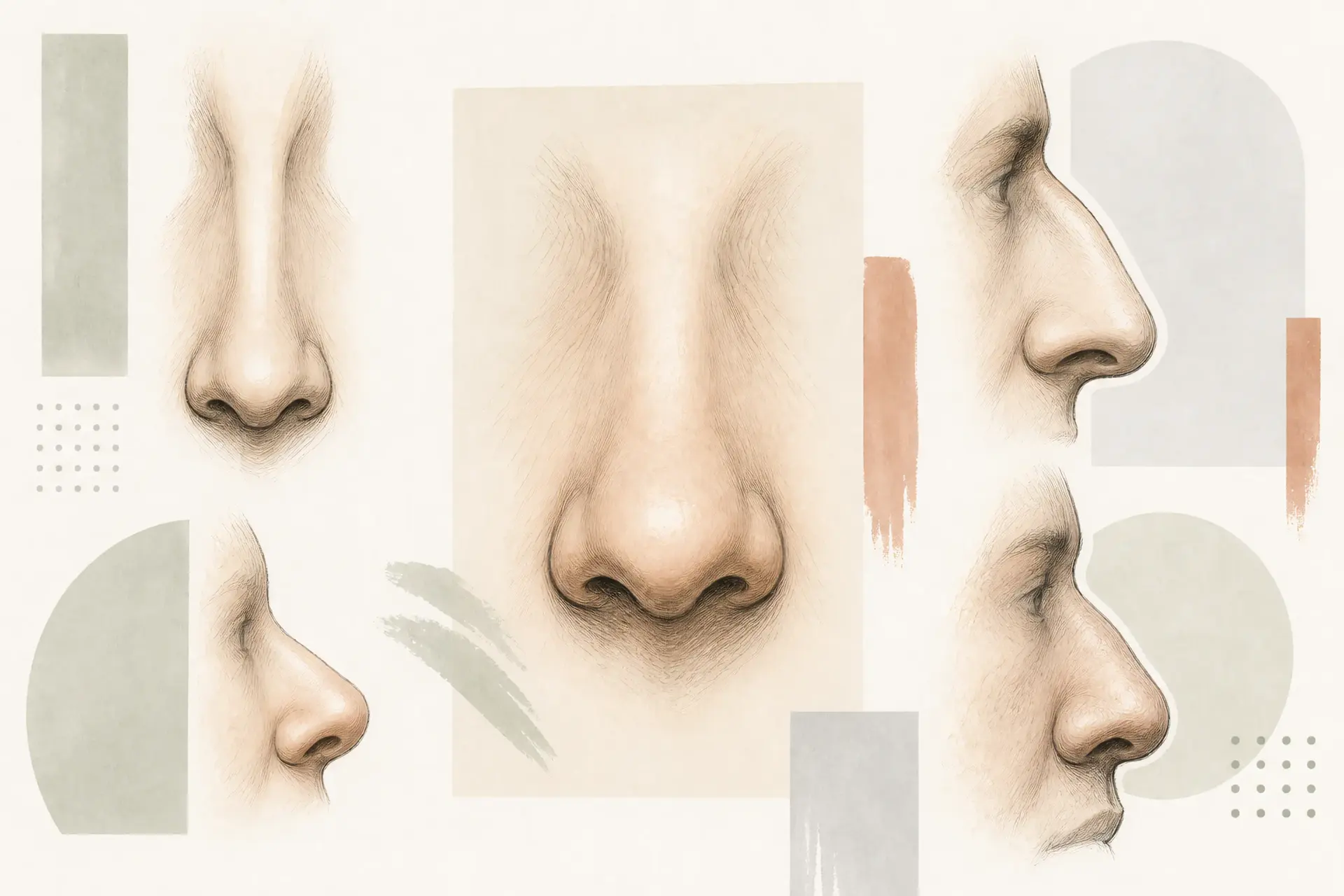
A front-view measurement guide
Wide Nose
Most people first hear the words wide nose at a glasses fitting or under a contour tutorial, and it usually lands as a front-view observation about how broad the base, nostrils, bridge, or lower third of the nose looks next to the rest of the face. That is the whole definition. Nothing about height, projection, or tip shape is implied, and a nose can be wide in one zone and slim in another.
This page sticks to the width dimension and its synonyms (wide nosed, broad nose, broad based, and the rest). Below you'll find how width gets measured, the four places it shows up, how it overlaps with flat, Nubian, button, and bulbous types, and what to do with the answer once you have it.
The quick answer
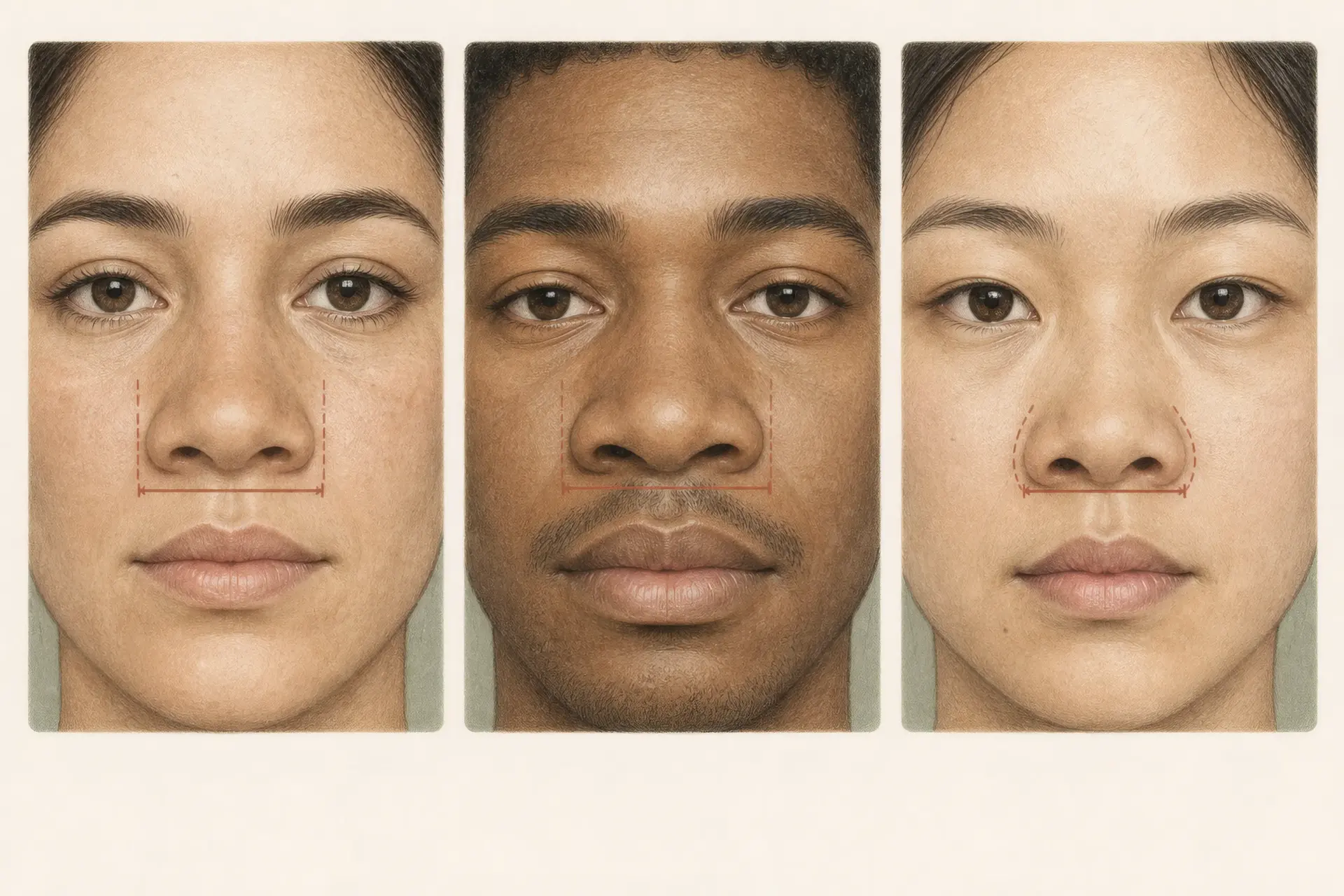
A nose counts as wide when the alar base width, the straight-line distance from the outer point of one nostril flare to the other, clearly exceeds the space between your inner eye corners. Drop two imaginary vertical lines down from those corners. If your nostril points sit well outside the lines, the nose reads wide from the front. Width can also come from a broad bridge, wide middle-third sidewalls, strong nostril flare, or a mix of all three zones, and each one counts on its own.
Want an objective read from a single photo? The free nose shape detector measures your bridge, tip, base, and nostril proportions for you.
How nose width is measured
The standard measurement is alar base width, the straight-line distance between the two outermost points of the nostril flares, ala to ala. Surgeons record it in millimeters. You can estimate it from a straight-on photo taken several feet away.
The classic proportion rule goes like this. In a balanced face, the alar base width lands close to the intercanthal distance, the space between the inner corners of the eyes. Drop two verticals from those corners and see whether the nostril points sit inside them, on them, or clearly outside. Inside reads narrow. On the lines reads average, and outside reads wide. The rule comes out of classical facial proportion studies, and it holds up well as a home check even though it was never meant as a verdict on any single face. Average base width also varies across populations, and the nose types by ethnicity guide covers that variation honestly.
Two different things get lumped together under "wide". Base width is the overall ala-to-ala distance, while alar flare is how far the nostril walls curve outward past the alar-facial groove. A nose can pair an average base width with strong flare and read wide from the front anyway. And the reverse happens too, a genuinely broad base under quiet, flat nostril walls. The nostril shape guide goes deeper on flare, nostril walls, and base proportions.
One warning before you measure anything. Your phone is the worst measurement tool you own, because wide-angle selfie lenses sit close to the face and stretch whatever is nearest. On a face, that is always the nose.
Why I measure from portraits instead of selfies.
A reader once sent me a selfie taken at arm's length on a 24mm-equivalent phone lens, and her nose looked dramatically wider than the same face in a portrait shot from eight feet back. So we measured. Alar base width against interpupillary distance, ruler on the portrait, and the supposedly wide nose landed well inside average band. Camera distance had done all the damage, and I've distrusted arm's-length evidence ever since.
Where width shows up: bridge, middle third, base, and flare
Width rarely shows up everywhere at once. These are the four zones worth checking separately, and plenty of noses run broad in one and slim in the rest (I have mistyped my own nose by skipping this step, so take the extra minute).
Bridge width
Broad dorsal lines from the front.
The dorsum is the top line of the nose, and from the front its two edges form what surgeons call the dorsal aesthetic lines. When those lines sit far apart, the bridge itself reads wide even when the base is narrow. Side lighting can push this further, because a broad dorsum catches shadow in a way a slim one never does.
Middle third
Wider sidewalls and alar facets.
The middle vault sits between bridge and tip. Wide sidewalls here make the whole central column look broad, and prominent alar facets pull the eye outward toward the nostrils. People skip this zone and jump straight to the nostrils. Worth a separate look.
Alar base
A broad distance between the outer nostril points.
This is the classic one. When the ala-to-ala distance runs well past the intercanthal lines, the lower nose dominates the front view. Base width is also the easiest number to compare across photos, at least for most people, since the nostril points are simple to mark.
Nostril flare
Outward curvature beyond the alar-facial groove.
Flare is about curve more than span. Nostrils that sweep outward past the groove where the nostril meets the cheek read wide in motion and in smiles, even on a nose with an average base. Smiling widens every nose a touch, so judge flare with a relaxed, neutral face.
Check each zone on its own before you combine them. A broad bridge over a narrow base needs a different styling plan than a slim bridge over a broad base, and lumping the zones together hides that. Write down one word per zone, wide, average, narrow, or mixed, and the pattern goes obvious fast.
Overlaps with flat, Nubian, button, and bulbous noses
Width keeps company with other traits, and that is where single labels start to wobble. Four overlaps account for most of the confusion.
Flat Nose
Low bridge, width coming from the base.
A flat nose is defined by low bridge height and reduced projection, but a low bridge often travels with a broad alar base. From the front, that base reads as width. Two different axes, one photo.
Nubian Nose
Width plus length.
A Nubian nose pairs a long bridge at moderate height with a broader base. It is the overlap people mean when they say wide and elegant in the same breath, since the extra length keeps the whole nose proportional.
Button Nose
Small tip, visible base.
The button label comes from the small, rounded tip, but that tip can still sit on a noticable lower base. When the base runs broad while the tip stays tiny, you end up with a hybrid description that one word will never cover.
Bulbous Nose
A wide, soft tip doing the work.
A bulbous tip is rounded and wide with softer definition, and it contributes to a wide appearance even when the alar base is average. The eye reads tip width as overall width. Fair or not.
This is why trait-based descriptions beat labels. "Broad alar base with an average bridge and mild flare" tells a stylist or a surgeon something workable, while "wide" alone tells them where to start asking questions. I could be wrong here, but I think most one-word answers collapse after ten seconds in front of a mirror. The full nose shape guide maps every type if you want the bigger picture.
Styling and consultation notes
Width information turns useful fast once you attach it to a decision. Frames and makeup come up constantly, and professional consults follow close behind. Our glasses frames guide covers fit by face shape, and the bridge-width logic transfers directly. For the makeup side, the nose contouring guide maps placement by nose type.
- Frames with a bridge width that matches your nose. Too narrow pinches, too wide slides, and temple tension does the rest of the fitting work.
- Adjustable nose pads earn their keep on a broad, lower bridge, since fixed saddle bridges tend to sit low and slowly creep down.
- Soft contour along the sides of the nose visually narrows it, and a thin highlight down the center refines the column. Blend more than you think you need to.
- In a consultation, the precise terms are alar base width, alar flare, dorsal width, and intercanthal distance. Saying “my nose looks wide from the front” starts the conversation, and those terms finish it.
One more note on terminology. Nasolabial angle, tip rotation, projection, and bridge line all belong to the profile conversation, while width belongs to the front view, and keeping those conversations separate saves you from contradicting yourself mid-consult. Bring a straight-on photo and a profile photo, and let each one answer its own question.
Wide nose FAQs
Three questions that surface in nearly every width discussion.
Is a wide nose the same as a flat nose?
No. Wide is width-led, describing how broad the base, bridge, or nostrils look from the front. Flat is bridge-led, describing low bridge height and reduced projection from the side. A flat nose can look wide because the two traits often travel together, but either one can show up alone. Judge width from the front and flatness from the profile, since each belongs to a different angle.
Can nostrils be wide even if the base is not?
Yes. Alar flare can make the nostrils look wide even when the ala-to-ala base width sits inside the average range. The outward curve of the nostril wall does the visual work, and flare tends to increase when you smile or speak. Check yourself with a neutral expression before drawing any conclusions.
Does camera distance affect how wide my nose looks?
Yes, and by a lot. A close-up phone lens exaggerates whatever sits nearest to it, and on a face that is the nose. Selfies taken at arm's length can add visible width that a portrait from several feet away will not show. For self-checks, use a photo taken from at least six feet back, or have someone else take it.
Next steps
So the working definition. A wide nose reads broad from the front, measured at the alar base and the flare of the nostrils, with the intercanthal distance as the proportion reference. If width isn't the whole story for your nose, the nearby guides cover a flat nose (low bridge), a Nubian nose (length plus width), a button nose (small rounded tip), and a pointy nose (tip sharpness at the other end of the width question). And if you haven't pinned down your type yet, start with what type of nose do I have.