Nose type deep dive
Downturned Nose
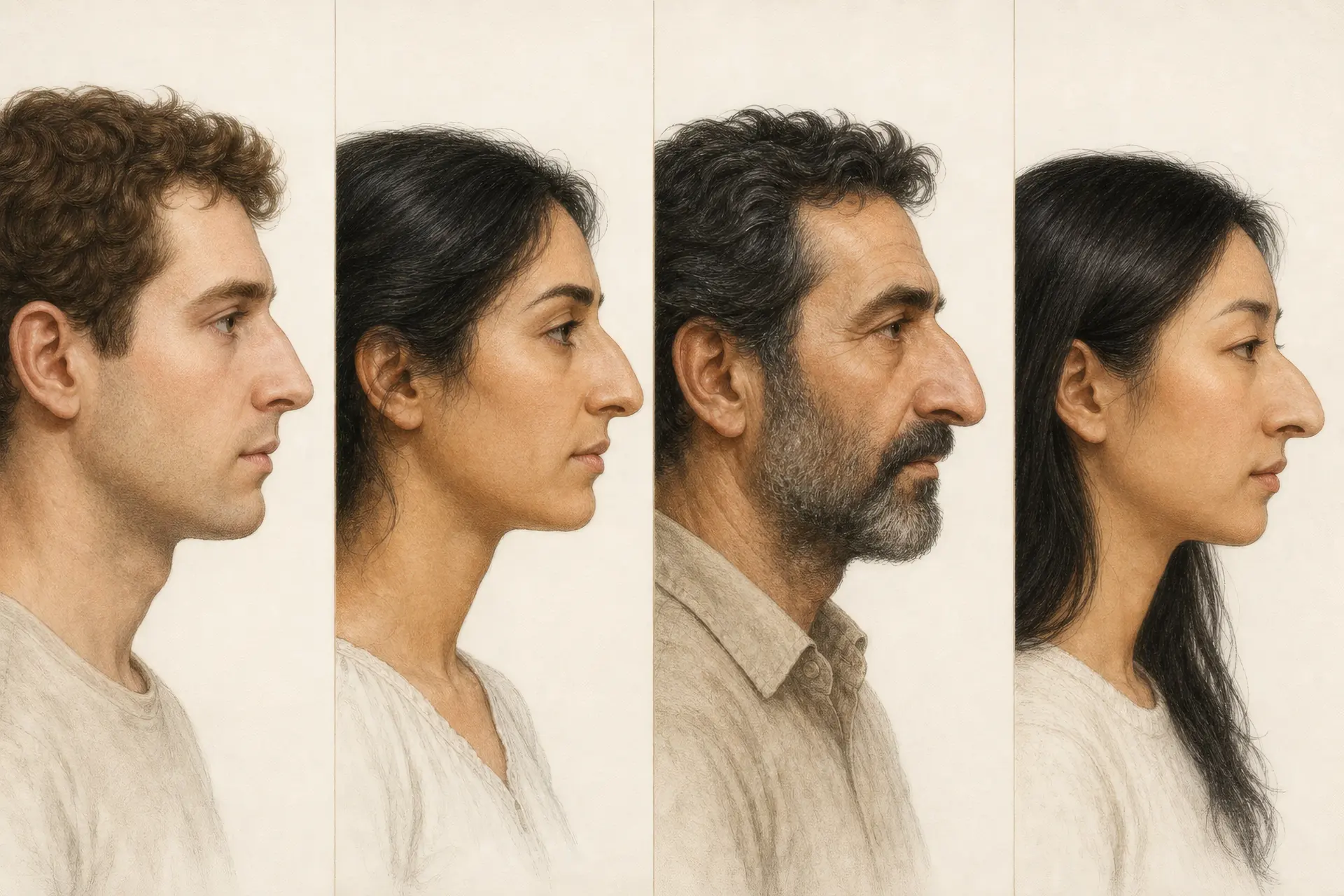
Plenty of people meet their downturned nose in a profile photo they never meant to take. The bridge looks straight. The proportions seem fine. And yet the tip leans toward the upper lip, and the whole side view reads heavier than expected.
That lean is the entire definition. A downturned nose is classified by tip direction alone; the bridge behind it can run straight or carry a hump and the label stays put. Hawk and Roman work differently, since both are bridge-plus-tip combinations, and confusing the dimensions is where most self-typing goes wrong. This page keeps them apart. You'll get the defining traits in plain language, a direct comparison against hawk and Roman, styling and consultation notes, and the questions people ask most.
The quick answer
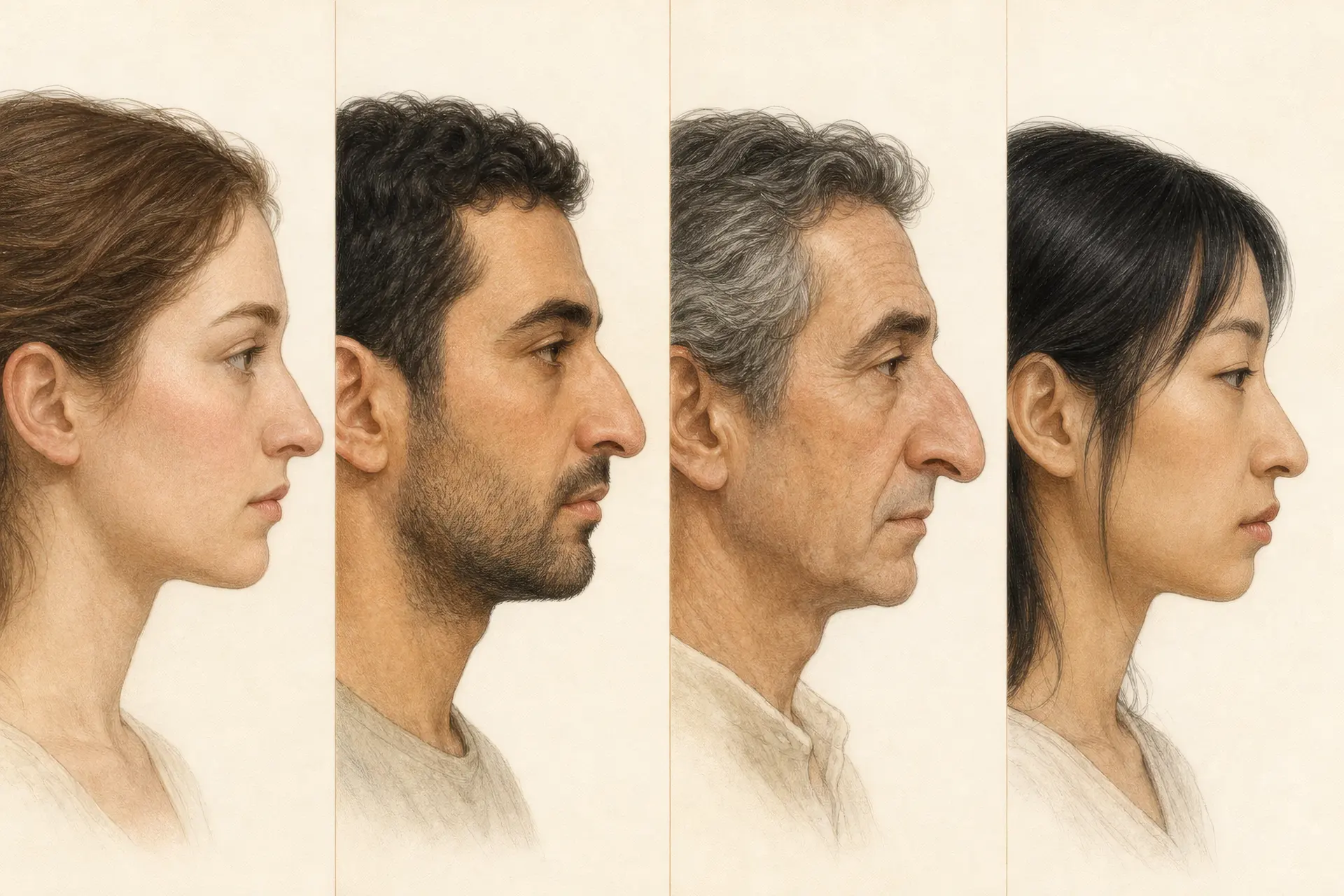
A downturned nose comes down to one observation, a tip that angles toward the upper lip in profile. Bridge shape stays out of it. A straight bridge with a drooping tip lands on this page. A hump plus a droop points to hawk, and a hump with a level tip points to Roman. Check a relaxed side photo first.
Want to skip the mirror? The free nose shape detector reads tip rotation and bridge curve from a single photo.
What defines a downturned nose tip
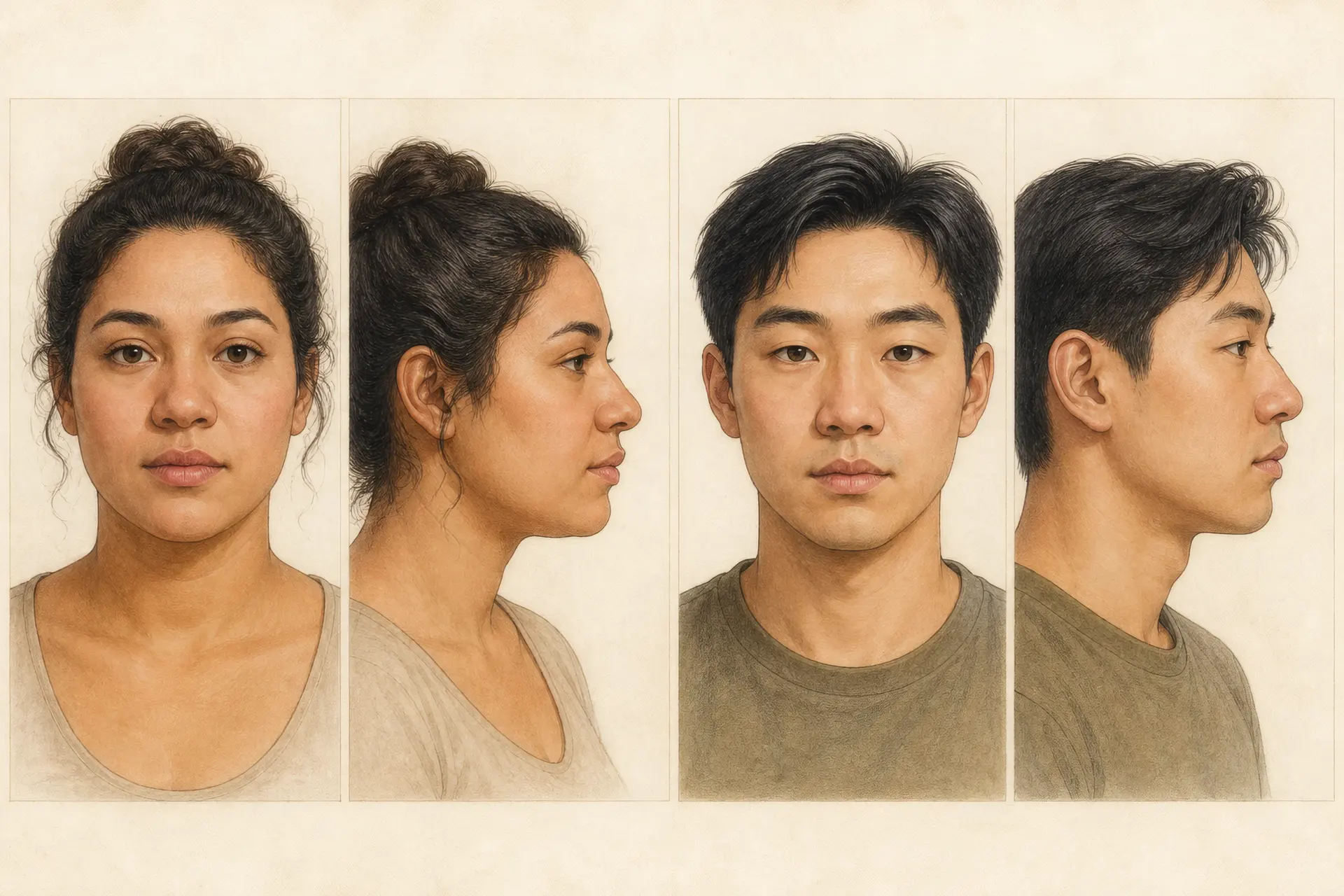
Surgeons call the trait tip rotation, and they measure it with the nasolabial angle, the corner where the columella meets the upper lip. When that angle closes below roughly ninety degrees in men or ninety-five in women, the tip reads downturned. You don't need a protractor. In a relaxed side photo, a downturned tip visibly aims at the lip instead of pointing straight ahead.
- Profile first. From the side the tip leans toward the upper lip, which gives the silhouette a drooping finish even when the rest of the nose is unremarkable.
- The bridge is free to vary. Humped versions qualify, and so do dead-straight ones.
- A concave or gently scooped bridge changes nothing about the label either. The constant is always the tip.
- In stronger cases the tip hangs low enough to partly hide the nostrils from the front. Worth knowing before you judge your nose from a single close-up selfie.
Two things intensify the droop in daily life. Smiling engages the depressor septi nasi muscle, which pulls tip downward in some people, so a nose that looks level at rest can turn downturned in every candid laugh. And aging plays a part. Tip support loosens over the decades, a slight downward drift is a common occurence, and plenty of level tips in their twenties read downturned by their fifties. Our guide on how to prevent the nose from getting bigger with age goes deeper on that drift. At least for most people, the front view stays unaffected unless the rotation is pronounced.
Front photos deserve a caveat. A close wide-angle selfie exaggerates any downward lean, because the lens sits below eye level and stretches the lower face. Step back and shoot with the rear camera at eye height. (Passport booths get this right more often than phones do.)
Everyday speech muddies the term, so a quick separation helps. "Hooked" implies a stronger curl and usually a hump behind it, and it lands as an insult more often than a description. Downturned is the neutral, observational version. It names what the tip does and nothing more, which is why the full nose shape guide treats it as a dimension of its own rather than a fixed type.
Downturned nose vs hawk nose vs Roman nose
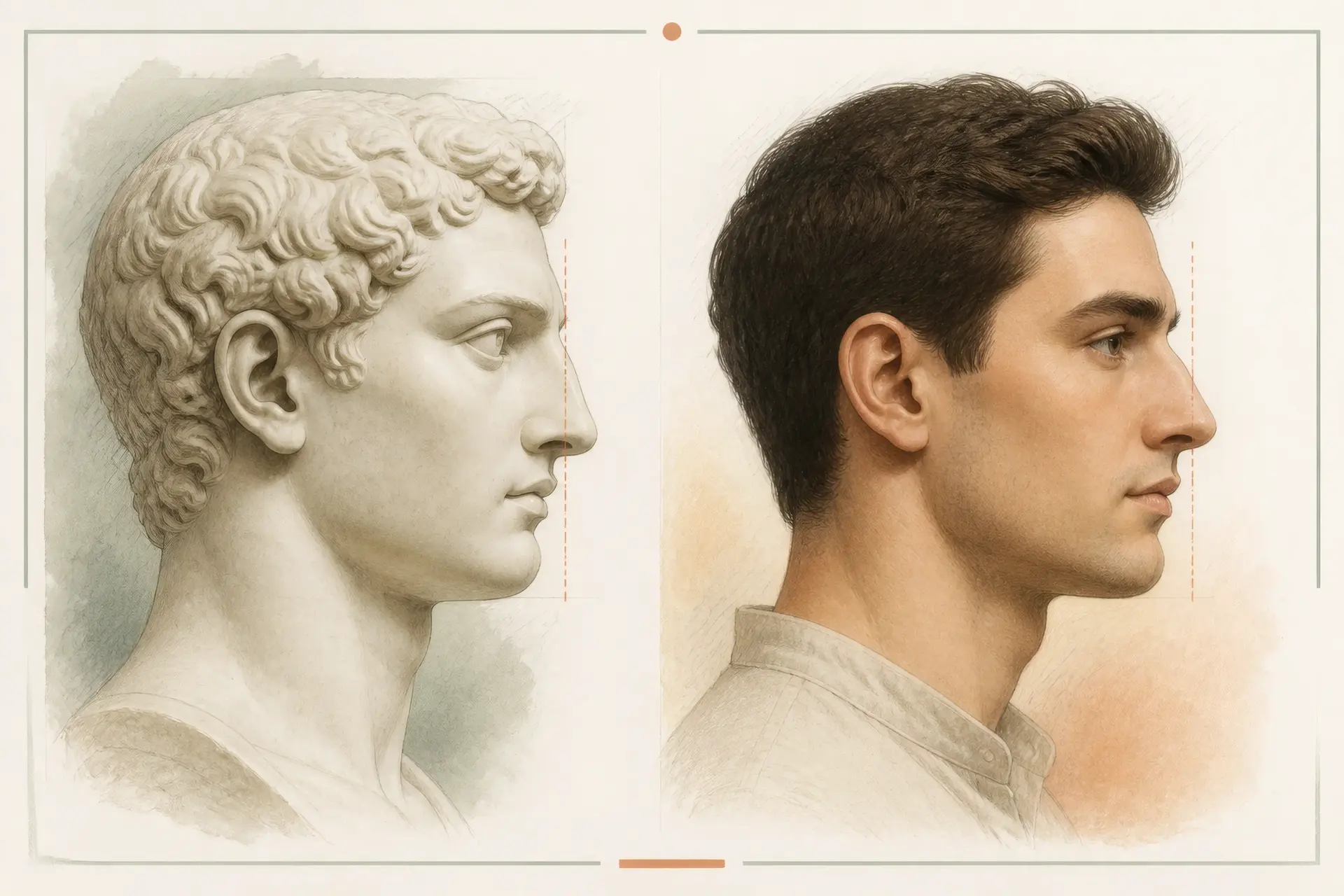
The cleanest way to keep these labels apart is to count dimensions. Downturned tracks one dimension, tip direction, and ignores the bridge entirely. Hawk and Roman each track two. A hawk nose pairs a convex bridge with a strongly downturned tip, so every hawk nose is technically downturned while most downturned noses never earn the hawk label. Roman pairs the same convex bridge with a level or forward-projecting tip, which removes it from this page's territory completely.
| Label | Bridge | Tip |
|---|---|---|
| Downturned Nose | Anything, straight to humped to scooped | Angled downward toward the lip |
| Hawk Nose | Convex with a visible hump | Strongly downturned, sometimes hooked |
| Roman Nose | Convex with a visible hump | Level or forward-projecting |
The field cues take ten seconds. Straight bridge with a drooping tip puts you on this page. Hump plus droop, that's hawk. Hump with a level tip, that's Roman. I could be wrong here, but I'd guess half the people who call their nose Roman belong in plain downturned territory, because the hump they remember is smaller than the droop they never measured. If the distinction matters for a consultation, the hawk nose and Roman nose pages go deeper on each combination, and the nose shapes chart plots where every family lands.
Keep one more thing in mind while you compare. Tip rotation is a spectrum, running from lifted through level to down, and the same nose can slide along it within a single afternoon. Smiling pulls some tips lower. So does gravity after fifty. A borderline case that looks level in the morning mirror can read downturned in an evening photo, and both readings are honest.
Styling and consultation notes
A downward tip changes how glasses read, where contour belongs, and which words earn respect in a surgeon's office. The practical notes, in no particular order.
- Frames. Balanced or top-heavy styles work best here. Avoid heavy lower rims, since they echo the droop and drag the whole face down with them.
- Adjustable nose pads matter more than frame shape. A frame that sits slightly higher on the bridge shortens the visual drop to the tip.
- Makeup, if you wear it. A touch of highlight under the tip, right along the columella, visually lifts the lowest point of the nose.
- Soft contour down both sides of the bridge balances proportions without going anywhere near the tip itself.
- Skip all of it if the profile suits you. Plenty of downturned tips look deliberate and elegant, and contour can't improve on that.
The sunglasses lesson from a humid August.
I spent one sticky afternoon in Porto watching a friend's cat-eye sunglasses slide down her nose every twenty minutes. She blamed the bridge. In my experience the heavier problem was visual, since those thick lower rims pointed every glance toward her downturned tip. She swapped to a thin metal pair the next morning and her vacation photos stopped looking like the glasses were melting off. Frame weight below the midpoint is the enemy with this shape. That's an opinion I can't fully prove, but a decade of beach photos backs it up.
The glasses frames guide covers fit by bridge height in detail, and the nose contouring guide maps tip-lifting placement step by step.
If a consultation is ever on the table, skip the label debate and speak in structure. Terms that land include "tip rotation" and "nasolabial angle." If the strip of tissue between the nostrils shows more than you'd like, the phrase is "columellar show." For the surgical side, the American Society of Plastic Surgeons' rhinoplasty overview explains what tip work involves. Whether any of it is worth pursuing stays entirely your call.
One last styling opinion, offered without much proof. A camera held a few degrees above eye level flatters a downturned tip more than any contour trick I've seen, because the droop compresses against the lip from that angle. Hair can help in the same direction. Volume at the crown or a side part pulls the eye upward, while heavy fringe and flat roots do the opposite. Small levers, but they add up in photos.
Frequently asked questions
Is a downturned nose the same as a hawk nose?
No. Hawk is a two-part label that pairs a convex, humped bridge with a strongly downturned tip. Downturned describes the tip alone, on any bridge shape. Every hawk nose carries a downturned tip, while plenty of downturned noses sit on straight bridges and never qualify as hawk.
Can a straight bridge have a downturned tip?
Yes, and it's the most common version of the shape. Downturned refers to tip direction only. A smooth, straight dorsum with a tip that angles toward the lip fits this page exactly, and nothing about the label requires a hump or a curve.
Does a downturned tip affect breathing?
The external angle of the tip doesn't determine airflow. Breathing depends on internal structures like the septum and the nasal valves, and a drooping tip can sit over perfectly clear airways. One exception worth mentioning is a severely ptotic tip, which can narrow the external valve in some people. If breathing bothers you, an ENT exam tells you more than any mirror will.
Next steps
So the working definition stays short. Downturned means the tip points down, whatever the bridge does behind it. For the combination labels, read about the hawk nose and the Roman nose. For the opposite rotation, the upturned nose covers tips that lift. And if you're still sorting out which one you have, start with what type of nose do I have and run the mirror method in good light.