Nose type deep dive
Straight Nose: Bridge-Line Morphology Across Heights, Widths, Lengths, and Tips
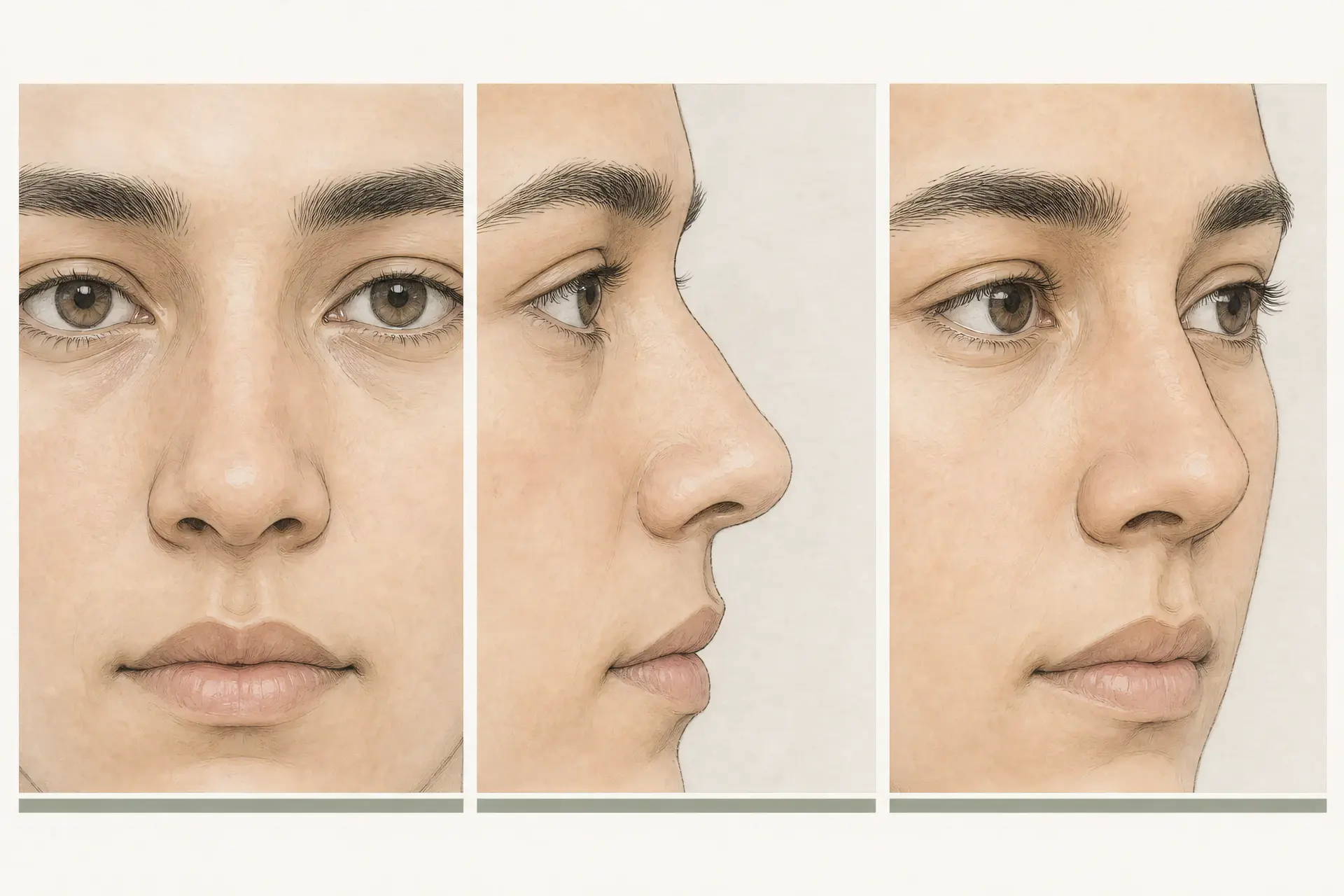
A straight nose is easy to spot from the side. Trace an imaginary line from between the brows down to the tip, and the bridge follows it almost without wavering. No hump pushing outward. No dip scooping inward. That even line is the whole definition, and everything else about the nose is free to vary.
That scope matters, because this page treats straight as a bridge-line description rather than a finished type. Height, width, length, and tip shape all move independently on top of a linear dorsum, so two straight noses can look nothing alike. The famous Greek nose is the named classical subtype, and it has its own page. Below, we cover what straightness means, how the other dimensions reshape it, how it compares to Greek and Roman profiles, styling notes, and the questions people ask most.

The quick answer
A straight nose has a bridge that follows one mostly even line from root to tip, with no outward hump (Roman and aquiline territory) and no inward dip (upturned and celestial territory). Straightness says nothing about size. Height, width, length, projection, and tip shape all vary freely, which is why straight noses range from Greek-refined to low and soft. Check a profile photo in daylight, and judge the bridge line before anything else.
For a faster check, the free nose shape detector reads your bridge line and tip angle from a single photo.
What defines a straight nose bridge
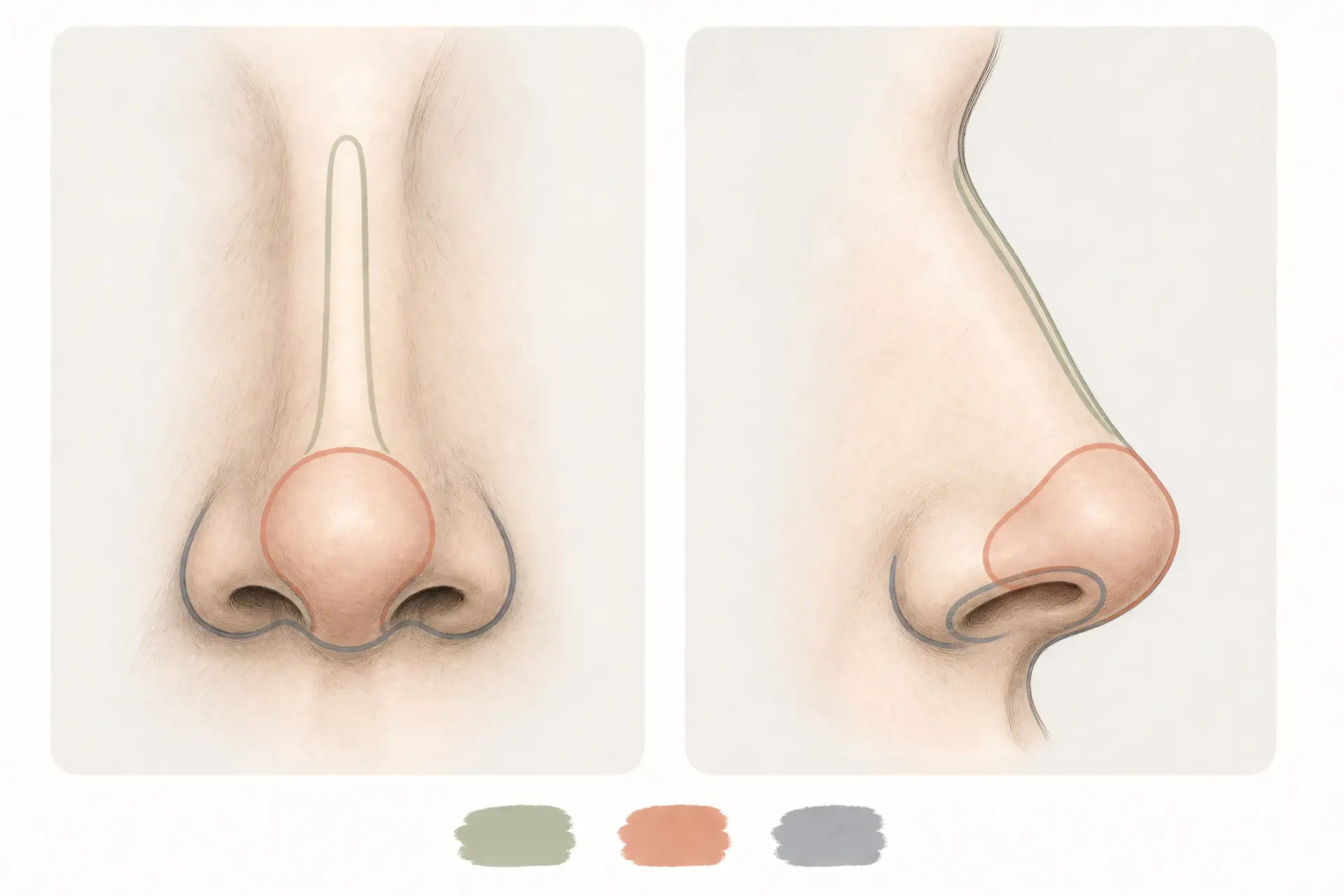
Straight describes one thing only. In side profile, the dorsal line from the radix (the root, up between the eyes) to the tip runs relatively linear, with no pronounced convex curve like a Roman nose and no concave scoop like an upturned or celestial one. Small irregularities still count as straight. Most real bridges have a millimeter of waviness somewhere, and nobody grades that with a ruler. The nose bridge types guide maps the straight line against its convex and concave neighbors.
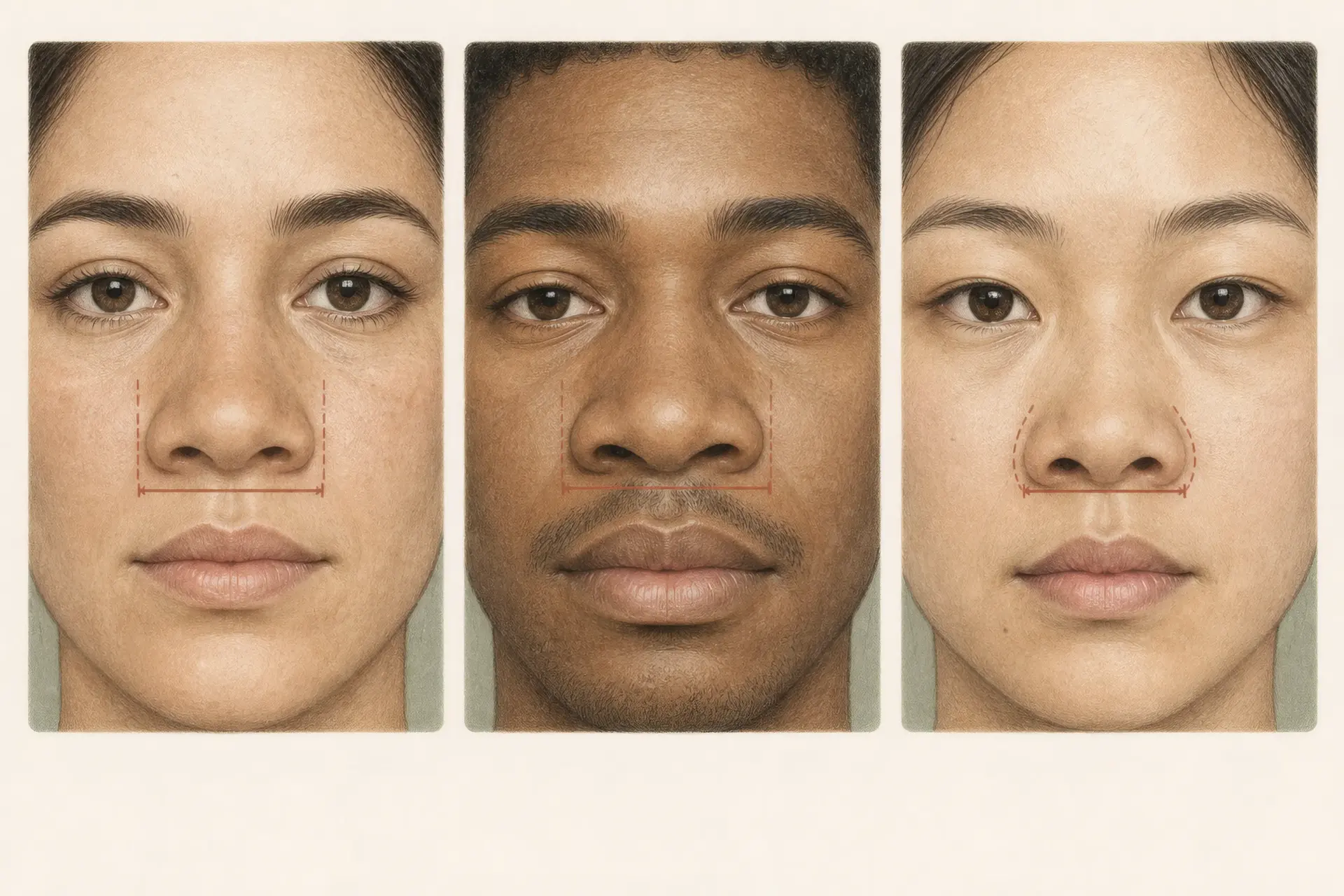
Where people get confused is mixing straightness up with every other measurement a nose has. Height is how prominently the upper nose stands away from the face, and a straight bridge can sit high or low. Width is the horizontal span of the bridge, the base, the nostrils, and it changes nothing about the profile line. Length is the root-to-tip distance, plain and simple. Projection is how far the whole nose reaches forward.
A nose can be straight and wide. Straight with a low bridge and a soft rounded tip. In my experience, most mislabeling happens because someone sees "straight" and assumes a full aesthetic package, when the word only ever promised one even line.
Straight nose shape across height, width, length, and tip
Once the bridge line is settled, the variation starts.
Height first. A high-bridged straight nose stands prominently off the face and gives the classic columnar profile, the Greek-adjacent look. A low-bridged straight nose keeps the same even line but sits closer to the face, drifting toward flat nose territory depending on projection.
Width moves independently. A narrow straight nose reads refined from the front, while a straight bridge over a broad base reads strong and grounded. Straightness survives either way, because width lives in the front view while the bridge line lives in profile.
- Long straight. The even line just keeps going, and the nose reads elegant or prominent depending on how far it projects.
- Short straight, compact. Sometimes the tip rounds off, and the whole nose drifts toward button or snub impressions even though the bridge never curved.
- Tip behavior varies wildly. Refined and level on one face, softly rounded or slightly upturned on the next.
Put two examples side by side. Straight plus narrow plus a refined tip is Greek-like, the subtype with its own classical label. Straight plus a low bridge plus a rounded tip leans toward flat or button descriptions instead. Same bridge-line family, completely different noses. I could be wrong here, but the tip seems to do more to change the impression of a straight nose than any other dimension.
Straight nose vs Greek nose, Roman nose, and aquiline nose
Three labels, three different jobs. One is a geometry observation, one is an aesthetic subset, and one pair belongs to the convex family next door.
Straight
Any linear dorsum qualifies.
The umbrella term. Tall or low, wide or narrow, refined or soft. If the bridge runs in one mostly even line from root to tip, the nose is straight, full stop. Every other measurement is a seperate conversation.
Greek
The classical subtype inside the umbrella.
A straight-profile nose with a relatively high bridge and a smooth transition at the root, where the forehead flows into the nose without a sharp break. Classical proportions come along for the ride. Greek is a subset, not a synonym.
Roman and aquiline
Convex profiles, outside the family.
Both carry bridges that bow outward with a visible hump or arch, and an outward curve disqualifies a nose from straight by definition. The hawk nose pushes the same curve further and adds a hooked tip.
So no, not every straight nose is Greek. Greek carries proportion requirements that plenty of straight noses never meet, too low, too wide, too soft at the tip, and that is fine. The label was never a ranking. The Greek nose page covers the sculpture references and the forehead-line detail in full, and the nose shapes chart plots all three families side by side.
Styling and consultation notes
Straight bridges are the easy tenants of the glasses world. Standard pads usually sit flat, since there is no hump to balance on and no deep scoop to bridge across. What matters is height. High straight bridges take most frames well. Low straight bridges do better with adjustable pads or a taller saddle, otherwise the frame slides.
Makeup, if you bother. The bridge rarely needs contour, because the line is already even, so effort goes to tip definition or to balancing the features next door, brows and lips. (One less product on the counter, at least for most people.)
For consultations, structural words beat type names. "Linear dorsum" says the bridge is even. "Dorsal irregularities" flags the small bumps worth smoothing. "Tip rotation" covers whether the tip points up, level, or down. Surgeons use this vocabulary daily, and the American Society of Plastic Surgeons' rhinoplasty overview is a decent primer before you ever sit in a chair.
The humidity test I did not plan.
Last August I helped a friend shop for sunglasses at an outdoor kiosk, the kind with a fogged mirror and no air conditioning. She has a low, perfectly straight bridge. Every plastic frame with molded pads slid down within a minute in the humidity, one pair twice during a single sentence. The metal frame with adjustable pads stayed put. And it stayed put all afternoon. Frame shape got all her attention that day; pad design did all the work.
Frequently asked questions
Is a straight nose automatically a Greek nose?
No. Straight describes the bridge line only, while Greek implies a specific package, a relatively high bridge, a smooth root transition, refined width, and classical proportions. A straight nose with a low bridge, a broad base, or a soft rounded tip is still straight, it just does not meet the the Greek subset's extra requirements. Think of Greek as one polished member of a much larger straight-bridge family.
Can a straight nose have a hump?
By definition, no. A visible hump means the dorsal line bows outward, and that makes the profile convex, which lands in Roman or aquiline territory. Tiny irregularities do not disqualify anyone, since almost every bridge carries a small wave or an uneven spot somewhere. The real test is whether the overall line still reads even from root to tip. If a bump is the first thing you notice in a profile photo, straight is the wrong drawer.
Do straight noses age differently?
The bridge line itself stays put, because bone and cartilage change slowly. What shifts is the wrapping. Skin thins, soft tissue loses volume, and the tip can droop a few degrees as support weakens, which alters how straight the profile appears even when the underlying line never moved. Sun exposure speeds this up, at least on the skin side. Most people keep their bridge-line category for life.
Next steps
Straight means one even bridge line from root to tip. Greek is a named subtype inside that family, and Roman and aquiline are convex profiles outside it. Keep reading with the Greek nose, the Roman nose, the flat nose for low-bridge neighbors, or the wide nose for the width dimension. Still sorting out your own profile? Run the five-minute method at what type of nose do I have.