Nose type deep dive
Big Noses: Overall Prominence, Camera Distortion, and Neutral Self-Description
Nobody holds a ruler to their face before deciding they have a big nose. The verdict arrives whole, delivered by a group photo or a changing-room mirror with bad downlights. Some people say large. Others say prominent, which at least sounds neutral. Every version points at the same impression, a nose that carries more visual weight than the features sitting around it, and the impression owes far more to proportion than to any single measurement.
This page stays in neutral territory. Large nose, prominent nose, whichever label you arrived with, we treat it as an appearance description worth getting accurate, and nothing here promises reshaping. Ahead is a working explanation of how proportion builds the impression, plus why your phone camera exaggerates it and which styling levers soften it. FAQs close things out.
The quick answer
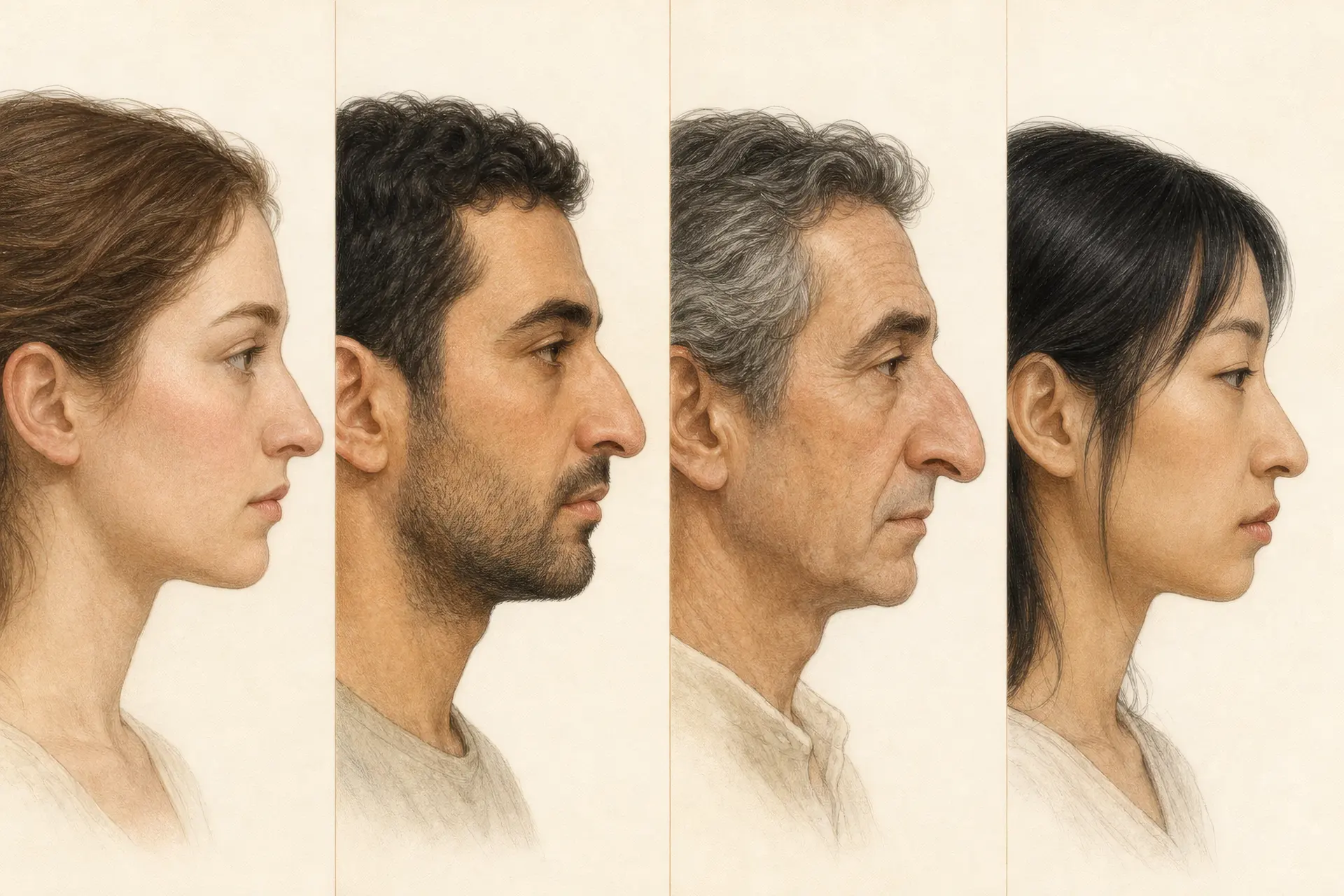
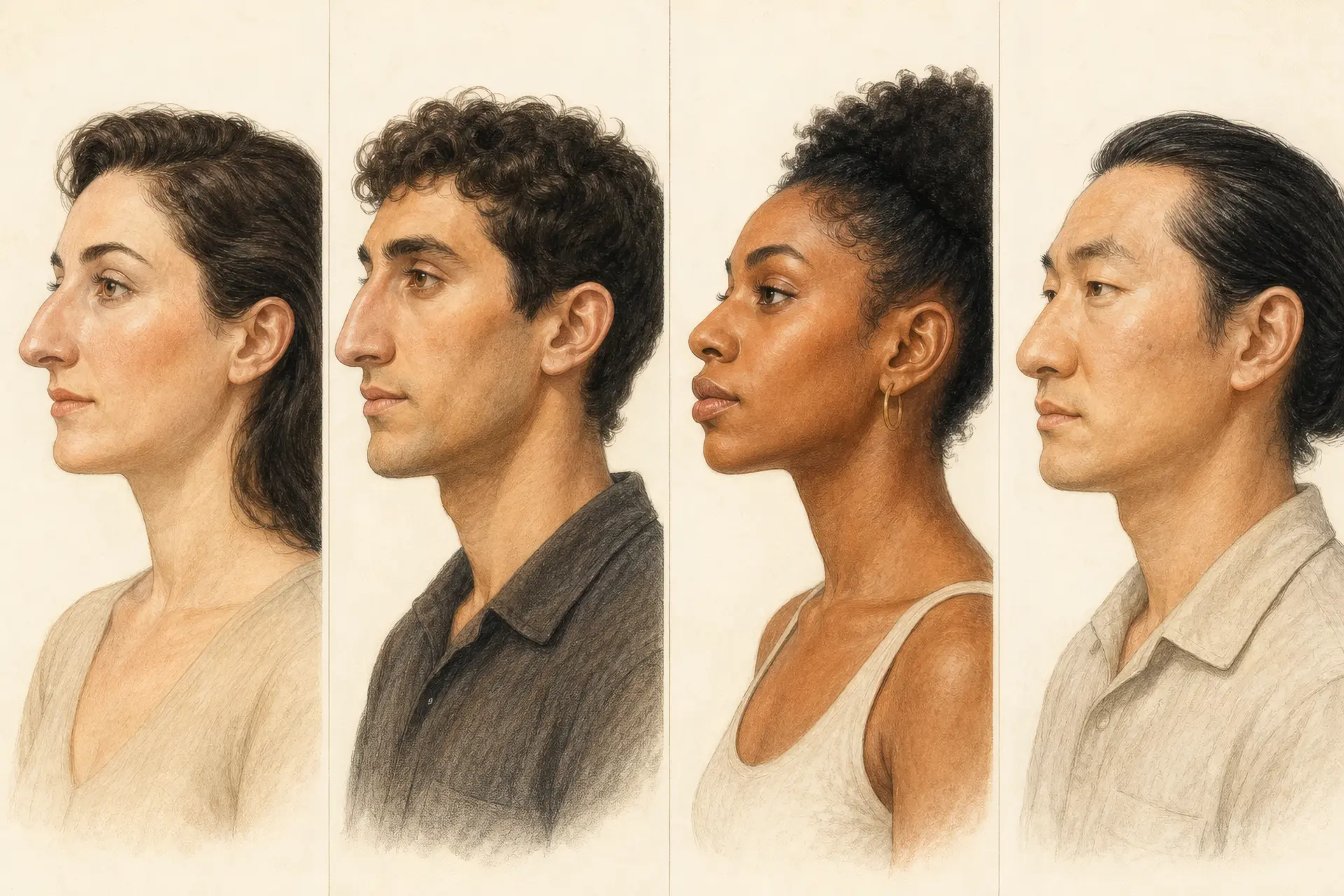
A big nose is an overall prominence impression, and no single dimension owns it. A base wider than the space between your inner eye corners can create it. So can generous projection from the face, or a bridge that dominates the profile. Often two combine. If your worry started with a selfie, read the camera section below before judging anything.
This page is for anyone who wants neutral language and practical styling options, not a pitch for surgery. Want objective numbers first? The free nose shape detector reads your proportions from one standard-distance photo.
What is considered a big nose?
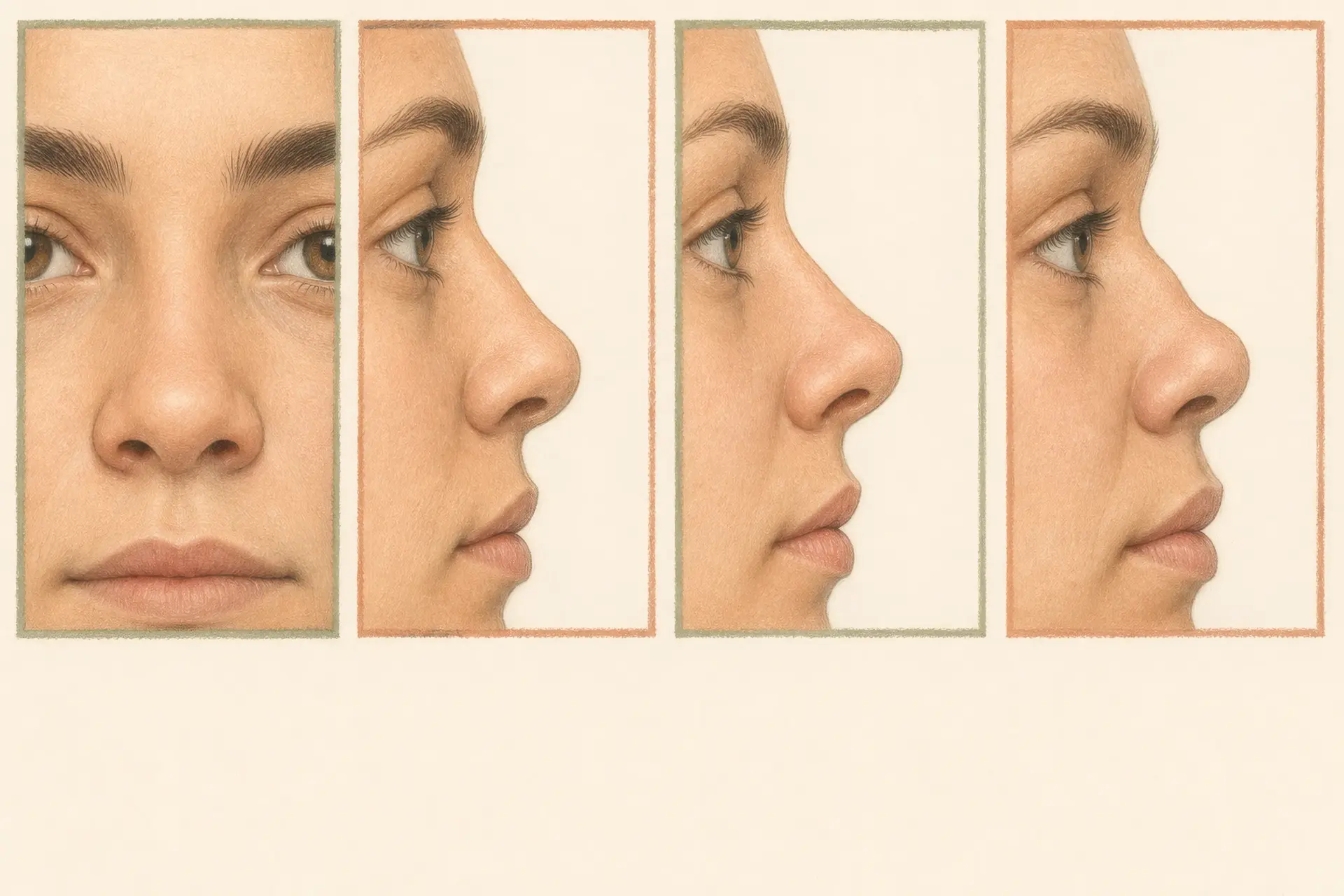
Proportion does the judging. One classic rule from portrait art says the width of the nose at the nostrils should roughly match the distance between the inner corners of the eyes. Projection gets measured against the forehead and chin, because a nose that juts further than its neighbors reads prominent even at perfectly average width. Surgeons lean on similar ratios when they assess profiles (the American Society of Plastic Surgeons explains the balance idea in plain terms).
So a nose earns the label when something runs above average. A base that spills past the intercanthal line. A long drop from brow to tip. Generous projection, or a dorsal line with real presence, the kind the Roman nose carries. Any one of these can tip the whole face toward big.
And context matters more than most people expect. The same nose reads moderate on a long face and heavy on a small one. Time shifts the baseline too, and our guide on how to prevent the nose from getting bigger with age covers that drift. Width-led cases belong to the wide nose page, while the opposite impression lives on the small nose page. The full nose shape guide maps where overall prominence sits among the other dimensions. This page handles the global impression itself.
Why a nose looks bigger in close-up photos
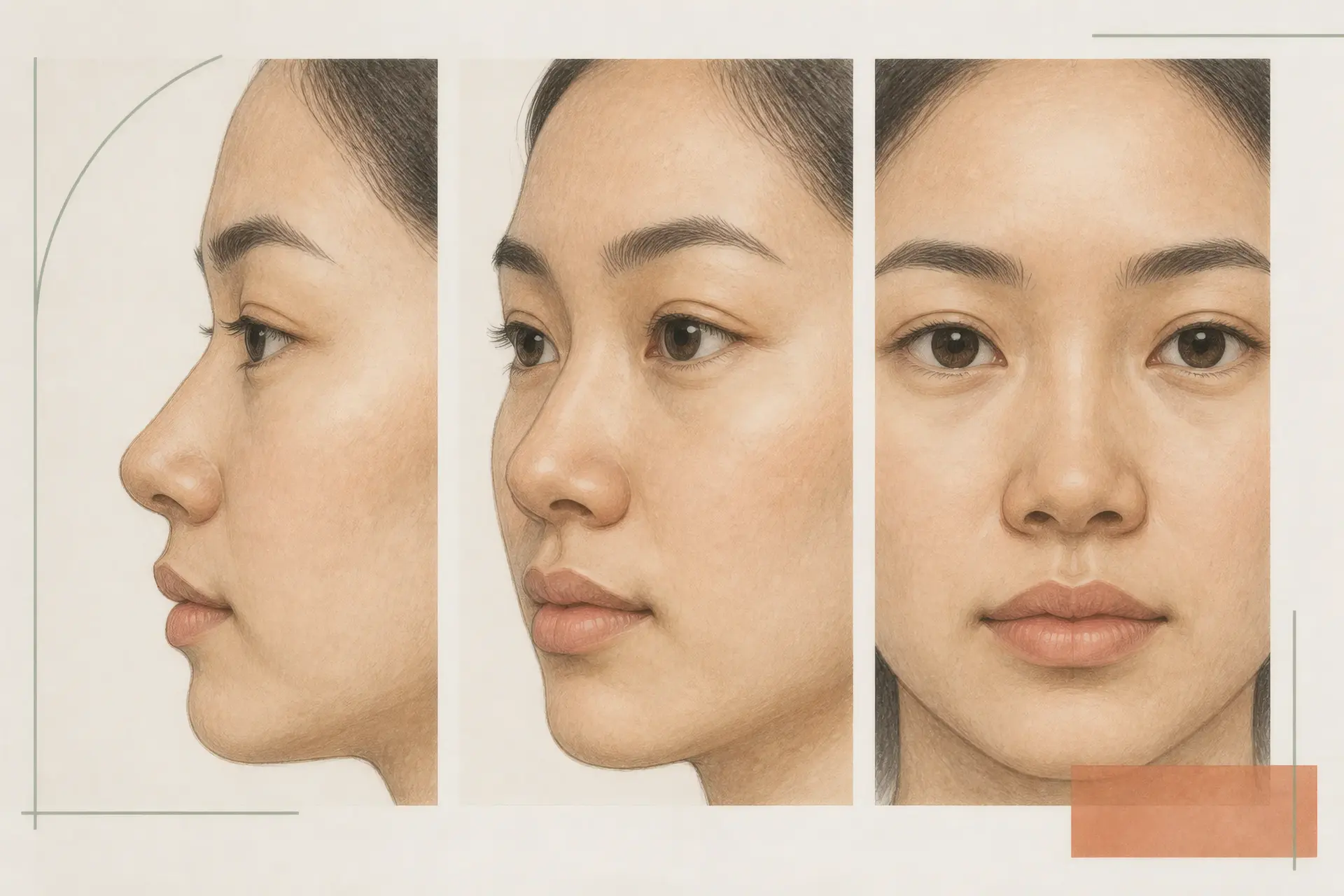
Your front camera is a wide-angle lens parked about thirty centimeters from your nose. At that distance the nose sits proportionally far closer to the lens than your ears do, so perspective stretches it. One often-cited estimate puts arm's-length selfies at making the nose look near thirty percent wider than a portrait shot from a meter and a half. I could be wrong here, but I suspect half of all big-nose worry is a lens artifact.
Fair assessment needs distance. Hand the phone to someone standing five or six feet away, or prop it up and use the timer. Take a front view and a profile at minimum, because a nose that looks huge head-on can read average from the side. Lighting plays along too. Overhead light deepens the shadow beneath the nose and adds visual weight, while soft frontal light flattens everything (passport booths are the worst offenders). A common occurence in bathroom mirrors, that shadow trick.
Big noses, large noses, and prominent noses: neutral language
Start with language. Swap the loaded word for observable parts. Prominent bridge. Wider base. Longer length. Phrases like these describe without judging, and they hand a stylist or an optician something actionable. At least for most people, naming the part shrinks the problem down to a size you can work with.
- Frames with a strong brow line. A bolder top edge pulls attention upward and balances a prominent bridge, and the temples should sit proportional to the face rather than dainty.
- Skip the extreme close-up.
- Makeup, if you wear it: a soft contour down both sides of the bridge visually narrows, while a light highlight along the center refines. Two products, ninety seconds.
- Hair with some volume at the crown or the sides balances a strong profile. A severe pulled-back style puts the nose on stage alone.
- Brow emphasis. Groomed, slightly fuller brows frame the upper face and share the attention a prominent nose usually takes by itself.
My mild opinion, offered without much evidence, is that most prominent noses look best when nothing tries to hide them, only balance them. Contour and frames are levers for balance, nothing more.
The humidity lesson.
Last August I helped a friend pick frames in New Orleans, and every thin wire pair slid down her prominent bridge within minutes of stepping into the swamp air. She swapped into a thicker acetate brow line, and the things stayed put through an entire afternoon of walking. In my experience, weight distribution matters more on a prominent nose than any style rule printed in a magazine.
Frequently asked questions
Is a big nose the same as a wide nose?
Not necessarily. Wide describes one dimension, the breadth at the nostrils relative to the rest of the face. Big is the overall impression, and it can come from projection, length, or a strong bridge on an average-width nose. Plenty of narrow noses read big in profile, and plenty of wide noses read modest in person.
Do camera angles make my nose look bigger?
Yes, dramatically. Distance is the main lever, because the closer the lens sits, the larger the nose appears relative to your eyes and ears. Wide-angle front cameras are the usual culprit. Shooting from five or six feet back, at eye level, with soft light gives the fairest read of your actual proportions.
Can I make my nose look smaller without surgery?
You can reduce perceived prominence, which is usually the real goal. Frame choice, brow emphasis, and hair volume change what the eye compares the nose against, and contour along the sides narrows the bridge visually. Photo habits matter too, since most people meet your nose through pictures. None of this touches structure. Attention is the thing being styled.
What should I say instead of 'big nose'?
Describe the feature instead of passing a verdict. 'Prominent bridge,' 'wider base,' or 'strong profile' all carry information without the loaded label. Neutral words also travel better, because an optician or stylist can act on them. If you are still sorting out which features you have, a feature-by-feature mirror method settles it faster than any label debate.
Next steps
Big means overall prominence, a global impression that no single dimension owns. Width-led cases live on the wide nose page, and the opposite impression on the small nose page. For bridge-driven prominence, read about the Roman nose and the hawk nose. Still figuring out which features you you actually have? Start with what type of nose do I have.