Nose type deep dive
Roman Nose
The phrase Roman nose gets thrown at nearly every profile with a bump on the bridge, and half the time nobody can say which bump counts. Aquiline. Hooked. Arched, eagle, beak, convex. Six labels circling one silhouette, and the confusion is baked in.
This guide untangles the family. You'll get the core traits that define the shape, a plain-language map of every overlapping label, and an honest look at where usage genuinely splits (mostly at the tip). One expectation first. These are everyday labels, and nobody gets to draw hard clinical borders between them, so we won't invent any.
The quick answer
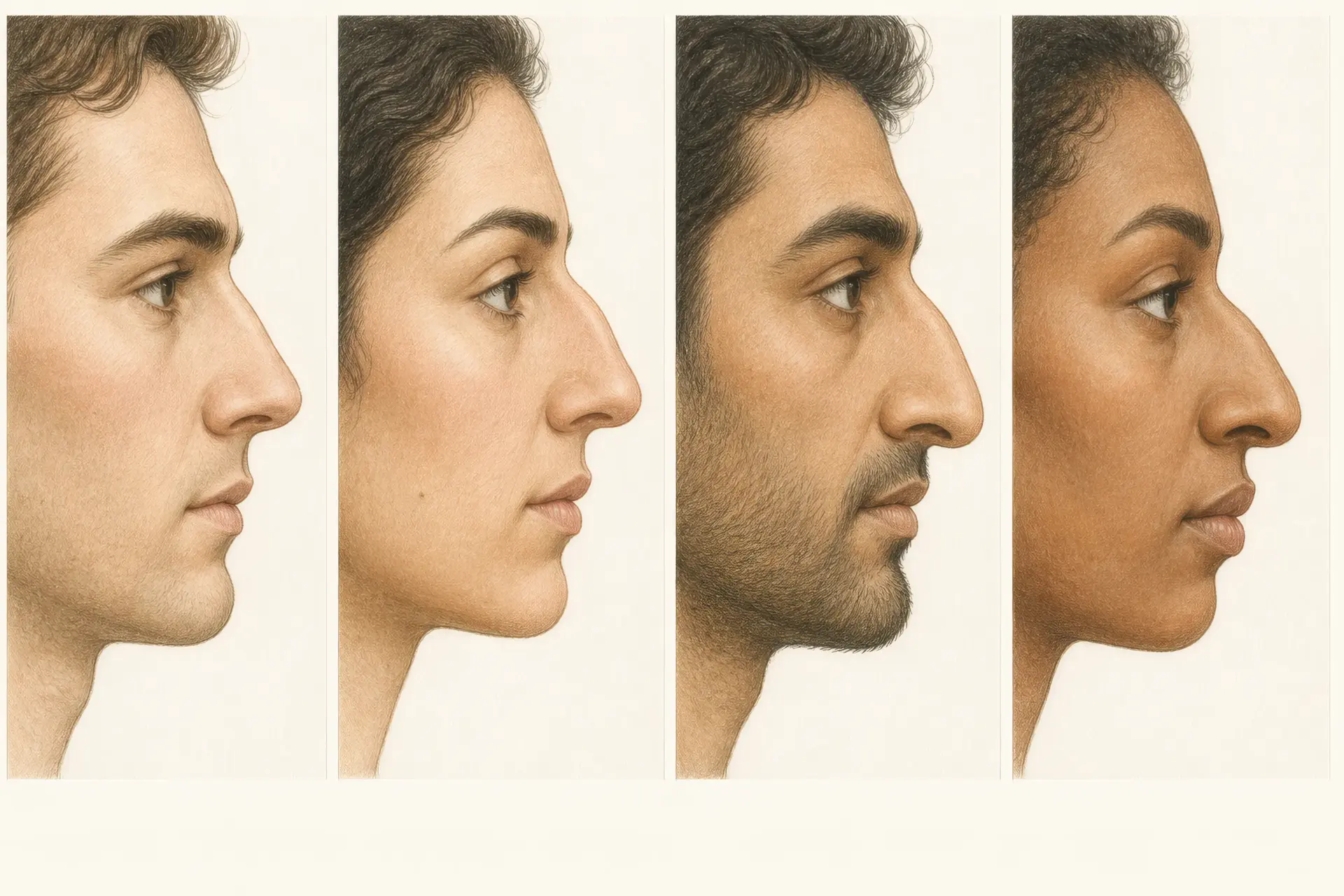
A Roman nose has a visible outward curve on the bridge, a hump or gentle arch that usually sits in the upper-to-middle third, plus a tip that points level or forward instead of diving toward the lip. Check your profile photo. Outward curve up top, tip that does not droop sharply, and the label fits.
Want a second pair of eyes? The free nose shape detector reads your bridge curve and tip angle from a single photo.
In this article(7 sections)
What defines a Roman nose? Core traits
Three features carry the whole classification, and the bridge does the heavy lifting.
The bridge
A visible convexity, usually in the upper-to-middle third.
The dorsum carries a hump or an outward curve you can catch from the side. Sometimes it reads as a distinct bump, sometimes as one long arc from root to tip. Either way, the bridge bows outward instead of running straight, and that single observation does most of the classifying work.
The tip
Level or forward-projecting, rarely strongly downturned.
This is the trait people skip, and it is the one that separates Roman from hooked. On a Roman nose the tip points ahead or sits level with the alar base. Tip rotation stays close to neutral, so the nasolabial angle looks open instead of pinched shut.
The silhouette
Strong, prominent, often medium to long.
Step back and the whole profile reads bold. The dorsal line is defined, projection is generous, and the nose tends to be the first feature you notice in a side photo. Nothing about it hides.
One more label to fold in here. "Convex nose" is a descriptive umbrella for any outward-curved bridge, and in casual contexts it gets used interchangeably with Roman. So if you have read that you have a convex profile, you are already standing in the middle of this page's topic. The full nose shape guide shows where the convex family sits against the straight and concave families, and the nose bridge types guide breaks each family down line by line.
The label map: Roman, aquiline, hooked, arched, eagle, and beak
Same family, six names. Here is what each one usually means when a person (or a magazine) reaches for it.
Roman Nose
Prominent convex bridge, level or forward tip.
The everyday umbrella for a strong profile with a hump. When someone at a glasses counter says Roman, this is what they mean, a convex dorsum without an extreme droop at the end.
Aquiline Nose
The same hump, with the curve continuing downward.
On an aquiline nose the outward curve does not stop at mid-bridge. It keeps bending through the lower third toward the tip, giving that eagle-like arc. The tip angles down, but without the extreme droop you would call hooked.
Hooked Nose or Hook Nose
A more extreme downward curl.
Hooked pushes the aquiline idea further. The tip can droop enough to partly cover the nostrils when you look at the face head-on, and the whole lower nose seems to pull toward the upper lip.
Arched Nose
A stylistic term for the curved dorsal line.
Beauty writing loves this one. Arched emphasizes the sweep of the bridge over the tip, and in practice it gets swapped freely for Roman or aquiline depending on which sounds softer in the sentence.
Eagle Nose and Beak Nose
Descriptive metaphors for the curved silhouette.
Both compare the profile to a bird of prey. Fun fact worth keeping: aquiline literally means eagle-like, from the Latin aquilinus, so eagle nose and aquiline nose are the same idea wearing two coats.
Notice the pattern across those cards. Every label describes the same convex-bridge family, and the differences are degree and tip position, not hard clinical categories. Anyone who tells you there is a precise medical line between Roman and aquiline is selling you tidiness that anatomy never signed up for.
Roman Nose vs Aquiline Nose vs Hooked Nose: where usage differs
When sources do bother to separate the labels, they lean on a simple framework with two moving parts, the bridge curve and the tip behavior.
| Label | Bridge curve | Tip behavior | Front view |
|---|---|---|---|
| Roman Nose | Hump present on the bridge | Level or forward-projecting | Nostrils fully visible from the front |
| Aquiline Nose | Hump plus a curve that continues down the lower bridge | Downturned, but only mildly | Nostrils still visible from the front |
| Hooked Nose | Pronounced convexity, often the strongest of the three | Strongly downturned with a visible curl | Tip may partially hide the nostrils head-on |
Sources disagree on this constantly, and the blame lands on loose usage. Cultural and historical writing has always treated these terms casually, and surgeons make it worse in a useful way: one will describe your profile by the dorsum, another by tip rotation, and both are describing the the same nose from different ends. Add beauty blogs renaming things for softness and you get six labels for one silhouette.
My advice, for what it's worth. Describe your own nose with observable traits instead of fixating on a label. Hump, yes or no. Tip level or down. That pair of answers tells a stylist, an optician, or a surgeon everything a label would, and the mirror method walks you through capturing both in five minutes.
Styling, glasses, and consultation notes
A high convex bridge changes how frames sit, how contour reads, and how you should talk to a professional. A few things worth knowing.
- Look for frames with adjustable nose pads. They let the frame rest on the sides of the bridge instead of balancing on top of the hump.
- Avoid heavy keyhole bridges with fixed pads. On a high convex dorsum they pinch at the top and slide at the bottom, sometimes in the same hour.
- Makeup, if you want it: a soft contour along both sides of the bridge visually smooths a small hump, and a light highlight down the center keeps the profile balanced instead of flat.
- Skip contour entirely if you like the profile. Plenty of people contour a hump for a year and then decide it was the best part of their face.
The glasses frames guide covers fit by bridge height in detail, and the nose contouring guide maps hump-softening placement step by step.
The glasses lesson I learned the slow way.
Years ago I spent an afternoon helping a friend with a strong convex bridge try on maybe thirty frames. Every fixed-pad pair did the same trick: teetered on top of the hump like a seesaw, then left a noticable red dent by dinner. The one pair with adjustable pads sat flat in under a minute. In my experience that single feature matters more on a Roman bridge than frame shape, color, or price combined.
If a consultation is ever on the table, skip the label debate and use structural terms. "Convex dorsum," "dorsal hump," and "tip rotation" will get you further than arguing about aquiline. At a high level, filler can camouflage a small hump for a stretch of months, while rhinoplasty reshapes the bone and cartilage underneath for a lasting change. Whether either is worth it is entirely your call.
Frequently asked questions
Is a Roman nose the same as aquiline?
In everyday conversation, yes, the two get used interchangeably. When people bother to separate them, aquiline stresses the curve continuing downward through the lower bridge toward the tip, while Roman allows a level or forward tip. The overlap is bigger than the gap.
What makes a nose hooked?
Degree of tip droop. A hooked nose has a more pronounced downward curl, enough that the tip can partially obscure the nostrils in a front view. A mild downward angle with visible nostrils sits closer to aquiline territory.
Does ethnicity determine Roman noses?
The shape shows up more often in some populations, particularly around the Mediterranean, the Middle East, and parts of South Asia. But convex bridges occur in every group on the planet. Prevalence is not destiny, and no label belongs to one ancestry.
Can I change a Roman nose without surgery?
A small hump can sometimes be camouflaged with filler placed above and below it, which smooths the line for months at a time. Anything beyond a minor correction typically involves rhinoplasty, because the hump is bone and cartilage, and those do not respond to contour cream.
Next steps
Roman, aquiline, hooked, arched, eagle, beak. One convex-bridge family with tip-based nuances, and now you can tell the nuances apart. For contrast, read about the Greek nose (the straight-bridge opposite), the upturned nose for the other end of tip rotation, or the flat nose and Nubian nose for the width and bridge-height dimensions this page skipped. Still sorting out your own profile? Start with what type of nose do I have.