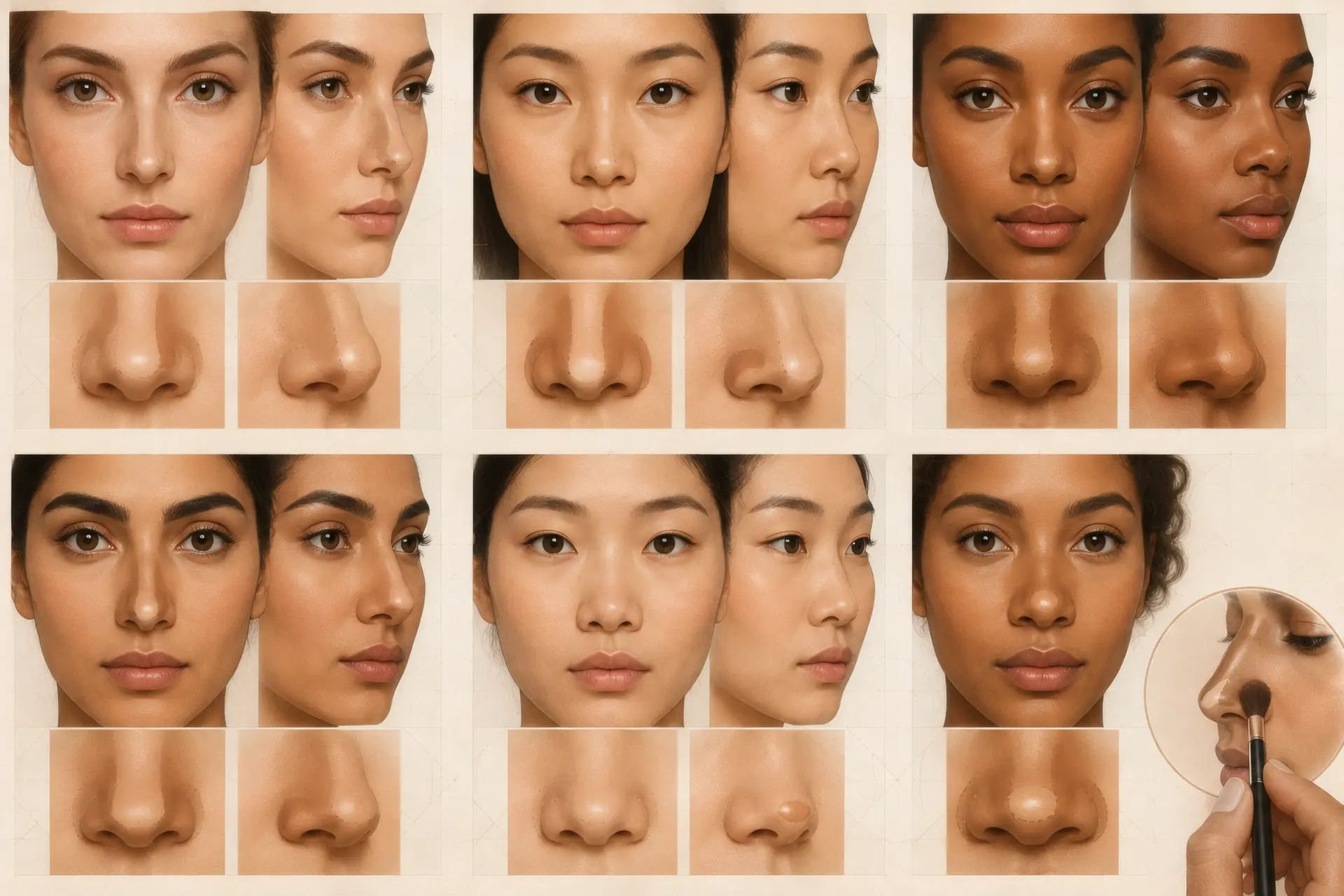
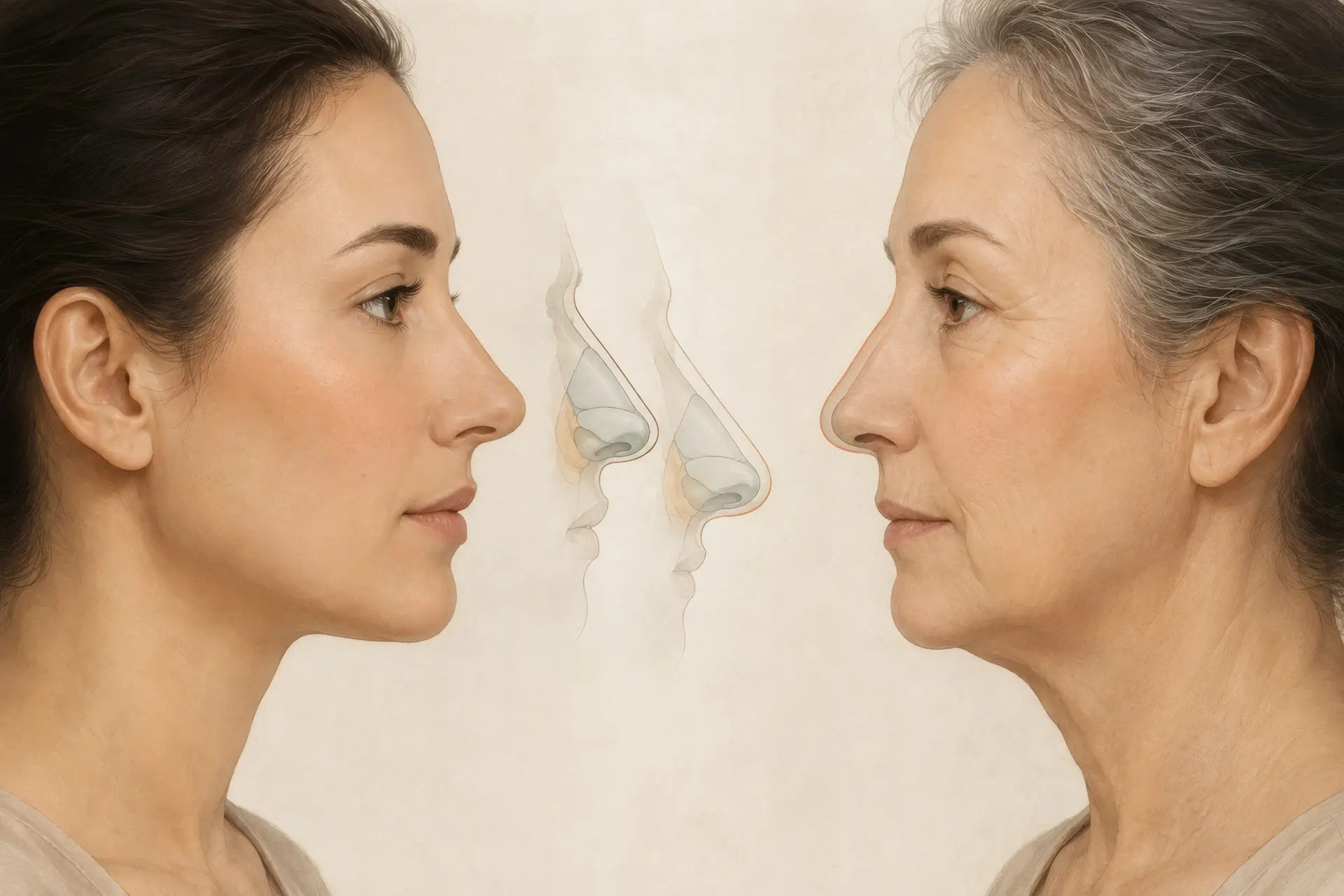
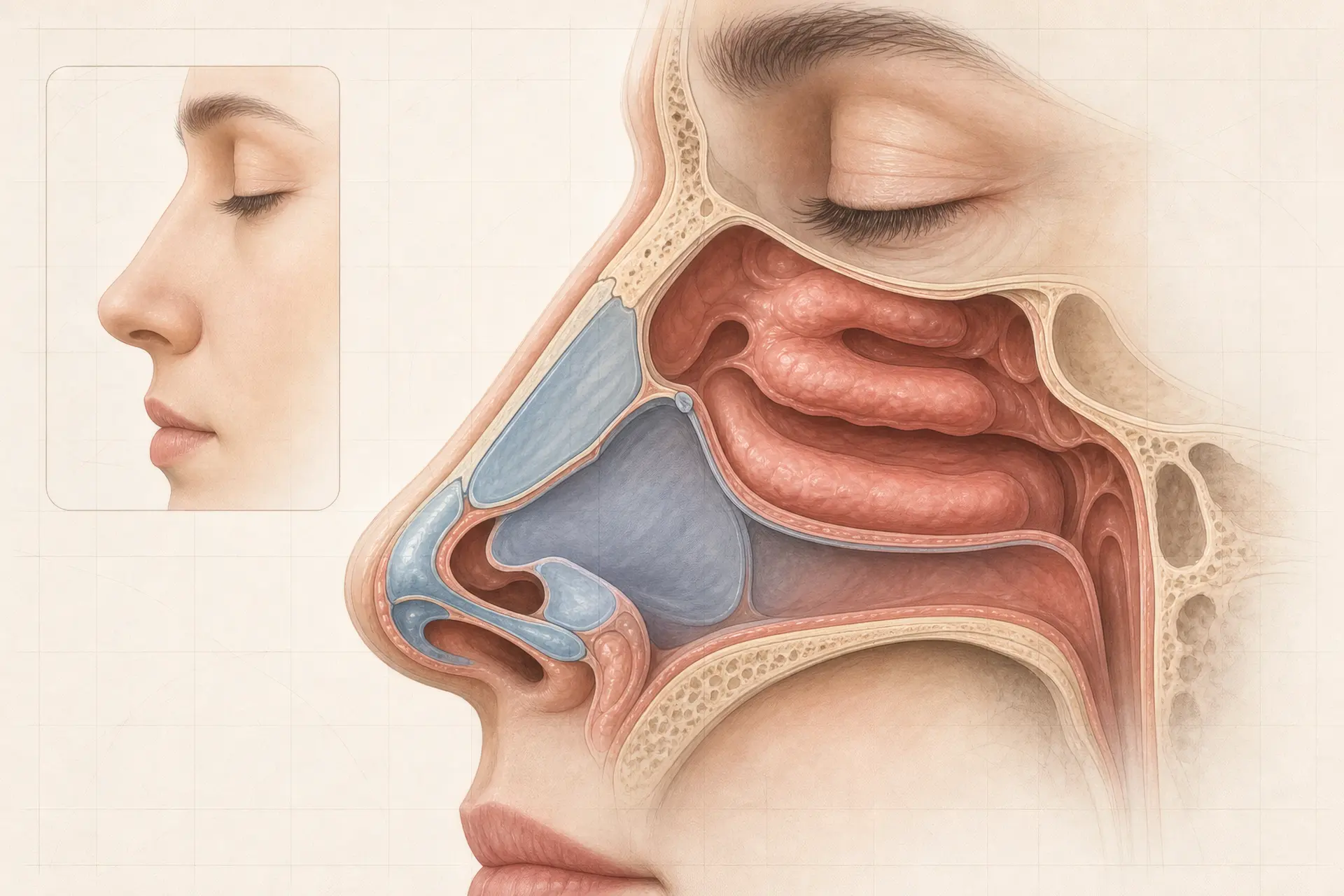
The classical straight profile
Greek Nose
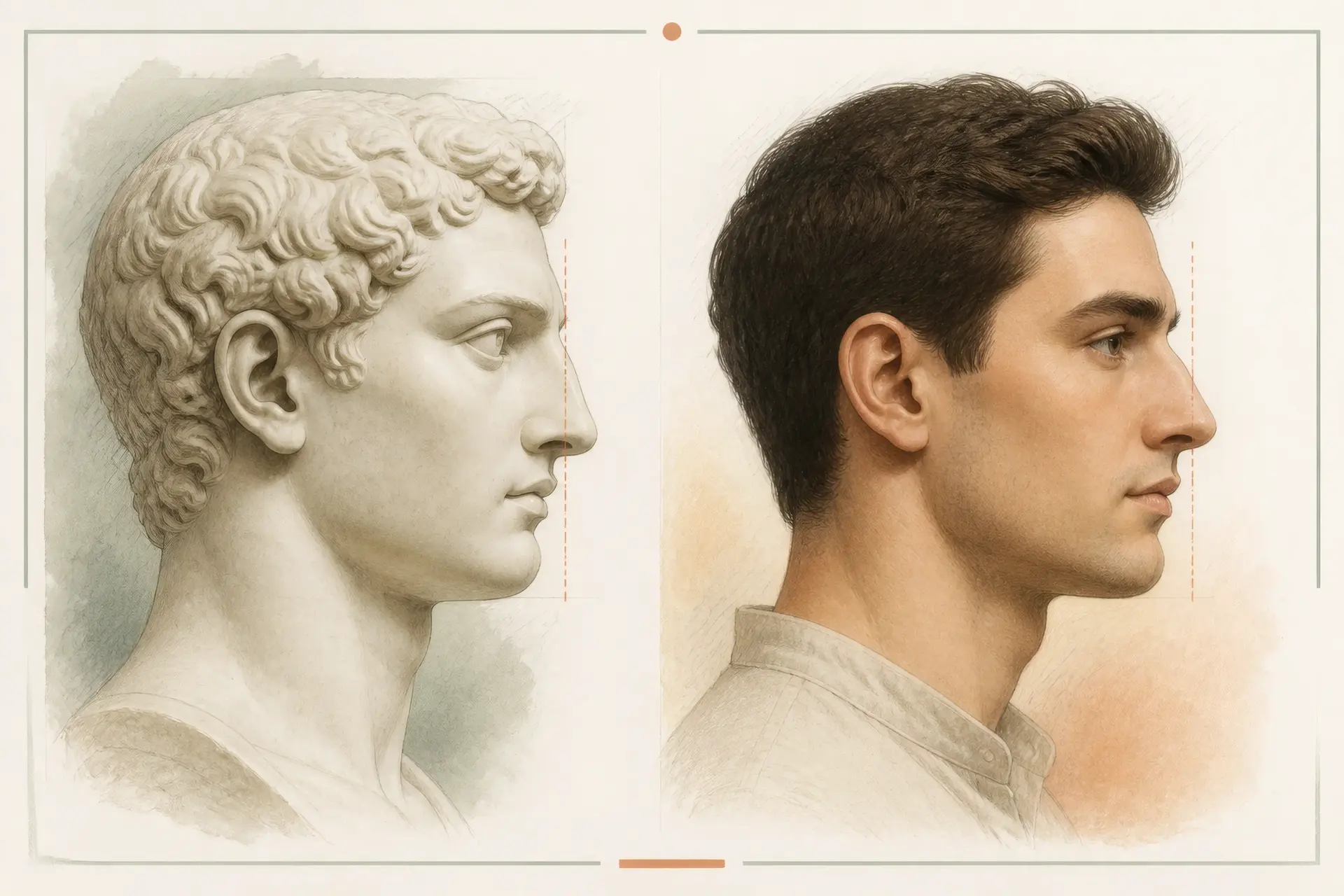
A Greek nose gives itself away in profile. The bridge runs in one clean, unbroken line from between the brows to the tip, no hump, no dip, and the whole nose tends to sit narrow and refined against the face. The name comes straight from ancient Greek sculpture, where artists carved that same seamless brow-to-tip line into their gods as the ideal of harmony.
Scope matters here. Straight is the broad category, and Greek is the specific, classical version of it. A straight bridge on a wide nose with a heavy tip is still a straight nose, and often a striking one, but it doesn't meet the narrow, refined proportions the Greek label implies. Below, where the term comes from, what the profile looks like up close, and how it differs from the Roman nose it gets confused with most.
The quick answer
A Greek nose has a straight dorsum with no hump or dip, a narrow build relative to the face, and a refined tip that sits level, never strongly upturned or downturned. From the side, the line from brow to tip looks almost drawn. To check yours, take a profile photo in even light and trace that line. If it stays flat and the nose reads narrow, you're likely in Greek territory. The free nose shape detector can confirm it from a single photo.
Where the name comes from
Walk through the classical wing of any large museum and the pattern jumps out. Statue after statue, Apollo, Aphrodite, Athena, and a dozen unnamed athletes, all share one profile. A forehead flows into the nose without a visible angle at the root, then a single straight line continues to the tip. The sculptors weren't copying real faces so much as an ideal. In classical Greek art, beauty meant harmony and proportion, and a nose that interrupted the face with a hump or a strong angle broke the rhythm. So they smoothed it away.
The term stuck. (Art history has a long memory.) For the sculptors, though, the label described an ideal, a face held in perfect balance. The perfect nose guide looks at what those proportion ideals measure in practice. Modern use is looser and purely descriptive. Calling a nose Greek today is shorthand for a straight, narrow, refined profile, full stop. It says nothing about where your family comes from, and people with no Greek ancestry have them all the time.
I spent an afternoon in the antiquities hall at the Met a few years back, holding my phone sideways next to a marble head of Athena to compare profile lines against a reader photo I'd been sent that morning. Her bridge was straighter than the statue's. That was the day I stopped treating "statue-straight" as an exaggeration.
Visual characteristics: bridge, width, and tip
Three features decide whether a nose earns the Greek label. Judge them separately, then together.
Bridge
A straight dorsum with no hump and no dip.
The dorsum runs in one smooth, unbroken line from the nasofrontal angle at the root down to the tip. In profile it can look drawn with a ruler, which is where all the statue comparisons come from.
Width
Narrow relative to the face.
The Greek nose usually reads slim, with clean dorsal edges and an alar base that stays inside lines dropped from the inner corners of the eyes. The width stays even along the whole length instead of flaring at the nostrils.
Tip
Refined and close to level.
The tip is defined without turning sharp or bulbous. Rotation stays near level, with a moderate nasolabial angle, so the nostrils barely show from the front and nothing about the tip dominates the face.
Put it together and the side profile gives the game away. The silhouette is linear and unbroken, the opposite of the convex Roman curve and the scooped, concave line of an upturned or celestial nose. From the front, everything reads balanced and calm, which is why Greek noses photograph well and why small deviations stand out. Even a two-degree bump along the dorsum is noticable once you trace the line. The nose bridge types guide compares the straight line with its convex and concave neighbors.
One caution before you self-diagnose. Check the bridge in even, diffused light, because a downlight can paint a shadow along the dorsum that looks like a dip. And take a three-quarter view too. A nose that reads straight in profile can show a slight bend once the angle changes, and Greek proportions assume the line holds from every side.
How the Greek Nose differs from the Roman Nose
These two get confused constantly, partly because both can photograph as straight in flat, frontal lighting. The dorsal line settles it. Take a profile shot and trace from brow to tip. A Greek bridge never leaves the straight line. A Roman bridge bows outward somewhere along the dorsum, even when the curve is subtle.
And keep the categories straight. "Straight nose" is the broad bucket, and plenty of noses qualify. Greek implies classical proportions and refinement, not just the absence of a hump. A wide, fleshy nose can carry a perfectly straight bridge and still sit outside the label. I could be wrong here, but I think most of the confusion would vanish if people checked width and tip shape before declaring their bridge straight.
| Feature | Greek Nose | Roman Nose |
|---|---|---|
| Bridge line | Straight and unbroken | Convex, with a hump or outward arch |
| Overall profile | Linear and calm | Strong and prominent |
| Width | Typically narrow | Often medium to broad |
| Tip | Refined, near level | Frequently downturned or heavier |
| Overall impression | Classical and balanced | Bold and commanding |
Styling and consultation notes
A straight, refined bridge is easy to work with. A few practical points come up again and again.
- Glasses first. Narrow to medium frames suit a refined bridge, at least for most people. Check that the nose pads grip, because a smooth dorsum gives frames little to hold and slipping becomes daily annoyance (worse with sunscreen, in my experience).
- Makeup is light work here. A thin highlight down the center of the dorsum emphasizes the straight line. Heavy side contour adds shadows this nose does not need, so keep it minimal.
- Consultations go better with anatomical terms than style labels. 'Straight dorsum', 'dorsal irregularities', and 'tip refinement' give a surgeon precise targets. 'I want a Greek nose' gives them a mood board.
Our glasses frames guide covers fit by bridge height and base width, and the nose contouring guide maps highlight and shadow placement by type if you want to emphasize or soften the line. Neither step is required. A Greek profile needs the least correction of any type I've worked with, and most people who have one are better off leaving the center line alone and putting the effort into skin and brows instead.
Frequently asked questions
Is my straight nose automatically Greek?
No. Straight describes one feature, the bridge line. The Greek label also implies narrow width, clean dorsal edges, and a refined, level tip, so a straight bridge on a wide or heavy-tipped nose falls outside it. Think of Greek as the classical subset of straight noses, with stricter proportions attached.
Can rhinoplasty create a Greek nose?
To a degree. A surgeon can straighten the dorsum by reducing a hump or correcting small irregularities, and refine the tip for a cleaner line. The starting anatomy sets the ceiling, though. Skin thickness, existing width, and tip support all shape what is achievable, so bring reference photos and expect an honest conversation about limits.
Does Greek nose mean Greek ancestry?
No. The label comes from classical art history, from the idealized profiles sculptors carved into marble, and it describes a shape and says nothing about a family tree. Straight, narrow noses appear in every population, and plenty of people from Greece have convex, concave, or wide noses instead.
The short version
The Greek nose is the archetypal straight, narrow, refined profile, a shape Western art spent centuries treating as the ideal. If your bridge bows outward instead, compare it with the Roman nose. If the tip lifts, the upturned nose guide fits better, and for a sharper tip there's the pointy nose. Width questions belong to the wide nose breakdown. Still torn between types? The mirror method walks through it step by step.
Check your own profile
Upload one photo and the detector will measure your bridge line, tip rotation, and base width, then match you against the Greek profile and its neighbors. Or read the full nose shape guide for every type side by side.