Evidence review
Scientific Evidence for Nose Taping Changing Shape
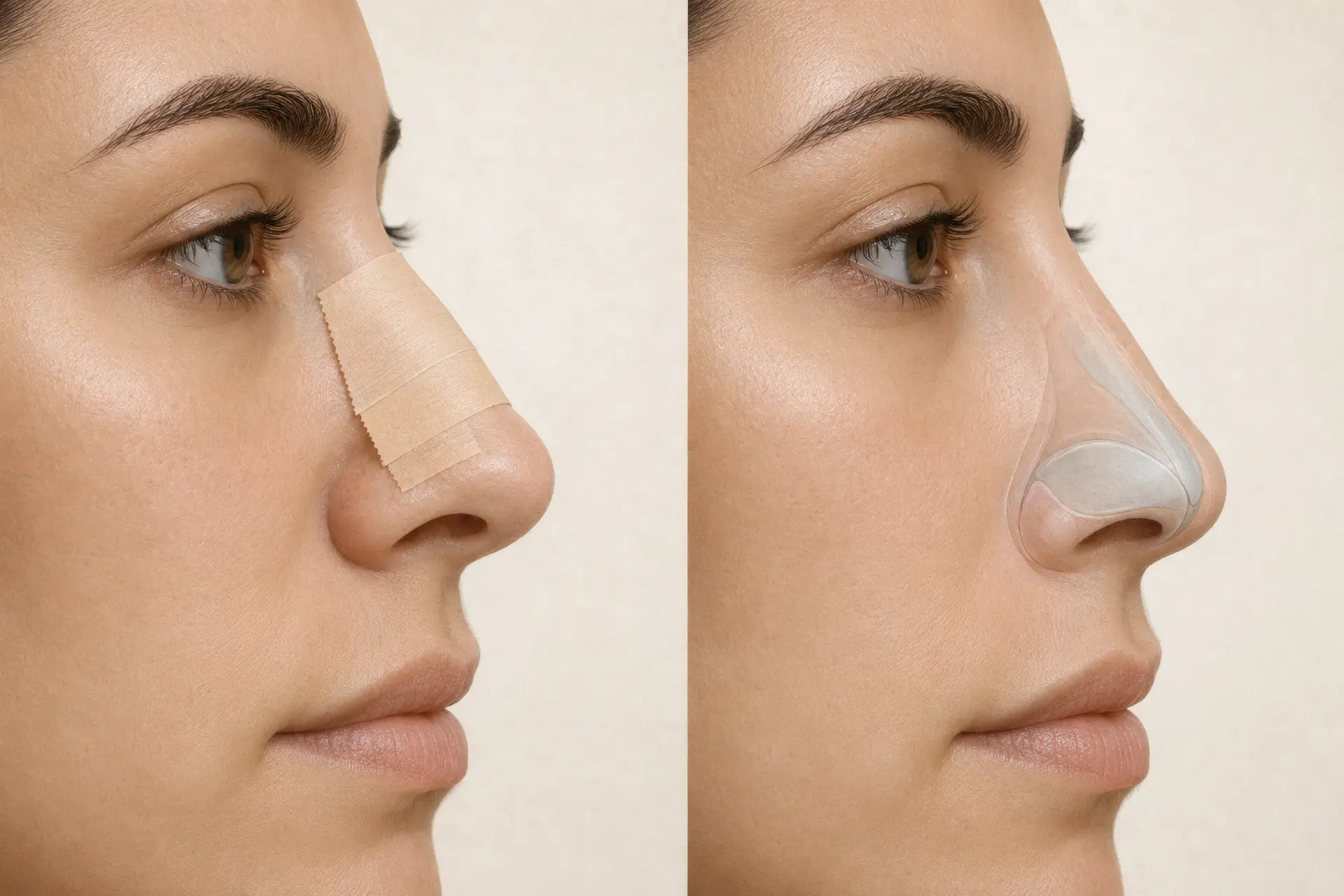
Three weeks after my cousin's rhinoplasty, her surgeon handed her a roll of brown paper tape and a fifteen-second demonstration. Pinch, press, smooth toward the cheeks, every night for a month. She assumed the tape was holding her new nose in place while it healed. It wasn't. And the difference between what she assumed and what the tape was doing matters for anyone asking whether taping can reshape a nose.
Two completely different claims get tangled up in this topic. One is medical, taping after nose surgery to manage swelling while skin settles onto its new framework. The other is a DIY promise that taping an unoperated nose overnight will slim it, straighten it, or lift the tip. The evidence behind those two claims is nowhere near equal, so this review keeps them apart.
The quick answer
Taping works after rhinoplasty, for one job. A randomized clinical trial found nightly taping for two to four weeks reduced swelling, with the clearest benefit in thick-skinned patients. For an unoperated nose, no reliable evidence shows tape permanently changing shape. Adult cartilage and bone don't remodel under external pressure.
Wondering what shape you're starting with? The free nose shape detector reads your bridge curve and tip angle from a single photo.
What taping does after rhinoplasty
Swelling is the long tail of rhinoplasty recovery. Edema can linger for months, especially in the supratip, that soft zone between the bridge and the tip where skin loves to hold fluid. Taping is the cheapest countermeasure a surgeon has. Press the skin down at night, squeeze fluid out of the tissue, and let the skin envelope redrape snugly against the cartilage and bone the surgeon built.
It compresses the skin envelope
Gentle overnight pressure over the dorsum and supratip.
Tape holds skin against the new framework so fluid has nowhere to pool. In the best-known randomized trial, four weeks of taping cut supratip swelling significantly compared with no taping (P = .001), and average skin thickness across the nose dropped in both the two-week and four-week groups.
Thick skin gets the most from it
The clearest effect shows up in thick-skinned patients.
Researchers split 57 patients by skin thickness measured with ultrasound. Thick-skinned patients improved in a measurable way. Thin-skinned patients showed no significant effect at all, which is why surgeons tailor taping schedules to the person instead of handing out one universal plan.
It never touches the structure
Skin yes, cartilage and bone no.
Nothing in the data suggests tape bends cartilage or moves bone. It manages the soft tissue sitting on top. The shape underneath comes from the operation, and taping helps the skin shrink-wrap onto that shape instead of healing puffy around it.
Thick, oilier skin over the tip is common in what people call a bulbous nose shape or a fleshy nose, and these are exactly the noses surgeons tend to tape longest. Studied protocols ran two to four weeks of nightly wear after the external splint came off, adjusted for skin thickness and how much edema was hanging around. Some surgeons stretch taping to three months for thick skin. Others skip it entirely. That spread tells you something. Taping is an adjunct for swelling control, and the the evidence is strongest in one subgroup.
The two studies, side by side
Only a handful of clinical studies touch this topic, and two randomized trials carry most of the weight. Both are small. Read them as directionally useful rather than the final word.
| Study | Population | Intervention | Outcome | Limits |
|---|---|---|---|---|
| Ozucer et al., 2016, JAMA Facial Plastic Surgery | 57 rhinoplasty patients, grouped by ultrasound-measured skin thickness | No taping vs nightly taping for 2 or 4 weeks after splint removal | 4-week taping reduced supratip swelling (P = .001); benefit concentrated in thick-skinned patients | Single center, 6-month follow-up, skin groups split at the median |
| Deggeller et al., 2018, Rhinology | 43 adults: 22 after rhinoplasty, 21 wearing the device with no surgery | Custom nose-former device worn up to 8 weeks post-op, or 14 months without surgery | No objective change in crookedness, hump, or width in either group; non-surgical wearers still felt more satisfied | Small groups, non-blinded, satisfaction rose without measured change |
I could be wrong here, but the second row is the one most taping videos hope you never read. A custom-molded device, fitted by researchers and worn for over a year, still produced no measured change. Drugstore tape applied in your bathroom mirror is working with far less.
The evidence gap for unoperated noses
No high-quality evidence shows tape permanently straightening, slimming, or lifting an unoperated nose. The nose-former trial is the closest thing to a direct test. Twenty-one adults wore the device for 14 months with no surgery involved, and objective measurements of crookedness, hump size, and width did not improve. Investigators examining the noses saw no change either. The odd footnote is that participants still reported feeling more satisfied at the end, a reminder that expectation can move satisfaction without moving a single millimeter of cartilage.
There's a mechanical reason for this. Adult nasal cartilage doesn't remodel under light external pressure, and bone needs sustained, calibrated force over a long period to shift, the way orthodontics moves teeth that sit in sockets. Nasal bones don't sit in sockets, and adhesive tape delivers nothing close to that force anyway. So any difference in the mirror after a night of taping is temporary compression of soft tissue, gone within hours, or a lighting trick.
Contrast that with routes that have evidence behind them. Filler can camouflage a small dorsal hump for months by smoothing the line above and below it. Rhinoplasty reshapes bone and cartilage for keeps. Everything else, tape, clips, suction gadgets, facial exercises, lives in the same evidence-free neighborhood. If you're chasing some idea of a perfect nose, understanding your nose anatomy first will save you money and tape.
Risks worth knowing
Taping sounds harmless, and next to surgery it is. Harmless and free of downsides are two different things, though.
- Skin irritation tops the list. Adhesive pressed into the same patch of skin night after night causes redness and itching, and some people develop contact dermatitis from the adhesive itself.
- Breakouts along the bridge. Tape occludes the skin and traps oil, so acne or folliculitis can show up within a couple of weeks of daily wear.
- A friend of mine taped her nose every night for four months after a video promised a slimmer bridge. The bridge did not change. What she got was a noticable rash line across her dorsum in the exact shape of the tape strip, and it took weeks to fade.
- Delayed help is the quieter cost. Months spent taping are months not spent asking a dermatologist or surgeon about options that work, whether that ends up being filler, surgery, or plain acceptance.
- Post-op patients sit in a different category. Your surgeon's protocol beats any schedule you find online, so don't add tape or drop it early on your own.
Frequently asked questions
Does nose taping work after rhinoplasty?
Yes, within limits. In a randomized trial, two to four weeks of nightly taping reduced swelling compared with no taping, and thick-skinned patients saw the clearest benefit. It controls edema and helps skin redrape over the new framework. It does not reshape the bone or cartilage underneath.
Can taping make my nose smaller permanently?
No credible evidence supports that for an unoperated nose. The one trial that tested a worn device for 14 months found no objective change in hump, width, or crookedness. Any slimming you notice right after removing tape is compressed soft tissue, and it bounces back within hours.
How long should I tape after surgery?
However long your surgeon tells you. The studied protocols ran nightly for two to four weeks, and thick-skinned patients are sometimes kept on tape longer. Extending or shortening the schedule on your own works against the plan your result depends on.
Are there risks to taping my nose?
Mostly skin trouble. Redness, itching, contact dermatitis from the adhesive, and acne or folliculitis under the tape are the common complaints. If the skin turns red or starts itching, stop and let it recover before deciding what to do next.
So what can change nose shape without surgery?
Filler can smooth a small bump or add balance for six months to a year or so, and it dissolves on its own. Beyond small contour tweaks, lasting structural change means rhinoplasty. Tape sits in neither category.
Sources
The two trials this review leans on, both free to read on PubMed.
- Effect of Postrhinoplasty Taping on Postoperative Edema and Nasal Draping, a randomized clinical trial (Ozucer et al., JAMA Facial Plastic Surgery, 2016)
- Prospective evaluation of a nonsurgical nose-former device for rhinoplasty (Deggeller et al., Rhinology, 2018)
Next steps
Tape manages swelling after surgery. That's the whole evidence-backed story. If you're still pinning down your own shape, start with what type of nose do I have for a five-minute mirror method, or run a photo through the detector below. And if your real worry is a nose that seems to be changing as the years pass, read how to prevent your nose from getting bigger with age for what drives that drift.